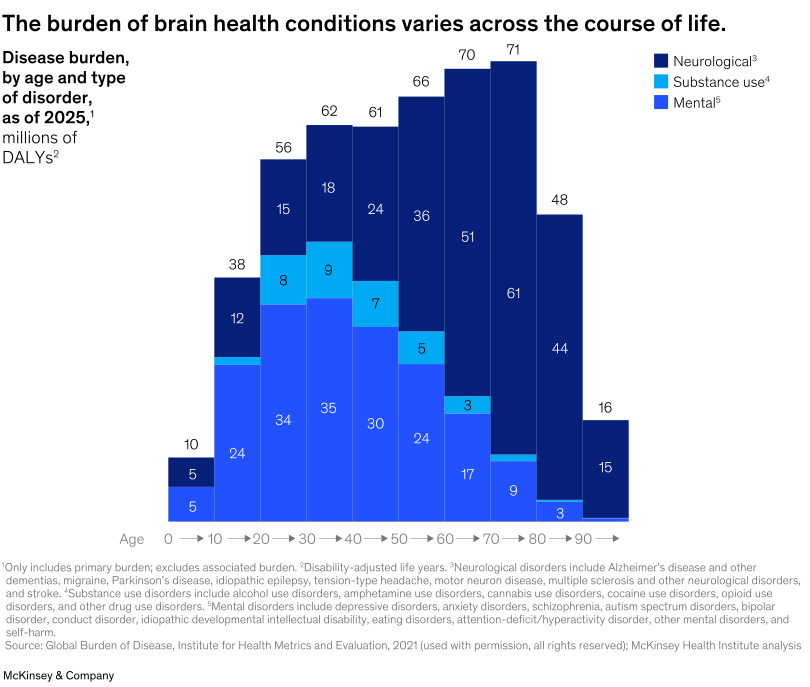
In the AI era, advantage will hinge on how well we combine human and machine strengths. That makes investment in brain capital—brain health and brain skills—more urgent than ever. Yet the brain has long been underprioritized in global policy and investment, according to McKinsey’s Erica Coe, Jacqueline Brassey, Kana Enomoto, Lucy Pérez, and coauthors. Continued underinvestment has a substantial cost: based on 2025 projections, brain health conditions account for 24 percent of the global disease burden. Half of mental health conditions appear by the age of 14, and three-quarters by 24. Advances in science and AI-driven disruption have made coordinated investment in the brain an economic imperative.
Image description:
A stacked bar chart illustrates the global disease burden of brain health conditions in 2025, measured in millions of disability-adjusted life years (DALYs), segmented by age group and type of disorder: neurological (dark blue), substance use (teal), and mental (light blue). Each age decile from 0–10 through 80–90 is represented as a vertical stack, showing the shifting composition and total burden across the lifespan. For children aged 0–10, the burden is 10 million DALY, with half attributed to mental disorders and half to neurological. In adolescence (10–20), the total rises to 38 million, dominated by mental disorders (24 million), with smaller shares from neurological (12 million) and substance use (2 million). For those aged 20–30 through 40–50, the burden remains high—56 million to 62 million DALY—marked by a large and stable share of mental disorders (34 to 30 million), a growing share of neurological conditions (15 to 36 million), and substance use peaking at 9 million in the 20–30 range before declining. In older age groups, neurological conditions become the overwhelming contributor: by ages 70–80, the total burden reaches 71 million DALYs, with 61 million from neurological disorders, 9 million from mental disorders, and 1 million from substance use. In the final age group (80–90), the total burden drops to 48 million, but neurological disorders still account for 44 million.
Note: This image description was completed with the assistance of Writer, a gen AI tool.
Source: Global Burden of Disease, Institute for Health Metrics and Evaluation, 2021 (used with permission, all rights reserved); McKinsey Health Institute analysis.
End of image description.