The production of materials accounts for roughly 20 percent of global greenhouse gas emissions. Companies’ efforts to meet their emission-reduction targets is complicated by the fact that emission intensity and hotspots vary widely across materials, note Partner Peter Spiller and coauthors. An analysis reveals that processing operations are the primary source of emissions for most materials, outweighing those from mining. Steel and nickel, in particular, need to address Scope 1 (process) emissions to decarbonize effectively.
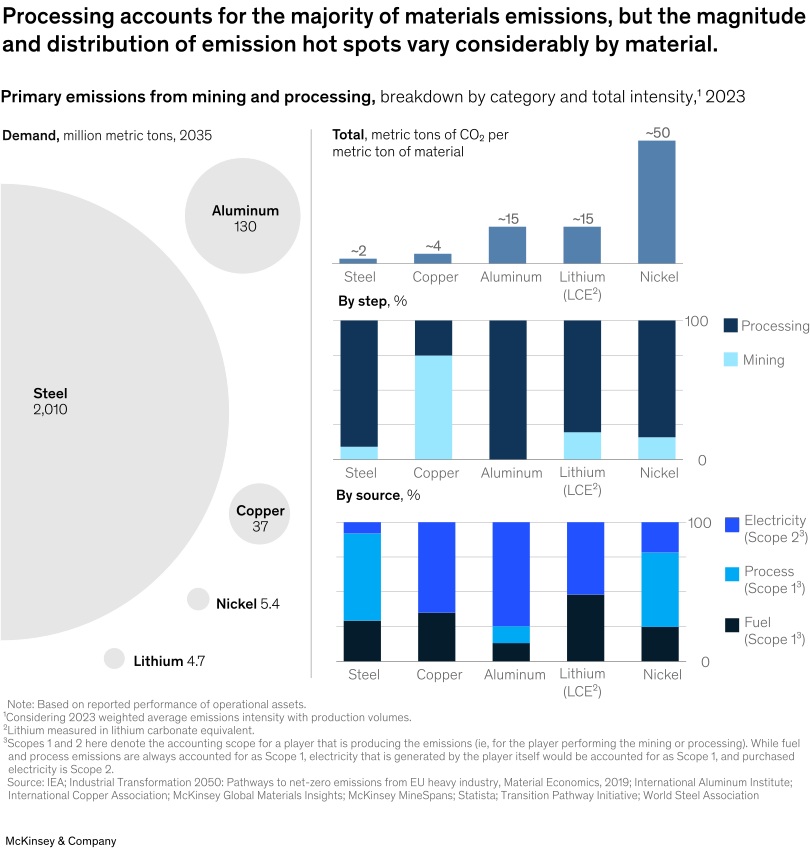
Image description:
A bubble chart, bar charts, and stacked bar charts compare primary emissions from mining and processing, broken down by category and total intensity in 2023. On the left, the bubble chart compares the demand in million metric tons in 2035 for steel, aluminum, copper, nickel, and lithium as 2,010; 130; 37; 5.4; and 4.7 million metric tons, respectively. To the right are the bar and stacked bar charts. The first bar chart plots the total metric tons of carbon dioxide per metric ton of material for steel, copper, aluminum, lithium (measured in lithium carbonate equivalent), and nickel as roughly 2, 4, 15, 15, and 50, respectively. The first stacked bar chart shows the percentage by step, comparing processing and mining for the same materials. For steel, aluminum, lithium, and nickel, nearly 100% of the materials are processed, whereas for copper, more than half is mined. The second stacked bar chart compares the percentage by source, including fuel (Scope 1), process (Scope 1), and electricity (Scope 2). For steel, the sources are roughly split between fuel and process, with a sliver of electricity. For copper, the fuel source is about 25% and the rest is electricity. For aluminum, the main source is electricity; for lithium, it’s a near-even split between electricity and fuel. For nickel, the main source is process, and then a roughly even split between fuel and electricity.
Note: This image description was completed with the assistance of Writer, a gen AI tool.
Source: IEA; Industrial Transformation 2050: Pathways to net-zero emissions from EU heavy industry, Material Economics, 2019; International Aluminum Institute; International Copper Association; McKinsey Global Materials Insights; McKinsey MineSpans; Statista; Transition Pathway Initiative; World Steel Association.
End of image description.
To read the article, see “Looking upstream: A path to unlocking low-carbon, circular materials,” June 3, 2025.