The energy transition is advancing but unevenly. Only about 13.5 percent of the deployment needed to meet the goals of the 2015 Paris Agreement is in place, estimate McKinsey’s Chris Bradley, Humayun Tai, Mekala Krishnan, Sven Smit, and coauthors. Although multiple factors have spurred regional progress, the overall pace is roughly half of what the Paris Agreement requires. Deployment in some advanced economies is slowing, while emerging economies are accelerating. China leads this push, accounting for about two-thirds of recent deployment in fast-moving areas such as power and mobility.
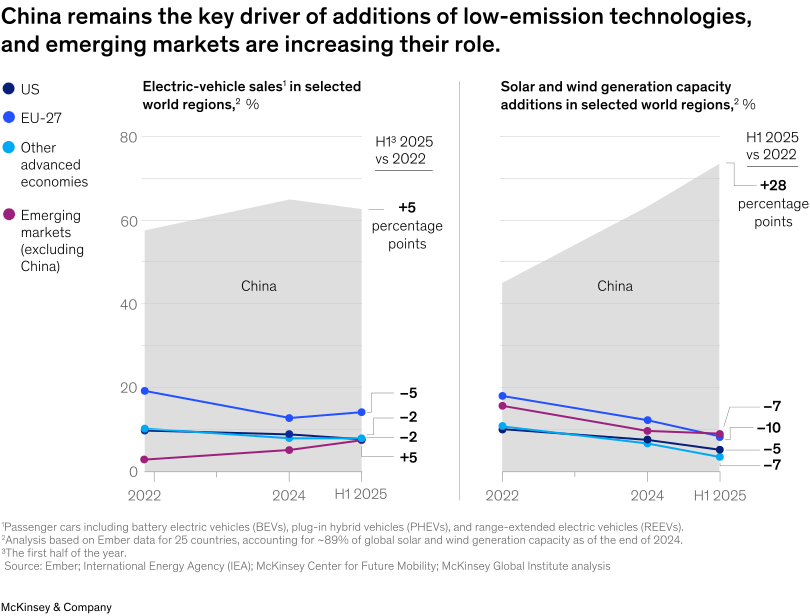
Image description:
A pair of line charts compares the change in solar and wind generation capacity additions (left) and electric-vehicle (EV) sales (right) across selected world regions—China, the US, the EU-27, other advanced economies, and emerging markets excluding China—from 2022 to the first half of 2025. In the solar and wind generation chart, China’s line rises steeply, increasing 28 percentage points to reach more than 70% in H1 2025. In contrast, the other regions all trend downward, with the US declining by 5 percentage points, the EU-27 by 10 percentage points, other advanced economies by 7 percentage points, and emerging markets by 7 percentage points. The EV sales chart shows a more mixed pattern: China’s share climbs by 5 percentage points, while emerging markets excluding China also gain 5 percentage points. Meanwhile, the US, EU-27, and other advanced economies see slight declines in EV sales percentages, at –2, –5, and –2 percentage points, respectively. Note: This image description was completed with the assistance of Writer, a gen AI tool.
Source: Ember; International Energy Agency; McKinsey Center for Future Mobility; McKinsey Global Institute analysis.
End of image description.
To read the article, see “The hard stuff 2025: Taking stock of progress on the physical challenges of the energy transition,” November 6, 2025.