Canada boasts abundant resources, top-notch talent, and market access, yet labor productivity has stalled. Real GDP per capita has decreased and the prosperity gap with the United States has widened. This slowdown isn’t a blip—it stems from years of investment drifting into lower-productivity, domestically oriented sectors and missed opportunities to scale exports in resources, services, and advanced industries, say McKinsey's Elaine Almeida, Greg Kudar, Richard Luft, Rob Palter, and Zak Cutler. Investment—which drives 80 percent of productivity growth—in extractive sectors fell 15 percent from 2010 to 2023, and several energy projects have been canceled or deferred since 2014. Bold, focused action could turn the tide: If Canada seizes growth opportunities, households could be roughly $16,000 better off by 2035 and enjoy stronger job prospects.
Image description:
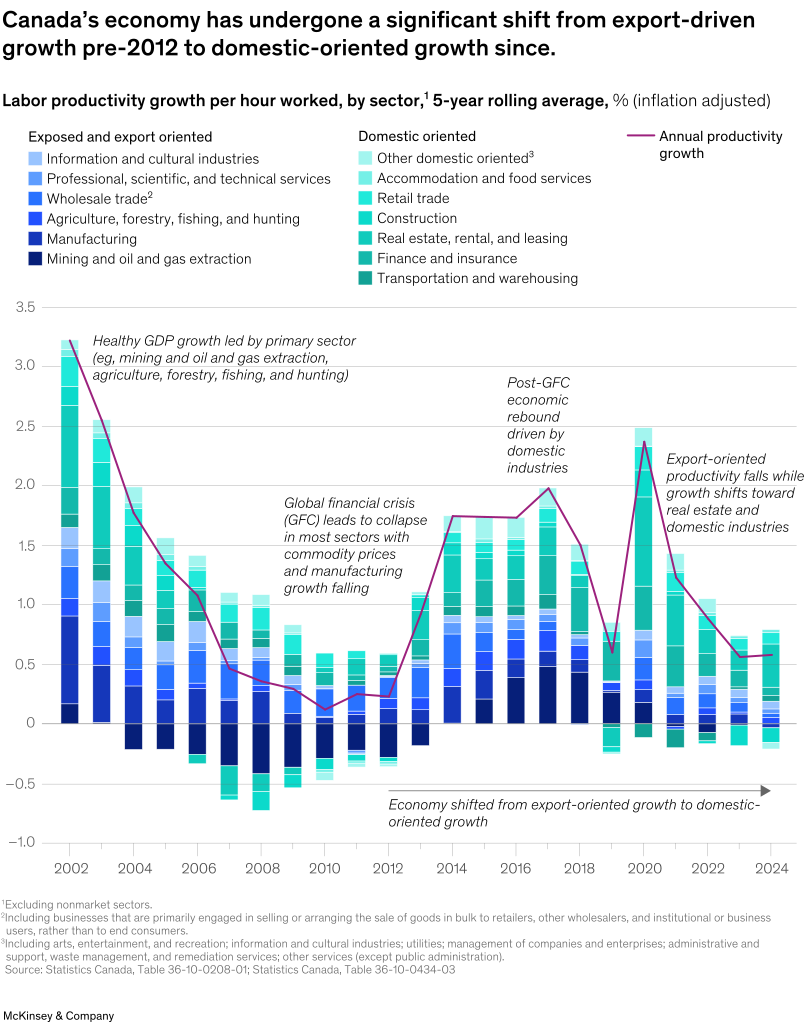
A stacked bar chart illustrates Canada’s labor productivity growth per hour worked, by sector, from 2002 to 2024, with a 5-year rolling average percentage shown in inflation-adjusted terms. The chart is divided into 2 categories: “exposed and export-oriented” sectors and “domestic-oriented” sectors. The exposed and export-oriented sectors include information and cultural industries; professional, scientific, and technical services; wholesale trade; agriculture, forestry, fishing, and hunting; manufacturing; and mining and oil and gas extraction. The domestic-oriented sectors include other domestic-oriented; accommodation and food services; retail trade; construction; real estate, rental, and leasing; finance and insurance; and transportation and warehousing. A purple line on the chart represents the annual productivity growth. The chart shows that from 2002 to 2008, labor productivity growth was driven primarily by export-oriented sectors, with a peak of ~3% in 2002. However, following the global financial crisis in 2008, productivity growth collapsed across most sectors, with commodity prices and manufacturing growth falling. The economy rebounded post-2010, driven by domestic industries, with productivity growth peaking again around 2017. Since then, export-oriented productivity has declined, while growth has shifted toward real estate and domestic industries. By 2024, the chart indicates a continued shift toward domestic-oriented growth, with a relatively stable productivity growth rate. Annotations on the chart highlight key events and trends, including the impact of the global financial crisis and the subsequent rebound.
Note: This image description was completed with the assistance of Writer, a gen AI tool.
Source: Statistics Canada, Table 36-10-0208-01; Statistics Canada, Table 36-10-0434-03.
End of image description.