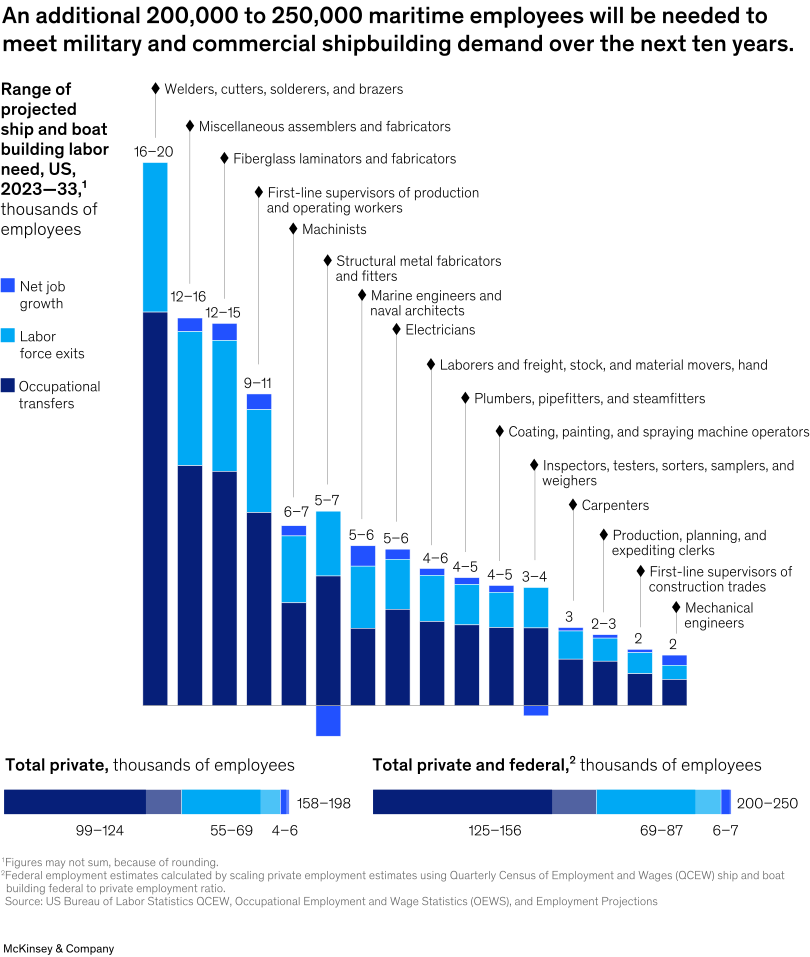
The US shipbuilding industry faces a significant labor gap, requiring an additional 200,000 to 250,000 maritime employees over the next decade to meet commercial and military demand. A large portion of this hiring will be needed to replace workers who are retiring or leaving the industry. McKinsey’s Brooke Weddle, Ryan Brukardt, Wan-Lae Cochran, and Andy Voelker note that the most acute needs will be in skilled trades. For example, up to 20,000 welders, cutters, solderers, and brazers will be needed by 2033. Shipbuilding stakeholders can focus on five critical actions to improve the maritime talent pool, including strengthening the value proposition for shipbuilding careers and bolstering the talent pipeline from educational institutions to shipyards.
Image description:
A stacked bar chart displays the projected range of ship and boat building labor needs in the United States from 2023 to 2033, segmented by occupation and showing 3 components: net job growth (dark blue), labor force exits (medium blue), and occupational transfers (light blue). The chart estimates that an additional 200,000 to 250,000 maritime employees will be required over the next decade to meet both military and commercial shipbuilding demands. The left side of the chart focuses on total private-sector needs, with welders, cutters, solderers, and brazers showing the highest projected demand at 16,000 to 20,000 employees, followed by miscellaneous assemblers and fabricators (12,000 to 16,000), and fiberglass laminators and fabricators (12,000 to 15,000). Other key occupations include first-line supervisors of production and operating workers (9,000 to 11,000), machinists (6,000 to 7,000), and structural metal fabricators and fitters (5,000 to 7,000). The bottom portion of the chart incorporates both private and federal needs, with each bar divided to illustrate the relative contributions of net job growth, labor force exits, and occupational transfers to the total projected need for each role, with the sum across all occupations ranging from 200,000 to 250,000 employees over 10 years.
Note: This image description was completed with the assistance of Writer, a gen AI tool.
Source: US Bureau of Labor Statistics QCEW, Occupational Employment and Wage Statistics (OEWS), and Employment Projections.
End of image description.