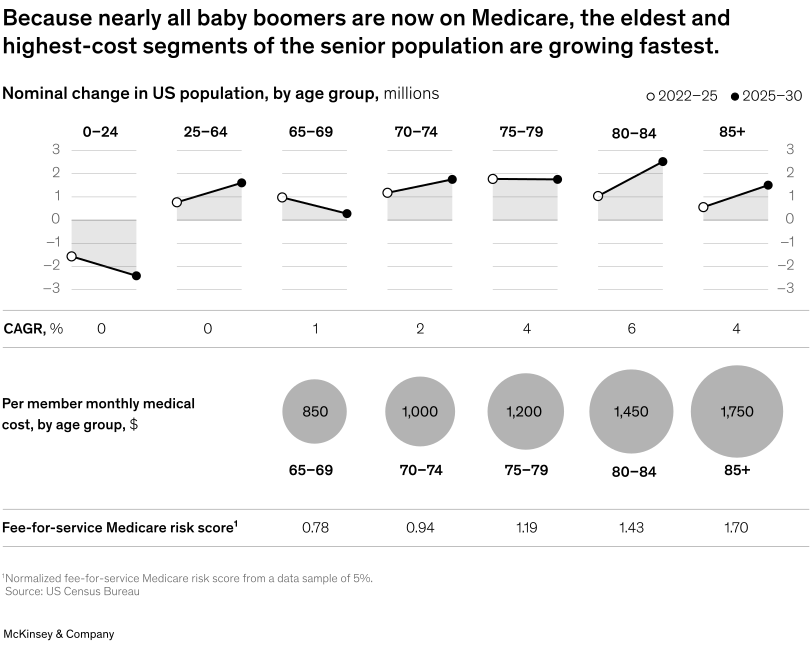
Rising healthcare demand from an aging population in the United States is clashing with persistent clinical workforce shortages. The resulting widening gap between demand and capacity is further straining access, quality, and affordability for patients, as well as cost pressures for the industry. The population of those aged 70 and older is projected to grow faster than any other group in the latter half of the decade, which will continue to accelerate medical utilization. Technology—especially AI—offers a potential bright spot to streamline workflows, expand clinical capacity, and improve the patient experience, say McKinsey Senior Partners Akshay Kapur and Shubham Singhal.
Image description:
A combination bar chart and table show the projected changes in the US population by age group and their associated medical costs and risk scores from 2022 to 2030. At the top, nominal increases in population (in millions) are broken into 2 time spans: 2022–25 and 2025–30, revealing the largest growth in the senior age brackets, particularly among those aged 80–84 (1.04 million from 2022–25, 2.53 million from 2025–30) and 85+ (0.56 million, 1.51 million). The compound annual growth rate (CAGR) for 2022–30 is also highest in these cohorts: 6% for ages 80–84, and 4% for both 75–79 and 85+. In contrast, the population under 24 is projected to decline, with decreases of –1.57 million and –2.41 million in the two periods. On the lower segment of the exhibit, age groups are matched with their per-member-per-month medical costs and normalized risk scores—both rising substantially with age. For those aged 85+, average monthly medical costs reach $1,750 with a fee-for-service Medicare risk score of 1.70; the 80–84 group’s costs are $1,450 and a risk score of 1.43. Costs and risk scores decrease steadily with younger cohorts: for those aged 70–74, costs drop to $1,000 and a score of 0.94, and for 65–69, $850 and 0.78.
Note: This image description was completed with the assistance of Writer, a gen AI tool.
Source: US Census Bureau.
End of image description.