AI is becoming widely used, but only a minority of companies are scaling more sophisticated capabilities, such as agents, into workstreams in ways that can transform their businesses. The adoption of AI agents at scale is most advanced in the technology industry, where functions including software engineering and IT report the highest levels of scaled use, McKinsey’s Alex Singla, Alexander Sukharevsky, Bryce Hall, Lareina Yee, Michael Chui, and coauthors note. Insurance leads in the use of AI agents for marketing and sales, while the healthcare industry shows strong uptake in knowledge management and IT.
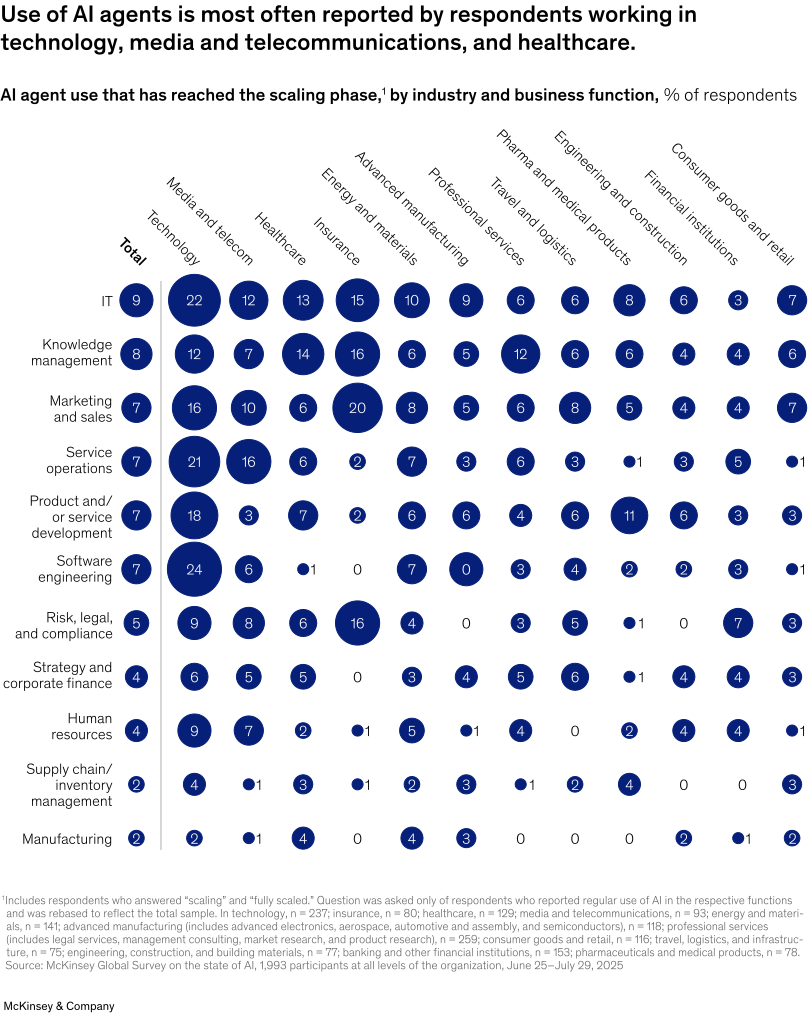
Image description:
A bubble chart illustrates the percentage of respondents who reported using AI agents that have reached the scaling phase, categorized by industry and business function. The chart is divided into 11 business functions on the y-axis: IT; knowledge management; marketing and sales; service operations; product and/or service development; software engineering; risk, legal, and compliance; strategy and corporate finance; human resources; supply chain/inventory management; and manufacturing. The x-axis lists industries: technology, media and telecom; healthcare; insurance; energy and materials; advanced manufacturing; professional services; travel and logistics; pharma and medical products; engineering and construction; financial institutions; and consumer goods and retail. The size of the bubbles corresponds to the percentage of respondents, ranging from 0 to 24%. The technology industry has the highest percentage of respondents using AI agents in IT (22%), software engineering (24%), and product and/or service development (18%). The media and telecom industry has significant adoption in service operations (16%) and the healthcare industry in knowledge management (14%). Note: This image description was completed with the assistance of Writer, a gen AI tool.
Source: McKinsey Global Survey on the state of AI, 1,993 participants at all levels of the organization, June 25–July 29, 2025.
End of image description.
To read the survey, see “The state of AI in 2025: Agents, innovation, and transformation,” November 5, 2025.