Egypt is a study in contrasts. One of the top three economies in Africa and the fifth largest in the Middle East and North Africa (MENA) region, with a GDP of $349 billion, the country is a regional power player. Yet, it is also navigating a complex landscape of geopolitical uncertainty and structural challenges.1
The macroeconomic reset of recent years has been mixed. Growth slowed from 6.6 percent in 2022 to 3.1 percent in 2024, but the foundations are firmer: Inflation in 2024 eased from about 34 to 28 percent, with forecasts pointing toward roughly 13 percent by the end of 2025.2 At the same time, the current-account gap has narrowed, tourism is recovering, remittances have proved resilient, and primary budget surpluses peaked near 6 percent of GDP in 2022 to 2023.3
The government has set an ambitious target to reach 7 percent annual growth by 2030, underpinned by higher investment and a larger role for the private sector.4 Against this backdrop, the binding constraint is the availability of foreign exchange (FX). The central question now is where can Egypt earn more hard currency—and save more of it—most quickly and reliably?
This report focuses on the sector moves most likely to expand net FX by lifting inflows (exports, tradable services, and production linked to foreign direct investment) and curbing structural outflows (imported fuels and inputs). Eighteen macroeconomic sectors and 53 sectors were assessed, covering more than 1,200 products and services, and 11 macrosectors were prioritized using two lenses: attractiveness for FX (export potential, import exposure, and expected global growth) and right to play (competitiveness based on inputs, market access, and the enabling ecosystem, complemented by a cost-competitiveness view) (see sidebar “Methodology to identify high-potential growth sectors”). The approach focuses on near-term, quantifiable FX impact. Sectors not discussed here, while remaining relevant to the economy, are excluded because their near-term, measurable FX effect is less immediate under current conditions.
Mapping out the FX journey: From foundations to frontiers
Egypt’s FX opportunity across the 11 prioritized macrosectors spans both “earn” and “save” opportunities. On the earnings side, strengths include tourism and hospitality, textiles and apparel, ICT services, processed foods, pharmaceuticals, and selected chemicals. On the savings side, the energy balance and targeted import substitution in components, machinery, and materials can reduce structural FX leakages.
Traditional pillars—such as manufacturing, wholesale and retail trade, and agriculture—remain important. The FX prize, however, is expected to come from a sharper set of high-value, tradable, or import-substituting plays in high-growth sectors. These moves sit alongside risks that merit attention: a widening energy deficit raising reliance on liquefied natural gas (LNG) imports; elevated external debt service obligations; uneven progress on subsidy reform and asset divestments; a low savings rate; and continued exposure to global and regional shocks.5
The 11 macrosectors map to four archetypes of opportunity that mirror an FX journey from reinforcing the economy’s foundations to pushing the frontiers of global competitiveness (Exhibit 1).
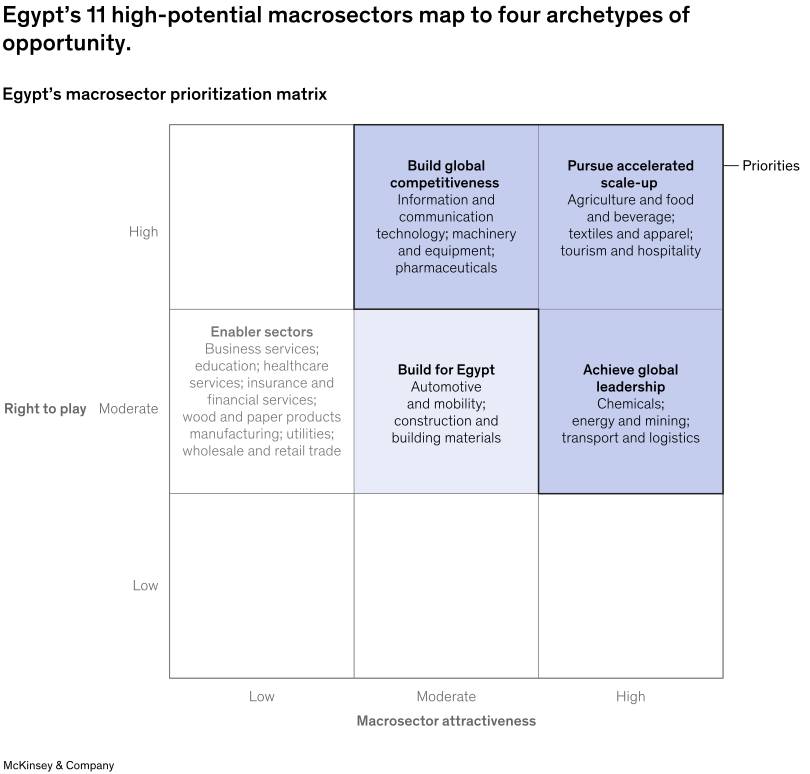
The archetype “Build for Egypt” covers domestically essential sectors that reinforce the economy’s base yet are less globally competitive today. Here, FX benefits are largely on the “save” side through reduced import exposure and deeper local content. The archetype “Pursue accelerated scale-up” includes sectors with strong domestic demand and clear export potential where Egypt has a competitive edge; these can deliver relatively rapid FX inflows. “Build global competitiveness” comprises competitive sectors that currently serve smaller or niche markets and need scale and depth of capability to compete internationally; their FX impact grows as they expand. “Achieve global leadership” includes sectors already present in large global markets where Egypt could reach leadership positions through improved cost competitiveness. These sectors combine significant export potential with the opportunity to reduce selected import dependencies.
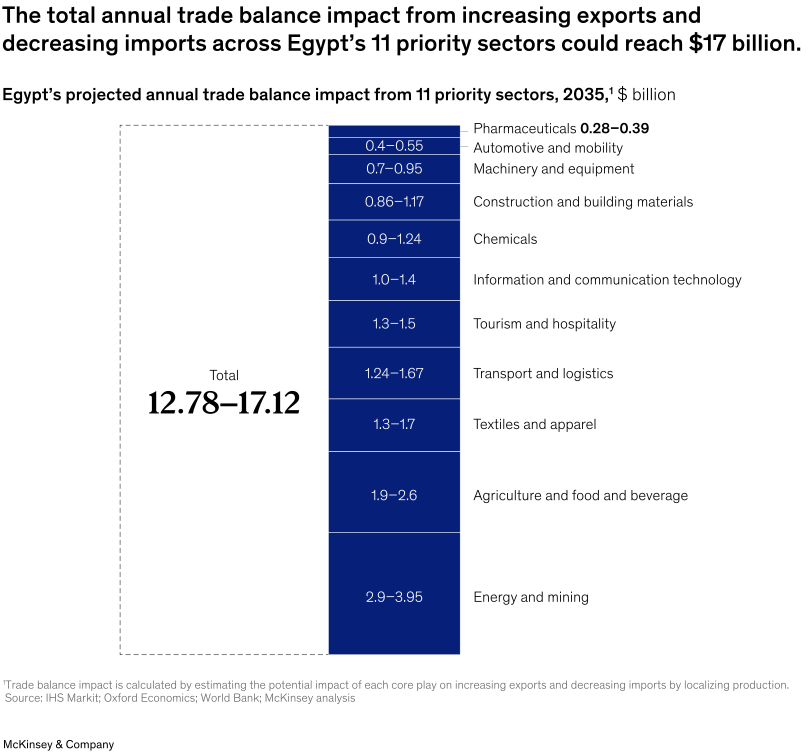
The archetype view helps clarify how early improvements in reliability, quality, and market access can unlock near-term FX gains and set up longer-horizon ambitions, while keeping the analysis anchored in evidence from each macrosector. Across all 11 identified sectors, the trade balance impact of these interventions could range from $13 billion to $17 billion each year (Exhibit 2).
Build for Egypt
Two macrosectors play a foundational role in Egypt’s domestic economy, despite being less competitive globally today: automotive and mobility, and construction and building materials.
Automotive and mobility: Localize value; cut the import bill
Automotive and mobility contributed an average of 0.7 percent of Egypt’s GDP between 2021 and 2024, reflecting a limited domestic footprint today.6 However, demand fundamentals are strong: automotive ownership rates are low (64 cars for every 1,000 people), and domestic demand is projected to more than double by 2032 as population and incomes rise.7 However, local activity is concentrated in basic assembly; design, advanced components, and key materials largely remain offshore, leaving value creation outside Egypt. Almost half of new vehicles are imported as completely built-up units, and component imports—notably tires and steel parts—contributed to a sector trade deficit of $4.6 billion in 2024.8
Strategic plays for this macrosector could include localizing tire production at scale, moving exports up the value chain from tier-one parts to tier-two assemblies, developing the domestic replacement and maintenance market, and improving product fit for local conditions such as ride comfort, HVAC performance, and dust resistance. The FX logic is to raise local content and temper import needs while creating the basis for export positions over time.
Construction and building materials: Upgrade quality, raise export value
Despite a contraction of about 7 percent from 2022 to 2024, the construction and building materials macrosector remains a consistent contributor, accounting for approximately 6.25 percent of GDP in 2024.9 From 2022 to 2024, exports—with marble and granite at the helm—grew at almost 12 percent CAGR, while imports fell by 3.7 percent.10 Opportunities in the macrosector span structure (cement and steel), fit-out materials (stone, ceramics, flat glass, metal mountings, lighting), and plumbing. Practical plays could include accelerating green cement capabilities to align with tightening environmental standards; raising the export orientation of ceramics by improving raw-material processing and energy efficiency; moving from raw or basic-cut stone exports to finished products via automated finishing; upgrading existing flat sheet glass lines and aligning with green-building requirements; and localizing selected plumbing items where reliance on imports is significant. The emphasis can be on quality upgrades and product mix shifts that lift export value and reduce imported inputs.
Pursue accelerated scale-up
Three macrosectors combine strong domestic demand with FX export potential, where Egypt holds a clear competitive edge: agriculture, food and beverages, textiles and apparel, and tourism and hospitality.
Agriculture and food and beverages: Grow exports; trim commodity dependence
Valued at approximately $60 billion in 2024, the agriculture, food, and beverages macrosector is a significant player in the Egyptian economy, contributing about 16 percent of GDP.11 Primary agriculture grew at a 5.6 percent CAGR between 2020 and 2025, while processed foods grew by a 4 percent CAGR over the same time. The external position has improved as the trade deficit has narrowed; agricultural exports reached $6.1 billion in 2024 and have grown four times faster than imports, led by oranges and dried onions. However, import dependence is still high, with soybeans, wheat, and corn accounting for about 40 percent of agricultural imports.12 Structural constraints include limited arable land, small and fragmented farms, and acute water scarcity; agriculture uses nearly 85 percent of available water.13 Key plays here could include localizing production of strategic crops and feed to temper the cereal import bill; reducing postharvest losses in perishables via cold-chain and handling improvements; building on momentum in processed foods; and expanding into regional markets with nearshoring platforms and private-label programs suited to Gulf Cooperation Council (GCC) and African buyers.
Textiles and apparel: Lift weaving and finishing; win EU and GCC orders
While accounting for just 0.5 percent of GDP, the textiles and apparel macrosector has a positive trade balance and momentum: apparel exports reached almost $4 billion in 2024.14 Egypt is a leading producer of long- and extra-long-staple cotton, and exports of cotton and synthetic textiles are increasing in line with global demand, signaling strong potential for foreign direct investment.15 Looking ahead, several opportunities could deliver FX gains. For example, Egypt could unlock export potential by improving quality and capacity in weaving and finishing, upgrading machinery, adopting techniques that enhance fabric appearance and strength, and transitioning to eco-compliant chemicals to meet buyers’ standards in the European Union and GCC. Scaling garment manufacturing and nearshoring platforms could also help it to diversify markets and serve demand in the Middle East, Africa, and the Mediterranean. The United States currently imports more than half of Egypt’s top five apparel exports. By creating shared infrastructure, such as central finishing and laundry hubs, and accredited testing and compliance labs, the sector can also improve quality, speed, and reliability for investors and buyers. The FX effect would come from higher-value orders and faster, more predictable access to priority markets.
Tourism and hospitality: Raise spending per visitor; build ‘Brand Egypt’
Tourism and hospitality contribute about 10 percent to both GDP and employment.16 Egypt’s draw is enduring, with a breadth of experiences and globally significant cultural assets, yet its recovery from the pandemic has lagged behind peers, and average daily spend per tourist declined slightly by 0.2 percent CAGR between 2019 and 2024.17 Four practical plays could deliver FX gains. First, the sector could raise the spend per visitor by scaling distinctive, higher-value experiences and broadening into wellness, culinary, maritime cruises, and medical tourism. Second, upgrading budget accommodation—still the majority of the supply—could improve reliability and guest ratings and boost demand. Third, expanding air access by adding routes and attracting low-cost carriers to serve secondary cities and underserved destinations. Finally, a focus on building “Brand Egypt” through improved destination marketing and upgrades to aggregator booking ecosystems could help raise the country’s profile. Egypt trails its regional peers in the World Economic Forum’s Travel & tourism development index 2024, suggesting scope to improve visibility and conversion.18
Build global competitiveness
Three macrosectors that currently serve smaller or niche markets have significant potential to scale to compete globally: information and communication technology (ICT), machinery and equipment, and pharmaceuticals.
ICT: Win at EMEA nearshoring; scale ‘Digital Suez’
Digital services in Egypt are booming: exports reached about $1.7 billion in 2024, supported by growth in IT, business process outsourcing, customer experience, and engineering services; offshoring employment has expanded to more than 300,000 jobs in 2025, with plans to reach roughly 500,000 by 202619; and the sector’s contribution to GDP rose to about 5.4 percent in 2024 from roughly 3.5 percent in 2020.20 Structural advantages include Egypt’s location on Eurasia–Africa subsea routes, with ten landing stations and 14 active submarine cables, plus cost-competitiveness and multilingual talent.21 Four key plays could deepen participation where FX impact and margins are strongest: winning Europe, the Middle East, and Africa (EMEA) nearshoring with multilingual customer experience (CX) and managed IT, building a “Digital Suez” to grow data center and cloud exports, moving up the value chain into expert work and product engineering, and developing an Arabic-first AI wedge aligned with the national AI strategy.
Machinery and equipment, including electronics: Scale growth components; diversify into Africa
Although small—contributing just 0.16 percent of GDP in 2024—this macrosector shows promise.22 Sector output declined by about 6 percent per year between 2020 and 2024, yet exports grew at 12 percent over the same period, with notable momentum in electronics.23 The rise of media equipment exports is also notable; Egypt now ranks 31st globally by market share, with around $1 billion in annual value, while exports of household appliances are also growing strongly (15 percent CAGR between 2020 and 2024), with some product categories such as freezers growing at an 83 percent CAGR.24
Four key plays could accelerate momentum and narrow the estimated $900 million trade gap in this macrosector: scaling local production of in-demand electrical components (insulated conductors, boards, consoles) and exporting these into Africa, where Chinese suppliers dominate; deepening local assembly in household appliances and diversifying the export mix; pragmatically expanding media equipment exports by increasing production and market reach; and by localizing selected heavy machinery and components where imports are concentrated (pumps, compressors, filtering equipment, valves, bearings). The FX contribution from these plays could come from both import substitution and export growth.
Pharmaceuticals: Lift export intensity in generics and OTC medicines
Valued at $7.89 billion in 2024, the pharmaceutical sector is the second largest in the Middle East and Africa after Saudi Arabia ($8.3 billion).25 Despite a modest 1 percent decline between 2019 and 2023, the sector is forecast to grow by about 5 percent annually from 2024 to 2028, potentially reaching $10 billion by 2028.26 FX growth in this sector could come from broadening market access, tempering import needs, and improving export readiness. For example, Egypt’s export intensity in the generics and over-the-counter (OTC) category (8 percent) trails peers such as South Africa (12.4 percent), Saudi Arabia (9 percent), and India (37.5 percent)27; our analysis suggests that scaling exports of these products by 12 to 15 percent could yield $220 million to $390 million. A second opportunity could be to localize import-reliant generics and OTC products where capabilities exist. Stakeholders could also build local sterile-injectables capacity, beginning with a focused product set (for example, anti-infectives and anesthetics) and expanding as quality systems deepen. Finally, investing in packaging and serialization capacity could support compliance, reduce waste and recalls, and propel savings.
Achieve global leadership
Three macrosectors that already have a meaningful presence in large global markets hold significant potential to improve their cost competitiveness to attain world-class status: chemicals, rubber, and plastics; energy; and transport and logistics.
Chemicals, rubber, and plastics: Convert feedstocks into higher-value exports
The chemicals sector contributed about 1.6 percent of GDP in 2024 and has grown rapidly at 10.2 percent annually since 2018.28 Total trade reached $21.6 billion in 2024, and while Egypt remains a net importer, exports (5.9 percent CAGR) have outpaced imports (4 percent CAGR) in recent years, gradually narrowing the gap.29 FX gains in this sector could span import substitution and higher-value exports. For example, expanding downstream conversion in polyolefins, which accounted for nearly one-third of Egypt’s $2.6 billion plastics import deficit in 2024, could reduce imports and boost exports of higher-value finished goods.30 Similar gains could come from localizing production of selected organics and inorganics; polycarboxylic acid alone accounted for roughly $600 million of imports in 2024, and our analysis suggests that meeting 20 to 30 percent of demand could narrow the deficit by $120 million to $180 million.31 Additional opportunities could lie in upgrading fertilizers from urea to NPK (nitrogen, phosphorus, and potassium), water-soluble, and coated grades, and, over time, exploring clean ammonia aligned with emerging global demand, as well as developing methanol derivatives and green methanol. According to Methanex, Egypt currently has 1.3 million tons of methanol capacity and active derivative concepts.
Energy and mining: Balance power, reduce LNG exposure, scale exports
Rising demand, abundant solar and wind resources, and significant mineral reserves position Egypt strongly to drive growth in the energy macrosector. However, structural bottlenecks and shrinking oil and gas reserves have constrained progress and deterred investment.32 The FX logic here is to reduce LNG and refined-product import exposure, which increased by around 9 percent annually from 2018 to 2023, and scale up renewables to meet rising electricity demand—expected to more than double from 170 terawatt-hours today to 421 terawatt-hours by 2050—while positioning for selective exports.33 In power, three opportunities could bring FX gains: scaling renewables and storage; managing demand; and developing Egypt into a regional energy-trading hub, leveraging existing grid interconnections and establishing clear market rules to support efficiency and profitability. In hydrocarbons, opportunities could include upgrading refineries to increase yields of middle distillates and addressing gas market balance via industrial efficiency and targeted supply-side remediation in aging fields. In mining, there is significant growth potential—especially in gold—through streamlining exploration, permitting, and local processing.
Transport and logistics: Cut dwell times, connect ports to markets
Transport and logistics (T&L) contributes 3 to 6 percent of GDP and is projected to grow from $26.9 billion in 2023 to $37 billion by 2028.34 Egypt’s geographic position, the Suez Canal Economic Zone (SCZONE), and a broad port and river network underpin the opportunity, with five Egyptian ports ranking highly in the 2024 Container Port Performance Index.35 FX opportunities in this macrosector can be found across maritime, rail, roads, and warehousing. For example, the SCZONE and maritime network could be leveraged to facilitate specialized supply chain activities and serve anchor verticals, which have been shown to coincide with higher throughput and help to anchor tenants.36 Second, by replicating successful port operation models, the macrosector can close utilization gaps and improve reliability, including by better using rail links and dry ports. Building out cold-chain logistics, which at roughly three million cubic meters of cold storage are small relative to global benchmarks.37 Developing an integrated network of logistics zones and dry ports through standardized designs and federated digital platforms, and streamlining logistics via coordination and data sharing has also been shown to enhance performance by speeding container flows and improving on-time performance across modes. These moves could enable exporters and boost import substitution across the economy.
Compounding FX gains: A playbook for Egypt
Egypt’s FX imperative is unequivocal: earn more hard currency from tradable sectors and save more by reducing structural leakages. This analysis identifies 11 macrosectors that can deliver near-term, measurable FX impact and sets out targeted plays within each. The emphasis throughout is on what our evidence suggests is most actionable within current capabilities and conditions.
Proposed paths run from foundational moves in energy and logistics upgrades to support export and import substitution gains, to new frontiers in tourism and manufacturing, ultimately paving the way for technological competitiveness and long-term industrial leadership to secure FX gains.
Several patterns recur in the sector views. Quality and reliability are central, whether in the precision of textiles finishing, the uptime of data centers, the consistency of cold-chain temperatures, or the predictability of port and rail slots. Market access matters, from compliance with buyers’ chemical standards to broader destination marketing in tourism. Shared infrastructure can change the slope of performance, whether a finishing hub, a testing lab, or a federated digital platform linking logistics zones. And in multiple sectors, diversification of products, processes, and markets can lift value capture while tempering exposure to concentrated demand and imported inputs.
Egypt’s FX story is ultimately cumulative: incremental improvements across several sectors can add up to material progress on hard-currency availability. The archetypes and sector observations provide a way to concentrate attention where impact could be most immediate while keeping sight of longer-horizon ambitions that support competitiveness. In that sense, the FX agenda is a route to growth—grounded in Egypt’s sectoral realities and focused on turning existing strengths into foreign-exchange resilience over the decade ahead.