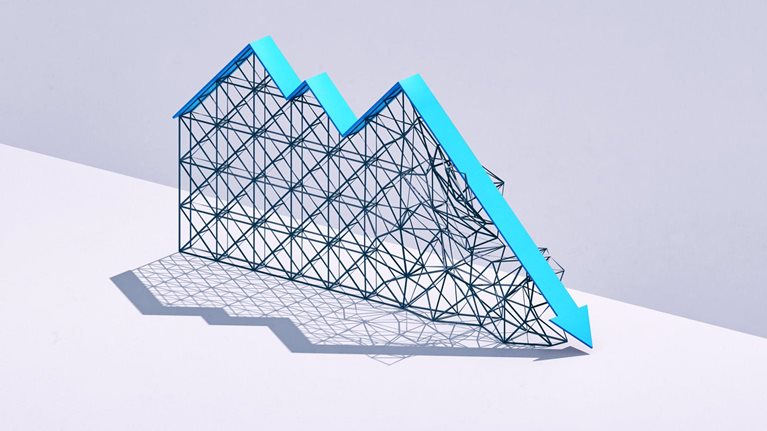
In this edition of Author Talks, McKinsey Global Publishing’s Mark Staples chats with Tyler Goodspeed, chief economist of ExxonMobil, about Recession: The Real Reasons Economies Shrink and What to Do About It (Basic Venture/Hachette Book Group, March 2026). Drawing on four centuries of economic history, Goodspeed examines the forces behind downturns and what they mean for long-term growth and policy. An edited version of the conversation follows.
Your book covers peat, locusts, and pirates. What’s the connection?
There’s a two-step process to identifying historical economic recessions. The first step is quantitative. You must look at the statistical evidence. Was there an ongoing economic contraction? The second step is more qualitative. At the time, what were people concerned about economically? What were they lamenting? What were their economic concerns? That’s different from what they were blaming the recession on. When you look at the statistical evidence—the quantitative evidence—you very often see violent changes in the rate at which people are unemployed—sharp contractions, rather than gentle ones, where you tip or you slip into recession. With the qualitative evidence, you often hear people speak about “big shocks” or big clusters of shocks.
For example, in the three- or four-year period from 1717 to 1720, statistics show that the North American colonies were experiencing an economic contraction on par with the Great Depression or the equally great economic recession during the American Revolution. There was a complete collapse in trade and in the money supply, as well as other indications of a really struggling economy. Yet there was no war. With the exception of a lot of writing about pirates, there were no other contemporary reports of economic dislocation. It turns out that this was the peak of the so-called golden age of Atlantic piracy.
Edward Teach, otherwise known as Blackbeard, even blockaded the important port of Charleston. There were brigands preying upon commerce between the Caribbean and Salem, intercepting commerce ships off the coast of Long Island. They were even raiding the Chesapeake Bay. Atlantic trade ground to a halt. Similarly, in the 18th and 19th centuries, and even into the 20th century, when you would see episodes of economic contraction, historians would write about a boom in one sector or another. Yet contemporary reports would include the word “famine.”
Famine was not included in the context of hunger. It was used in the context of peat or turf, which for most of the 18th and 19th centuries was an important source of fuel. Later, famine is applied to coal, which displaced peat as an important source of industrial and home heating. When there are episodes of industrial action—either management lockouts or strikes—you would see steep declines in the economic activity on account of the scarcity of coal. That’s how peat, pirates, and the likes of locusts ended up in a contemporary business book.
If recessions result from random shocks, then the idea of the business cycle is misguided, right?
Correct. Fortunately, the notion of a business cycle—the notion that there are booms followed by busts—yields a lot of testable hypotheses. In some way, recessions should be predictable. There should be some information in the height, speed, or duration of an economic expansion that tells you something about the depth, speed, or duration of the subsequent recession. Recessions should be relatively constant across time and space, unless we think that Americans are vastly more prone to boom and bust than Brits, and that our forebears were vastly more prone to boom and bust than we are.
If recessions are performing some cleansing or reallocating function, the economy should also look fundamentally different at the end of a recession or at the end of the subsequent recovery, compared to how it looked at the end of the proceeding expansion. Another hypothesis would be that with the expanded role of the state, we should expect to observe recessions become shallower and less frequent over time. When you tackle each of these testable hypotheses, it turns out that recessions are fundamentally unpredictable. Lots of business cycle theorists have postulated that recessions occur in sort of cyclical clusters of three years, or five to seven years, or ten years, or 60 years, in terms of super cycles.
If you look at the evidence, there is no information about a recession having occurred three years ago, or ten years ago, or seven years ago that predicts a recession today. There is also nothing in the height, speed, or duration of an expansion that tells you anything about the depth, speed, or duration or the subsequent recession. Over time, both economies have been getting much better at avoiding recession. That goes against the notion that this is a fundamental flaw in human behavior.
Finally, in terms of government smoothing, it turns out that the depth and severity of recessions have been pretty constant over time, with the glaring exception of an extremely martial period from about the start of World War I in 1914 through the end of World War II in 1945.
The 2008 global recession is often attributed to bad financial engineering. You don’t think so. Why?
It’s important to consider the 2008 recession in a broader macroeconomic context. If I asked you to guess when the inflation-adjusted price of a barrel of oil or the inflation-adjusted price of a gallon of gas reached its all-time high in the United States, you might guess 1973 in the aftermath of the Arab oil embargo. You might guess 1980 in the aftermath of the Iranian Revolution. You might guess 1990 or ’91 in the aftermath of Saddam Hussein’s invasion of Kuwait. Yet in fact, the all-time record for the price of a barrel of oil or a gallon of gas was in June 2008. This was a very unprecedented energy price shock—with a lot of causes on both the supply and demand sides.
But the net result was that by summer 2008, the average American household had to spend more than $2,000 more per year on energy goods and services than they had to pay just a couple of years before. At the same time, with adjustable rate mortgages resetting higher, they had to pay about $800 more per year on mortgage interest payments. Is that an energy price shock, or is that a mortgage price shock? Actually, energy feeds into a lot of other things. One of the most energy intensive products is fertilizer. At the same time, there was very high food inflation in 2007 and in 2008.
If you look at the evidence, there is no information about a recession having occurred three years ago, or ten years ago, or seven years ago that predicts a recession today.
The bottom half of the income distribution in the United States, after tax, has no savings. There is an historic energy price shock, food inflation, and mortgage payments resetting higher, so something has to give. For a small minority of American households, that meant delayed mortgage payments. Another recent recession that we’ve experienced was the relatively mild, relatively short recession that inaugurated the 21st century, which everyone calls the “dot-com recession.”
What’s interesting is that the decline in the Nasdaq and tech stocks was just one of multiple shocks that impacted the US economy in 2001. I argue in the book that was actually the least important shock because we had estimates of the responsiveness of consumer spending to changes in financial wealth. They just can’t explain the magnitude of the economic decline in the third quarter of 2001, especially when you consider that a lot of tech stocks were not owned by Americans and were highly skewed toward the upper end of the income distribution.
Those folks tend to be less responsive to changes in financial wealth, in addition to that tech stock decline, which incidentally had already started to recover at the start of the recession. In addition to those tech stock declines, the US economy was also dealing with an energy price spike, as East Asia recovered after the 1998 crisis.
The United States was also experiencing a decline in manufacturing employment as a result of October 2000, when it granted permanent most-favored nation status to the People’s Republic of China, a multitrillion-dollar, nonmarket economy. There were two immediate impacts of that. One is US companies announced roughly 80,000 layoffs in goods-producing industries. More important than outright layoffs, there was a collapse in net new hiring in goods-producing industries.
An interesting feature of many recessions is that they are characterized not by a sudden increase in the rate at which firms fire employees, but rather a sudden decrease in the rate at which they hire them. The final shock—the most important shock—was the 9/11 attack, which impacted the physical and human capital of the United States. There was widespread fear. There was the complete closure of US airspace for an extended period of time. In fact, all of the output decline during that 2001 recession occurred during the quarter in which the attack occurred. So, the dot-com recession is actually a misnomer. That should be known as the 9/11 recession.
Your book documents several banking-led crises. What happened in those?
One reason that I cover a number of banking crises is that, in historical memory, these crises are often defining moments of past recessions. We associate the recession with those moments of, what some would call, panic.
One of the episodes that I thought was most illustrative was a particularly “violent panic,” if you want to use that term, in September 1873. A lot had to go wrong in the lead-up to that crisis—from fraudulent English lords, to a providential plague of locusts that disrupted demand for railroad bonds to finance railroad construction in the US West. A highly improbable sequence of events resulted in the catastrophic financial crisis in September 1873.
You’ve mentioned a few energy shocks. Why do they so often cause recessions?
We tend to think about economic fluctuations as driven by aggregate shocks that affect the entire economy, simultaneously, and roughly equally. But there is a growing body of research that suggests that, actually, shocks to specific sectors matter more in generating economic fluctuations. Those are shocks specifically to sectors that have very high linkages to the rest of the economy and whose output isn’t easy to replace.
Many recessions are characterized not by a sudden increase in the rate at which firms fire employees, but rather a sudden decrease in the rate at which they hire them.
That’s one reason that we spoke about financial crises and why financial crises can be propagation mechanisms of adverse shocks. When there’s a shock to the banking system, because of a harvest failure or real estate price declines, it’s very difficult for people to find a replacement for bank capital.
Similarly, energy doesn’t just go into vehicles. It provides power generation. It generates heat for manufacturing fertilizer, steel, and cement. Think of maritime transportation, commercial aviation. For example, when there’s a shock to the oil supply, you can’t just easily substitute coal because a ship designed to run on diesel cannot just burn coal.
Historically, that’s why energy was one of those sectors. When there was a shock to the supply—whether a deep freeze impaired the turf supply, or an industry action impaired the coal supply, or geopolitical shocks impaired the supply of oil in the past 50 years— it was not easy for people to find a replacement for the energy sector, given its very high linkages to the rest of the economy.
You mentioned war as another cause of recession. How does war affect an economy?
In the course of writing this book, I found that the single worst shock that can be inflicted on an economy is war. War imposes enormous disruptions to people, to physical and financial capital, and inflicts enormous distortions on production. Some of the longest, deepest recessions we have observed over the past four centuries, in both the United States and the United Kingdom, have been war related.
In the United Kingdom, that includes 1763 to 1765. There was also a very severe recession in the aftermath of World War I. And the longest recession on either side of the Atlantic, depending on chronology you use, was a very protracted, deep recession in the United Kingdom, beginning in 1943 and continuing all the way to the first half of 1947.
In the United States, some of the worst recessions—except the Great Depression, which did occur during peacetime—were almost all war related. There was a very deep recession in the United States, on par with the Great Depression, during the American Revolutionary War. The same can be said just after the war, during the Articles of Confederation, and also, as I mentioned, that 1717 to 1720 period when there were brigands preying upon American commerce.
The 1973 recession was related to war in the Middle East and the subsequent oil embargo. Recession in 1991 was due to an oil price shock resulting from geopolitical conflict, again, in the Middle East. Again, these are enormous disruptions to people, capital, and production. That’s why they have been killers of economic expansion over the past 400 years.
Many believe that recessions are needed to purge the system of excesses. You disagree. Why?
The notion that recessions are enhancing a process of creative destruction is wrong. The evidence is very strong that creative destruction, the death of older or less efficient firms, and the birth of new, more dynamic firms, and the migration of workers and capital from less efficient firms to more efficient firms, is a very important process for long-term growth. The question is whether recessions enhance or impair that process.
One of the interesting things about recessions is they are rampant age discriminators. They discriminate against younger firms, relative to older incumbent firms. And they generally discriminate against younger, more marginal workers, compared to older, more job-secure workers. Also, research and development tends to move very procyclically. I don’t like the word, “cyclically.” Yet research and development tend to be higher during economic expansions and then contract very sharply during recessions. That’s the opposite of what you would expect, if recessions are performing some function, in terms of giving you time to invest in cleaning your desk or investing in ideas, rather than just producing to meet current demand.
There is most compelling evidence that recessions are not enhancing the process of creative destruction. If you look at the composition of an economy at the end of an expansion, at the allocation of people and output across sectors, and then you look at that composition at the end of the subsequent recession or at the end of the subsequent recovery, it typically looks remarkably similar to how it would have looked had the recession never happened. This shows that a recession is a temporary deviation from a long-run trend. Over time, the economy returns to that trend.
Is this book going to get you in trouble with your fellow economists?
Fortunately, the response from my academic colleagues has been overwhelmingly positive thus far. My findings would resonate among scholars who have really studied this stuff—[American economists] Valerie Ramey, Bob Hall, Christie Romer, for example—and with their understanding of economic fluctuations as episodic, as random, not cyclically or periodically recurring. The problem is we are pattern-seeking mammals. Patterns are how we process incoming stimuli, interpret those stimuli, causally, and store that information.
If you ingest a colorful mushroom or you consume stagnant water, you become ill. We see that bright mushroom, and we know that stimulant will cause pain. Similarly, with recessions, because there are many more records than there are recessions: record stock prices, record home prices, record building heights. It’s very easy to look around during or after a recession and find an asset or a time series that reached a record, that went up, and then during the subsequent recession, came down. That fits with patterns elsewhere—that we’ve observed and stored in our memory—that what goes up must come down and that the higher it goes, the harder and faster it hits the ground. We are pattern-seeking mammals.
Recession is a temporary deviation from a long-run trend. Over time, the economy returns to that trend.
That’s one reason that even economists who know that recessions are episodic and random, not cyclical and periodic, will nonetheless slip into the language of “boom and bust” when talking about historical economic recessions. Though in this book, I demonstrate that recessions are unpredictable, I will still take a peek at the yield curve. I will still calculate whether we breached the sum threshold, the sum indicator for whether we’re in a recession. In the same way that I’m not a believer in astrology, I sometimes look at my horoscope, because again, we always look for patterns. We want to understand what the future holds because it gives us some degree of agency over the future, some degree of knowledge. We don’t do well with randomness.
The book concludes by noting that the long-term trend of economic expansion is more important than recession. Why?
It is, perhaps, odd for a book about four centuries of economic recessions to end by talking about economic expansions. But the reality is that we worry a lot about recessions. We ought to be as concerned about the majority of years in which economies expand as we are about the minority of years in which they contract. Ultimately, the long-run trend growth rate matters much more for long-run prosperity and human flourishing. For example, the United Kingdom has long been more recession prone than the United States. Over the past century, the United States has been more than twice as recession prone as the United Kingdom.
But the United States is also 30 percent richer, per person, than the United Kingdom. Reversed, the United Kingdom is 30 percent poorer, per person, than the United States, and long has been. What matters more is the differential growth rate. A lot of early business cycle theorists were trained as physicians initially, so a lot of the terms that we associate with recessions were originally medical terms. You see these terms: crisis, malady, and remedy when business cycle theorists speak about recessions. Based on this book, a lesson to policymakers is that they ought to adhere to some form of the Hippocratic Oath. First, do no harm.
That means during a recession, contractionary fiscal and/or monetary policy is usually a very bad idea. We saw that during the Great Depression of the United States. We saw it during a very catastrophic recession in 1847 in the British Isles. Administer palliative care. And now we have automatic stabilizers. We have transfers to households, which matters because even though economies in the aggregate recover from recessions, that doesn’t necessarily mean that every individual household does. So first, do no harm. It also means that during economic expansions, policymakers should be careful not to overmedicate or otherwise sedate what are otherwise healthy economic hosts and to do so in the mistaken belief that they are going to prevent recessions. The reality is that recessions will continue to happen because history will continue to happen.

Visit Author Talks to see the full series.
Related Articles

Geopolitics and the geometry of global trade: 2026 update