Corporate America risks rolling back progress for women. According to this year’s Women in the Workplace study, only half of companies are prioritizing women’s career advancement, part of a several-year trend in declining commitment to gender diversity. And for the first time, there is a notable ambition gap: Women are less interested in being promoted than men.
When women receive the same career support that men do, this gap in ambition to advance falls away. Yet women at both ends of the pipeline are still held back by less sponsorship and manager advocacy.
This is a solvable problem, but it requires a greater investment in women’s careers at a time when a number of companies may be deprioritizing them. Some have already scaled back programs beneficial to women, such as remote work, formal sponsorship, and targeted career development, and HR leaders worry about the long-term impact of changes like these for women.
Corporate America has made real progress in women’s representation over the past decade—and companies that prioritize gender diversity see bigger gains. For companies that lost focus this year, 2026 should be the year of recommitting to women in the workplace.
The rest of this article summarizes the main findings from the Women in the Workplace 2025 report related to employee experience, women’s representation, company commitment and practices, and solutions (see sidebar, “About the study”).
The employee experience: Women are as motivated as men but less likely to see a path up
Structural barriers persist for women—they receive less career support and are given fewer opportunities to rise. Although they are as committed to their careers as men, a meaningful difference remains in how strongly they aspire to take on more senior roles.
Career support is strongly linked to a desire to advance. When women and men receive similar levels of support from managers and more senior colleagues, they’re equally enthusiastic about getting promoted to the next level: The gap in desire to advance falls away at all career levels.
However, the data show that women don’t receive the same career support as men, especially at entry and senior levels. Women overall are less likely than men to have a sponsor—and entry-level women stand out for receiving far less sponsorship than any other group of women or men. Even when entry-level women do have a sponsor, they’re promoted at a lower rate than men (Exhibit 1). Sponsors have a substantial impact on career outcomes. In the past two years, employees with sponsors have been promoted at nearly twice the rate of those without.
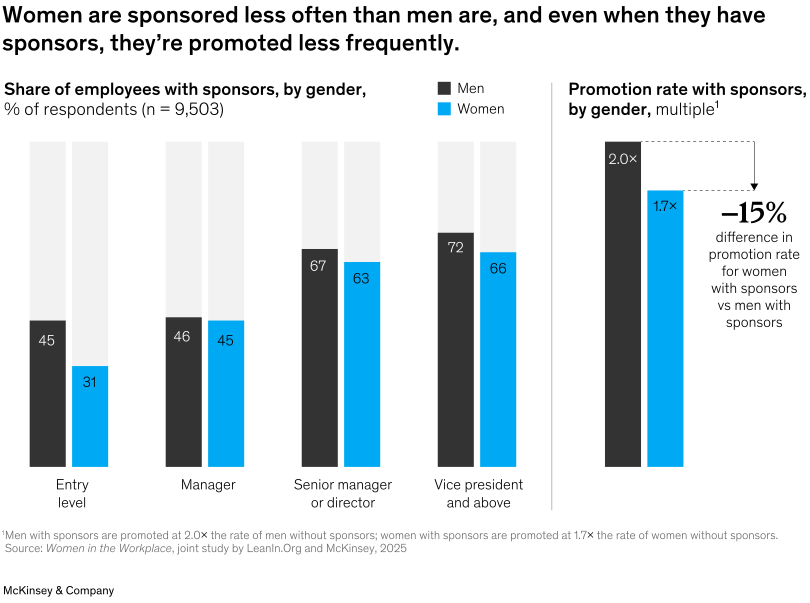
A set of vertical bar charts and a side-by-side bar comparison to illustrate gender disparities in workplace sponsorship and promotion rates. The left section of the exhibit displays the share of employees with sponsors by gender across four career stages: entry level, manager, senior manager or director, and vice president and above. At each level, a greater percentage of men report having sponsors compared to women: 45% of men versus 31% of women at entry level; 46% of men versus 45% of women at manager; 67% of men versus 63% of women at senior manager or director; and 72% of men versus 66% of women at vice president and above. The right section presents a bar comparison of promotion rates for employees with sponsors, showing that men with sponsors are promoted at twice (2.0x) the rate of men without sponsors, while women with sponsors are promoted at 1.7 times (1.7x) the rate of women without sponsors. A label highlights a –15% difference in promotion rates for women with sponsors compared to men with sponsors. Together, the charts underscore both the lower rates of sponsorship for women and the persistent promotion gap even when sponsorship is present.
This image description was completed with the assistance of Writer, a gen AI tool.
End of image description.
Senior-level colleagues can play a crucial role for less experienced employees, even when they are not acting as formal sponsors or direct managers. This support includes checking in on an employee’s general well-being, advocating for them or their work, giving them projects that directly align with their career goals, and being transparent about what it takes to advance. But compared with men, fewer entry-level women are receiving the kinds of career-boosting actions more senior colleagues can provide.
This leads us to the notable gap in women’s desire to advance, revealed in the data this year. Women and men are equally dedicated to their careers and motivated to do their best work, yet women overall have lower aspirations for promotion than men. This may seem at odds with women’s high commitment levels, but the data suggest that even highly motivated women may be discouraged from pursuing a promotion when faced with limited support or competing demands on their time. Without adequate support and balance, even the most motivated women can begin to question whether advancement is possible or worth the cost.
This gap is most pronounced at the entry and senior-leader levels: 69 percent of entry-level women want a promotion versus 80 percent of entry-level men; 84 percent of senior-level women want to be promoted versus 92 percent of senior-level men (Exhibit 2).
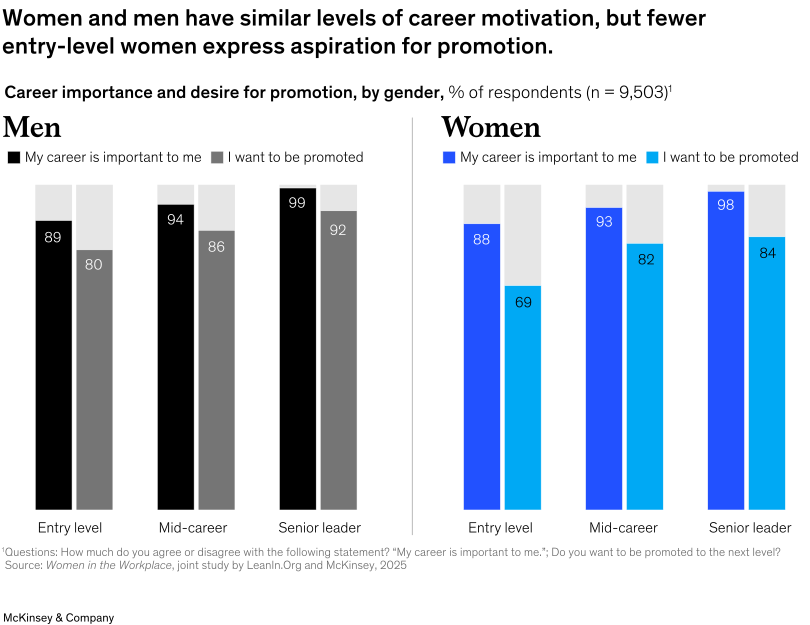
A set of side-by-side vertical bar charts compares men’s and women’s responses on career importance and desire for promotion, broken out by career stage: entry level, mid-career, and senior leader. For each career stage, the bars show the percentage of respondents agreeing with the statement “My career is important to me” and the percentage who want to be promoted. Among men, the proportion who say their career is important increases from 89 percent at entry level to 99 percent at senior leader, while the share who want promotion rises from 80 percent at entry level to 92 percent at senior leader; mid-career men fall in between, at 94 and 86 percent, respectively. Among women, responses show a similar but slightly lower pattern at each stage: 88 percent of entry-level women say their career is important, but only 69 percent want to be promoted, revealing a notable 19-point drop from men’s aspirations at entry level. The percentages for women rise at higher career stages, with 93 percent rating their career as important and 82 percent desiring promotion at mid-career, and 98 and 84 percent, respectively, at the senior leader level. Overall, almost all men and women across levels say their careers are important, but entry-level women are much less likely than their male peers to express aspiration for promotion, a gap that narrows in more senior stages.
This image description was completed with the assistance of Writer, a gen AI tool.
End of image description.
Compared with senior-level men, senior-level women see a steeper climb ahead. Senior-level women who don’t want to advance are more likely than men at the same level to say they’ve been passed over for a promotion and don’t see a realistic path to the top—factors that may make their next career step seem even further out of reach.
When it comes to what people are looking for in the workplace, the survey shows that all employees, regardless of gender, overwhelmingly see the benefits of a fair and inclusive workplace. They value unbiased processes, varied perspectives, and respect and recognition for everyone. They also believe that when employees feel respected and valued, they are motivated to do their best work, and that having a variety of perspectives leads to better decision-making and outcomes.
However, women experience a different workplace than men. Early- and mid-career women are less likely to believe opportunities are fair. Senior-level women stand out for thinking their gender will limit their future opportunities, perhaps because they’ve been in the workforce longer and experienced more headwinds over the course of their careers.
The pipeline: Women are still underrepresented at all levels
For the 11th consecutive year, women remain underrepresented at every level of the corporate pipeline—especially in senior leadership, where they make up just 29 percent of C-suite roles, unchanged from 2024 (Exhibit 3).
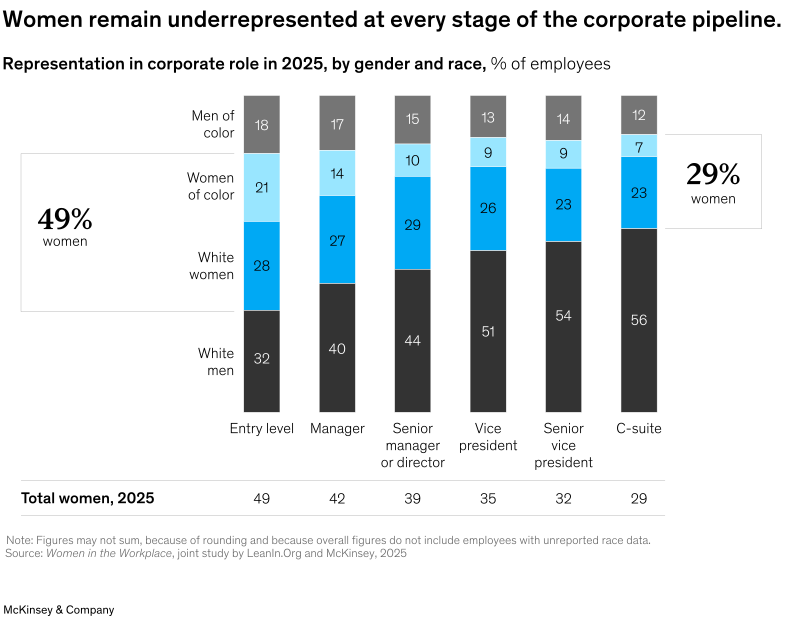
A stacked bar chart illustrates the percentage representation in corporate roles in 2025 by gender and race, highlighting the diminishing share of women at each stage of the corporate pipeline. At entry level, 49% of employees are women (21% women of color and 28% white women), with men of color and white men comprising 18% and 32%, respectively. As roles become more senior, the proportion of women drops: in manager positions, women represent 42% (14% women of color and 27% white women); in senior manager or director roles, 39% (10% women of color and 29% white women); and in vice president positions, 35% (9% women of color, 26% white women). Senior vice president roles show women further declining to 32% (9% women of color, 23% white women), and at the C-suite level, women are just 29% of employees (7% women of color and 23% white women). Throughout, the share of white men increases from 32% at entry level to 56% at the C-suite, while both groups of women see their proportions shrink at each stage, emphasizing the persistent underrepresentation of women—especially women of color—at higher rungs of corporate leadership.
This image description was completed with the assistance of Writer, a gen AI tool.
End of image description.
The “broken rung” at the first step up to manager also continues to hold women back. This year, only 93 women were promoted to manager-level roles for every 100 men. The gap is even bigger for women of color, with 74 women of color promoted for every 100 men (Exhibit 4). As a result, men significantly outnumber women at the manager level, making it difficult for women to catch up.
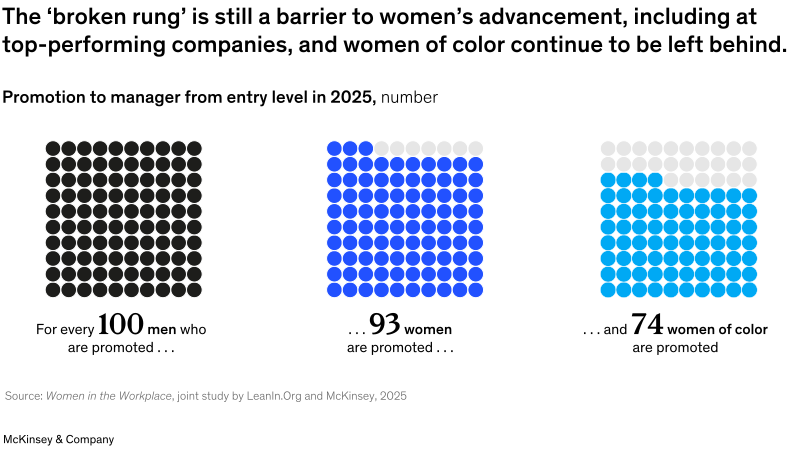
A set of unit charts illustrates the persistent gap in promotion rates to manager from entry level in 2025, emphasizing the metaphorical 'broken rung' that continues to hinder women’s advancement—particularly for women of color. The first chart, composed of 100 black dots, represents 100 men promoted to manager. The second chart, adjacent and comprised of 93 blue dots out of a possible 100, visualizes that only 93 women are promoted for every 100 men, highlighting a clear gender gap at this critical step. The third chart shows an even starker disparity: only 74 blue dots are filled, representing that only 74 women of color are promoted to manager for every 100 men who advance. The side-by-side comparison makes the underrepresentation tangible, underscoring that women—especially women of color—remain significantly less likely than men to be promoted to manager from entry level.
This image description was completed with the assistance of Writer, a gen AI tool.
End of image description.
It’s important to note that the 2025 pipeline data may paint a rosier picture than reality: The companies that shared their pipeline information this year have a higher representation of women than typical companies from 2021 to 2024.1
The share of women in leadership at top-performing companies—those with more women represented throughout the pipeline—is up seven percentage points, on average, since 2021. Meanwhile, low-performing companies have made modest, uneven gains.
Certain best practices are more common at top performers, including having senior leaders communicate that disrespectful behavior isn’t welcome in the workplace, holding senior leaders accountable for advancing diversity and inclusion, and establishing mechanisms for surfacing bias in hiring and promotions. However, the same overall pattern holds true at all companies: Women are still markedly underrepresented at senior levels (Exhibit 5).
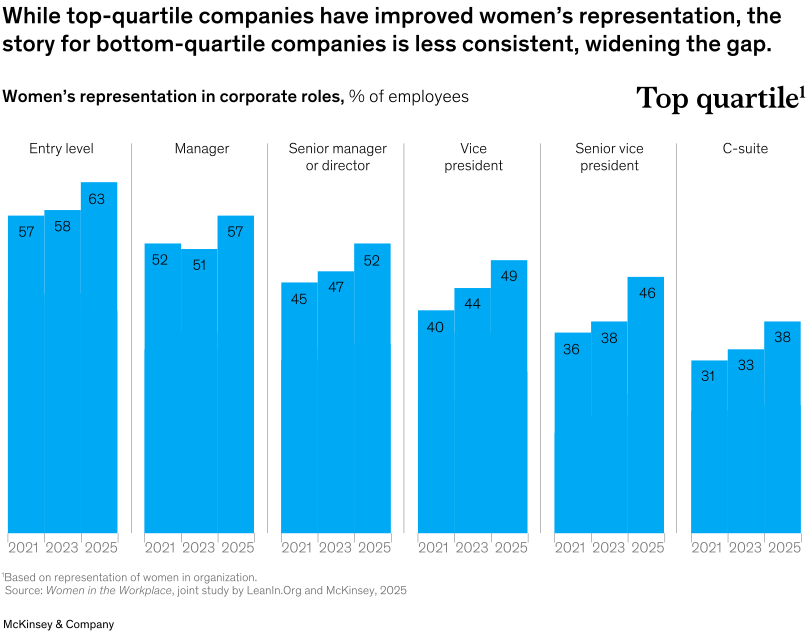
A clustered bar chart displays women’s representation—measured as the percentage of employees—in corporate roles at top-quartile companies for representation, tracking progress over three years: 2021, 2023, and projected 2025. The chart is divided into six corporate levels: entry level, manager, senior manager or director, vice president, senior vice president, and C-suite. Across all roles, the data shows consistent year-over-year growth in women’s representation. At the entry level, the percentage of women rises from 57% in 2021 to 58% in 2023, reaching 63% by 2025. For managers, the numbers move from 52% (2021) and 51% (2023) to 57% (2025). Senior manager or director roles rise from 45% to 47%, then reach 52%. At the vice president level, representation climbs steadily—40%, 44%, and then 49%. The senior vice president tier grows from 36% (2021) and 38% (2023) to 46% (2025). For the C-suite, women’s representation increases from 31% in 2021 to 33% in 2023, and is projected to hit 38% in 2025. The consistent upward trend across all roles illustrates significant improvement at top-quartile companies in advancing women into more senior positions over time.
This image description was completed with the assistance of Writer, a gen AI tool.
End of image description.
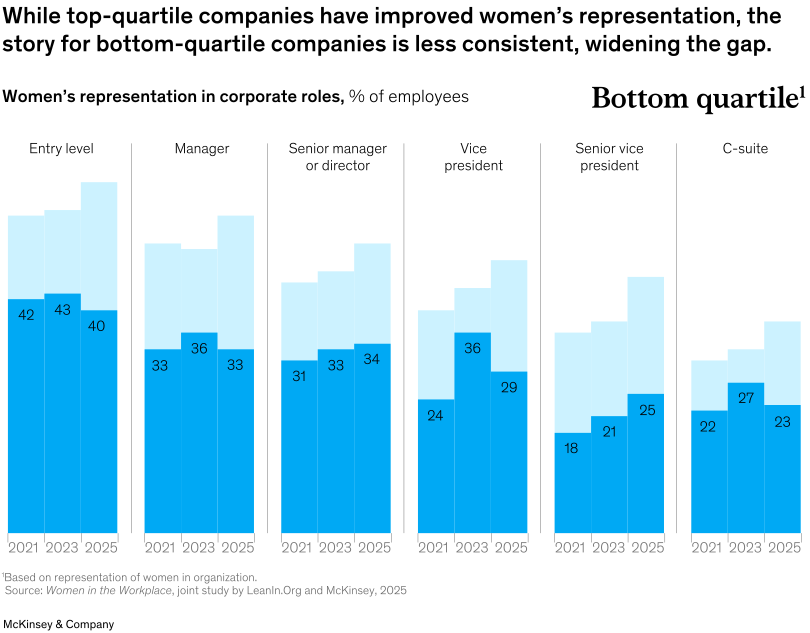
The data for top quartile companies fades to a lighter shade, and the data for bottom quartile companies is layered over top. For the entry level, the percentage is relatively flat, starting at 42 percent in 2021, inching up to 43 percent in 2023, but falling back to 40 percent in 2025. For manager roles, women’s representation is 33 percent in 2021, rises slightly to 36 percent in 2023, then returns to 33 percent in 2025. For senior manager or director positions, the figure is 31 percent in 2021 and increases marginally to 34 percent by 2025. The vice president level shows an increase from 24 percent in 2021 to 36 percent in 2023, but drops to 29 percent in 2025. For senior vice president, women’s representation is lowest overall—18 percent in 2021, 21 percent in 2023, and 25 percent in 2025. The C-suite shows a slow increase from 22 percent in 2021, 27 percent in 2023, and 23 percent in 2025. The chart visually underscores that progress for bottom-quartile companies is inconsistent across years and roles, with occasional gains often followed by declines or stagnation, especially at senior levels.
This image description was completed with the assistance of Writer, a gen AI tool.
End of image description.
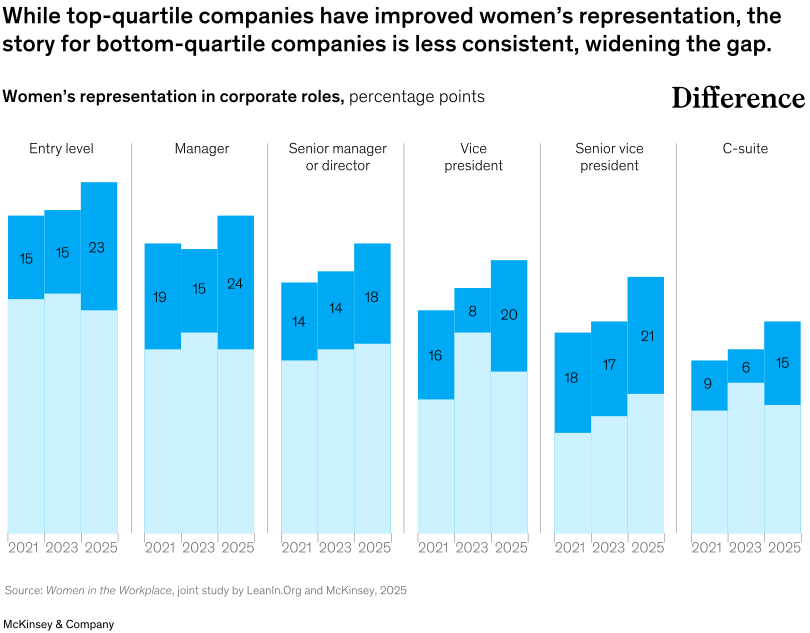
The data for the bottom quartile fades to a lighter shade, and the percentage point gap between bottom quartile and top quartile is highlighted. At the entry level, the gap grows from 15 points in 2021 to 23 points in 2025. For managers, the difference is steady at 19 and 15 points in 2021 and 2023, then jumps to 24 points in 2025. Among senior managers or directors, the gap increases from 14 points in both 2021 and 2023 to 18 in 2025. For vice presidents, the difference grows significantly from 16 in 2021 to 20 in 2025. The senior vice president level shows an increase from 18 in 2021 to 21 in 2025. At the C-suite, the gap starts at 9 points in 2021, dips to 6 in 2023, and then rises sharply to 15 points by 2025. This visualization highlights the trend of increasing divergence in women’s representation across leadership roles, with 2025 showing the largest gaps of the period, especially at the manager, vice president, and C-suite levels.
This image description was completed with the assistance of Writer, a gen AI tool.
End of image description.
Entry-level women are grappling with multiple challenges
Entry-level women in particular face an opportunity gap. Women early in their careers are far less likely than men to be people managers. As a result, far more entry-level men are on a path that can lead to promotion. Our survey revealed that four in ten entry-level women have not received a promotion, stretch assignment, or opportunity to participate in leadership or career training in the past two years.
They are also less likely to have effective sponsorship, to want or receive a promotion, and to feel that they can push back or take risks. They are more worried about how the use of AI will affect their jobs, but also receive less of the support needed to use AI effectively. Only 21 percent of entry-level women are encouraged by their managers to use AI tools, compared with 33 percent of men at their level. This matters because when employees are encouraged to use AI, they’re over 50 percent more likely to do so, allowing them to build essential skills.
Combined with the persistence of the broken rung, a daunting path may lie ahead for women at the entry level. If organizations don’t act now, they risk shrinking the pipeline of future women leaders even further. The result could be a generation of talented women who never make it to the starting line of leadership.
Companies may be at risk of overlooking women
A majority of companies say diversity is a high priority this year, and more than eight in ten remain committed to inclusion. However, commitment to women’s advancement is much lower: Only about half of surveyed companies say women’s career advancement is a high priority, and fewer are prioritizing women of color’s advancement (Exhibit 6). Companies with more women—and where women’s representation is increasing the fastest—are more likely to place a high priority on supporting women at their organization.
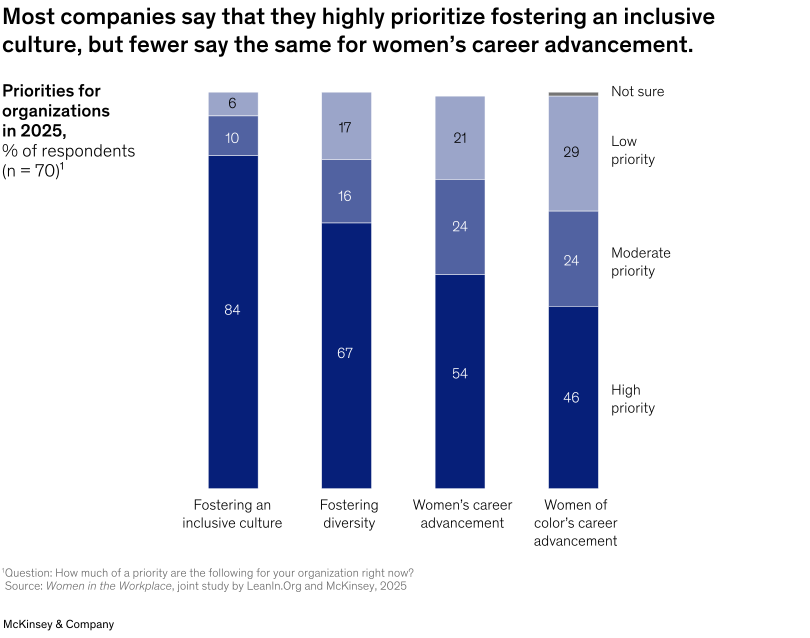
A vertical stacked bar chart compares the percentage of organizations that assign different levels of priority in 2025 to four areas: fostering an inclusive culture, fostering diversity, women’s career advancement, and women of color’s career advancement. The tallest, most darkly shaded bar shows that 84 percent of companies rank fostering an inclusive culture as a high priority, with 10 percent assigning it moderate priority and just 6 percent low priority. The next bar indicates 67 percent of organizations highly prioritize fostering diversity, while 16 percent see it as a moderate priority and 17 percent as low. The third bar highlights a drop for women’s career advancement: only 54 percent of companies mark it as a high priority, 24 percent as moderate, and 21 percent as low. The last bar, for women of color’s career advancement, shows a further decline: 46 percent of organizations view it as a high priority, 24 percent as moderate, 29 percent as low, and a sliver at the top represents a very small share uncertain. The chart visually underscores that, while most companies identify fostering inclusivity and diversity as high priorities, significantly fewer do so for women’s advancement—particularly for women of color.
This image description was completed with the assistance of Writer, a gen AI tool.
End of image description.
When it comes to the prevalence of HR practices in 2025, many companies are maintaining their efforts to support career advancement and foster a supportive work culture. But several changes may disproportionately affect women. While a majority of organizations are continuing to invest in diversity and inclusion, one in six have cut staff or resources.
Moreover, some companies have scaled back or discontinued career development programs with content designed to support women, and there has been a notable decline in remote and flexible work options—which research shows can be especially helpful to women’s success at work (Exhibit 7). Our data show that women who work remotely three or more days per week are less likely to have been promoted in the past two years than men in identical working arrangements.
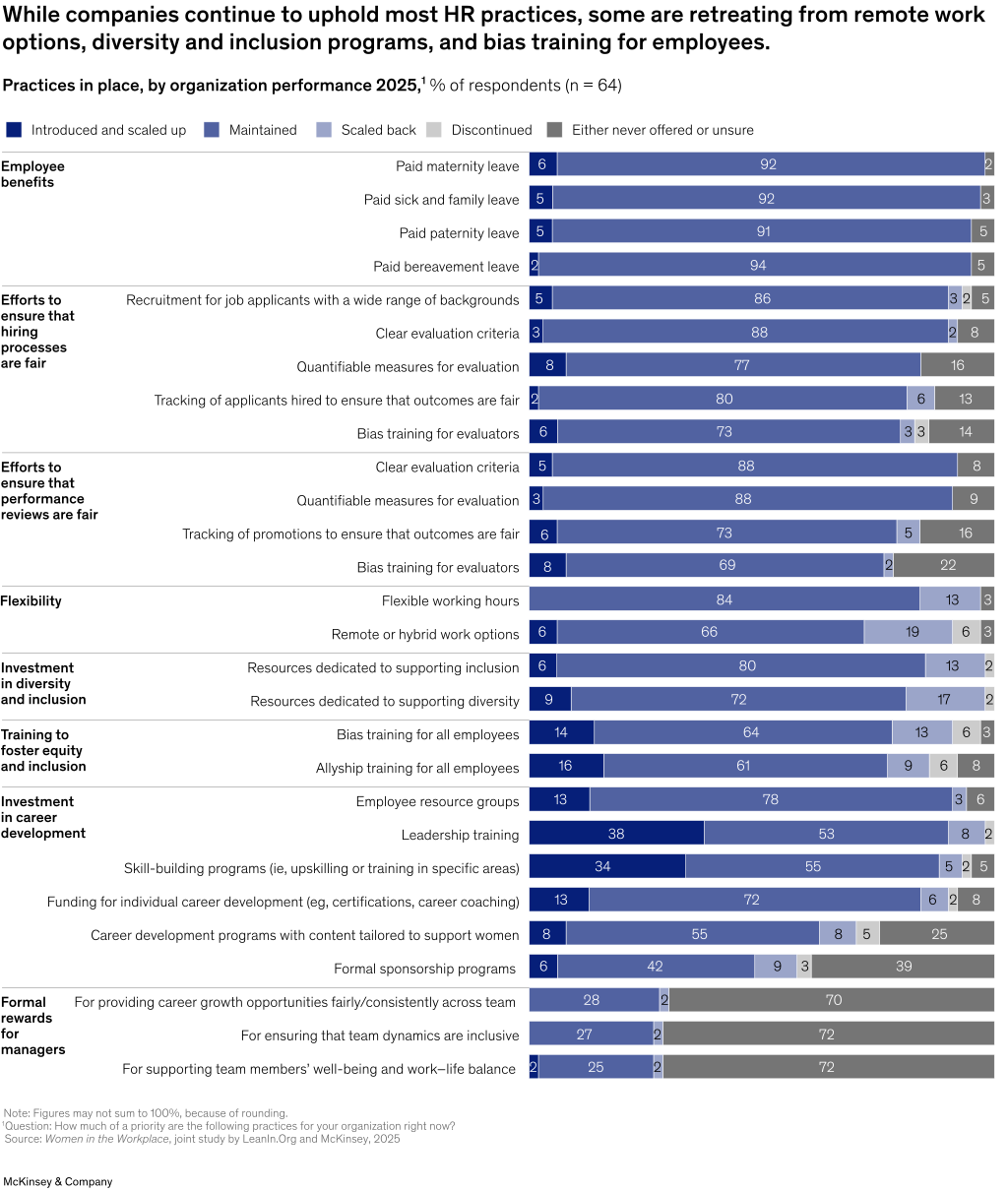
A horizontal segmented bar chart displays the prevalence and recent changes in HR practices across organizations, broken down by categories such as employee benefits, fair hiring and performance processes, flexibility, investment in diversity and inclusion, training on equity, career development, and formal manager rewards. Each bar is segmented to indicate whether a practice has been introduced and scaled up, maintained, scaled back, discontinued, or was never offered/unsure, based on responses from 64 organizations. Practices such as paid maternity and sick/family leave are overwhelmingly maintained (92%), with small shares introduced and scaled up (6%, 5%) and minimal discontinuation. Initiatives related to fair hiring and performance processes, like clear evaluation criteria (88%, 88% maintained) and recruitment of diverse applicants (86%), are also mostly upheld, though bias training for evaluators sees a higher rate of being scaled back or discontinued (14% and 22% for hiring and performance bias training, respectively). Flexibility is largely maintained for flexible working hours (84%), but a notable 19% of organizations have scaled back remote or hybrid work options, with only 6% introducing and scaling them up. Investment in diversity and inclusion shows some retrenchment, with 13% and 17% scaling back or discontinuing resources for inclusion and diversity, respectively, while 6–9% of organizations have scaled up those investments. Bias and allyship training for all employees have particularly high shares of organizations scaling back (14% and 16%, respectively) or discontinuing (19% for allyship), with only 6% or less scaling up. Career development offerings such as leadership and skill-building programs are maintained by more than half of organizations (53% and 55%), but formal sponsorship programs feature the largest share of organizations never offering or unsure (39%). Formal rewards for managers to promote fair growth, team inclusion, or well-being are rarely introduced (2–28%) and largely absent or unclear in most companies (70–72% never offered or unsure). The chart overall highlights persistent support for traditional benefits, but a retreat from remote work, DEI funding, and equity/bias training.
This image description was completed with the assistance of Writer, a gen AI tool.
End of image description.
Interviews with chief HR officers reveal a growing shift in how employee resource groups (ERGs) are structured. Nearly all women’s and other identity-based ERGs are now open to all employees—a move intended to foster inclusivity across the organization. While this approach reflects a broader commitment to belonging, many HR leaders caution that it may dilute the focus on the distinct experiences and barriers faced by specific groups.
“We’re holding ourselves accountable by sharing hiring and representation data with our board on a regular basis.”
— Chief HR officer, technology

The majority of HR executives interviewed express particular concern that as women’s ERGs become less centered on women’s unique advancement challenges, momentum on issues like sponsorship could slow further. This concern is reinforced by the data showing the challenges of sponsorship for women. Without intentional focus, leaders fear that progress in advancing women may stall and further decline.
Recommendations for companies: Build a fair and inclusive workplace
It’s no surprise that when employees view their workplace as fair and inclusive, they thrive. They’re more motivated, more willing to take risks, and far less likely to feel burned out or to consider leaving. These outcomes don’t just lift morale; they drive performance.
Opportunity for advancement is one of the biggest drivers of employee engagement but only when people believe opportunities are fairly allocated and within reach. Inclusion is equally critical: When people feel valued and supported, they’re better able to do their best work. Senior leaders play a key role in the success of fairness and inclusion efforts.
Fairness of opportunity
Three strategies are central to creating fairness of opportunity: ensuring hiring and promotions are fair, equipping managers to support career development, and fostering authentic sponsorship.
Ensure hiring and promotions are fair. Hiring and promotions are the main levers of advancement, and when these processes aren’t fair, companies miss out. High-performing talent may get passed over for a job offer with the organization, or the most talented employees in the company may end up in roles where they aren’t creating the most value. Additionally, employees may lose motivation and become more likely to think about leaving.
Equip managers to support career development. Freeing managers from routine tasks, setting clear expectations for their regular career check-ins, building capabilities to make them effective coaches, and equipping them with tools enable managers to effectively dedicate more time to their direct reports’ career development. Training is one element of capability building, but it’s a finite, transactional moment. Capability building, by contrast, demands repeated chances to apply, refine, and evolve behaviors in real situations so that inclusion becomes an embodied, everyday practice. And in an era of rapid AI adoption, it’s critical that managers give women and men equal support in using AI. Currently, men receive more encouragement to use AI tools, while women are more likely to miss out, particularly at the entry level.
Foster authentic sponsorship. Authentic sponsorship goes beyond formal matching programs; it’s about leaders who actively advocate for talent, open doors to new opportunities, and invest in the growth of others. Organizations can strengthen formal sponsorship programs by creating clear roles, commitments, and structures while also training sponsors and “sponsees” to build effective, trust-based relationships that lead to real opportunities. They can also further expand access to informal networks to help junior employees connect with senior colleagues and potential sponsors.
An inclusive culture
Three strategies are central to creating an inclusive culture: articulating a positive vision of an inclusive culture, strengthening ERGs to foster community and empathy, and activating employees to create inclusion day to day.
“Our journey on inclusion and belonging was the right one. Investing more has provided a competitive advantage for our organization.”
— Chief people officer, healthcare

Articulate a positive vision of an inclusive culture. Inclusion reflects how much people feel supported and how meaningfully they can contribute. Inclusion starts with a clear, well-communicated vision backed by concrete actions. In many industries, women are still too often “the only woman in the room.” These “onlys” face a tougher reality: They’re more likely to feel excluded, scrutinized, and under pressure to represent their entire gender—challenges their peers rarely experience.
Strengthen ERGs to foster community and empathy. Decades of research show that ERGs—traditionally organized around shared identities—play a powerful role in helping employees feel connected to their colleagues and their company. Since women tend to have less access to senior-level networks and manager career support, the career advice and practical support offered by ERGs can help to level the playing field.
Companies can ensure that ERGs are well resourced and fully integrated into the company, set ground rules to create trust, and broaden ERGs to include shared interests and purpose. Organizations are piloting purpose-driven ERGs that bring employees together around shared goals, building empathy through collaboration.
Activate employees to create inclusion day to day. Every employee, at every level, has the power to shape the culture around them. When inclusion is lived, not just led, it transforms how teams connect, create, and perform. Small, everyday actions—such as inviting new perspectives, calling out disrespect, and showing empathy—can spark big change, driving stronger collaboration and smarter decisions. Yet many employees hesitate because they’re unsure where to start. That’s where leaders and organizations play a critical role. When leaders set expectations, provide practical tools, and model inclusive behaviors, they turn inclusion from an abstract ideal into a shared daily practice.
Decades of research show that inclusion drives better outcomes: It’s associated with higher motivation and loyalty to the company, and it fuels business outcomes like productivity and innovation. There is work to do to create a workplace experience that feels fair to women.
The good news is that companies have an extraordinary opportunity in front of them. The actions that matter most are within every company’s control: prioritizing fairness, investing in inclusive leadership, strengthening connection, and empowering employees to make inclusion real in their daily interactions. These steps may seem small, but together, they reshape the workplace experience.
As AI continues to transform the workforce, leaders must ensure that all employees, including women, have equal access to support, encouragement, and the tools needed to thrive in a rapidly evolving environment. By addressing bias in AI systems and intentionally investing in inclusive leadership, fairness, and connection, companies can unlock the full potential of their people and the technology they adopt.
The next chapter of progress for women in the workplace will depend on choices leaders make today. If organizations commit to building environments where women are encouraged to pursue their ambitions, the payoff will extend far beyond fair opportunity for women. It will create workplaces that work better for everyone—places where all employees can grow, contribute, and chart futures filled with possibility.



The authors wish to thank Aanchal Subba, Akosua Ofori, Alison Gonzalez, Amy Kim, Anushaa Das, Barbara Tierney, Camille Shen, Charmaine Rice, Claire Fogarty, Debra Goodson, Doris Lynk, Elaine Soh, Emily Spittle, Hannah Lee, Huilin Zeng, Isha Gupta, Jacquie Hudson, Jennifer Onofrio, Jonathon Rivait, Lareina Yee, Laura Pineault, Mallory Smith, Margret-Ann Natsis, Nathan Wilson, Nina Li, Oliver Teng, Olivia Bewley, Priyanka Krishnamoorthy, Raghav Singh, Richard Johnson, Robyn Freeman, Ruhani Khanna, Sarah Tung, Susan Reed, and Tara Haase for their contributions to this article.