Over the past 15 years, the Philippines has proven its resilience. The economy has expanded by an average of 5.3 percent per year since 2010; unemployment fell to a record 4.3 percent in 2024; poverty declined from 16.7 percent in 2018 to 15.5 percent in 2023; and gross national income (GNI) per capita has more than tripled since 2000 to reach $4,470 in 2024—just shy of the World Bank’s upper‑middle‑income threshold.1 These are real achievements that reflect a young workforce, steady domestic demand, and an economy that withstood shocks. Yet resilience by itself will not define the next chapter. The strategic imperative now is to become relevant: to accelerate, compete, and export at scale so the country can reach high‑income status in the 2045 to 2050 window.
The growth math: Why productivity must lead
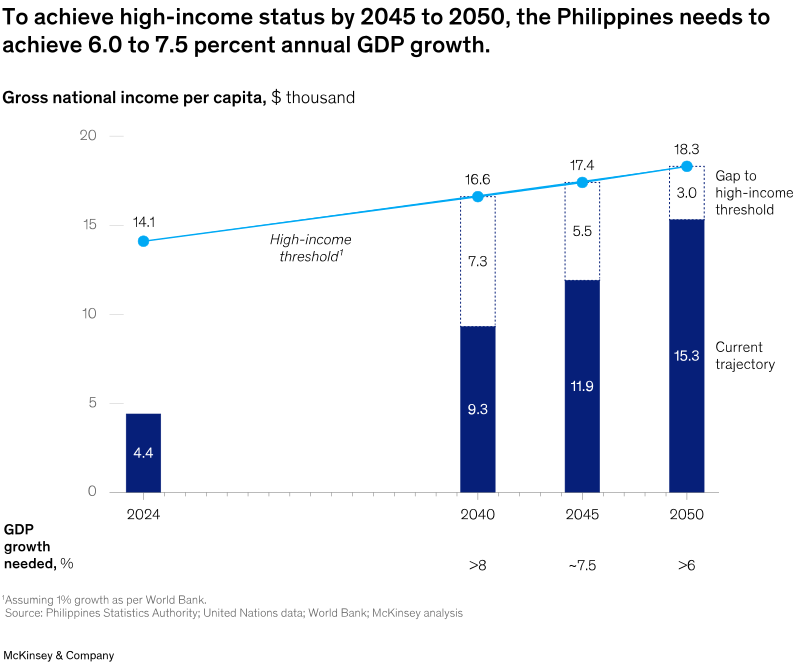
The national vision is clear: a thriving middle class and high‑income status by 2040. On current trends, however, the country would reach only $9,300 per capita income by 2040—well short of the threshold, which is likely to rise toward $16,600 by then. Closing the gap by 2045 or 2050 requires sustained GDP growth of roughly 6.0 to 7.5 percent for the next two decades—an ambition within reach if the growth engine shifts decisively from participation and capital deepening toward productivity and tradables (Exhibit 1).2
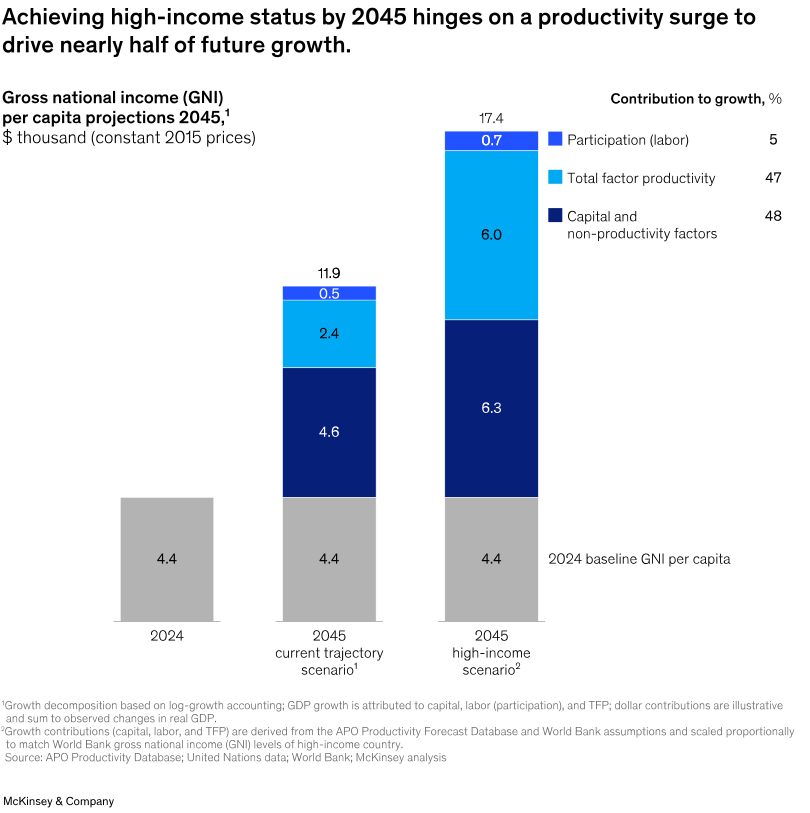
In the high‑income trajectory, total factor productivity (TFP) would need to account for nearly half of growth by 2045 (Exhibit 2).
The comfort trap: Inward-focused growth and participation-led expansion
The economy’s center of gravity is domestic. Household consumption accounted for approximately 72.5 percent of GDP in 2024, supported by employment and remittances of about $40 billion annually.3 But this inward orientation has limited investment, exports, and productivity pressure. Since 2010, most new jobs came from nontradables (retail, construction, and local services), while manufacturing employment stagnated at 8 percent of the workforce.4 The export‑to‑GDP ratio slipped from 33 percent to 27 percent (2010 to 2023), leaving the Philippines trading below its income peers;5 Vietnam now exports nearly five times more in value.6 Without a stronger export engine, growth will likely cap below what is needed to converge.
A second constraint is the fading demographic dividend. The working‑age share will peak around the early 2030s as fertility drops below replacement. Unless productivity rises meaningfully, the country risks “growing old before growing rich.” Historically, productivity has contributed only about 10 percent to GDP growth over the last 35 years—too low to power a transition.7
A strategic pivot: From home to the world, from ‘more’ to ‘better’
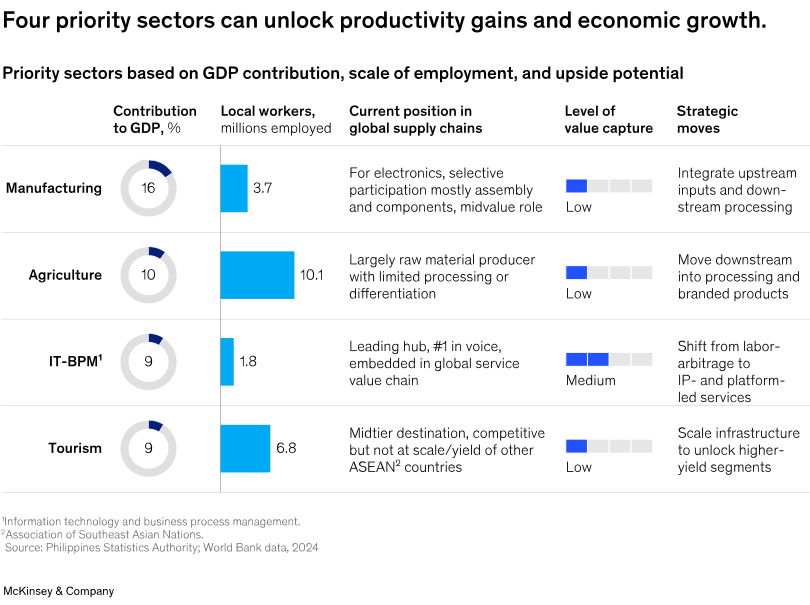
Countries that vaulted to high‑income status grew exports two to three times faster than GDP during their acceleration.8 A feasible ambition for the Philippines is to double exports as a share of GDP—from around 27 percent today to over 50 percent by 2040—anchored in sectors that are tradable, labor‑absorbing, and materially underperforming their potential. Four priority engines can unlock the shift: manufacturing, agriculture and the blue economy, information technology and business process management (IT-BPM), and tourism (Exhibit 3).
1. Manufacturing—move from assembly to advantage
Manufacturing remains approximately 16 percent of GDP and at around four million jobs, but its export intensity and value‑added share have declined.9 Electronics—58 percent of merchandise exports—are concentrated in assembly, test, and packaging (ATP), where value capture is limited (about 10 percent of the chain).10 With global supply chains diversifying, the Philippines can step up by: expanding into advanced packaging and test R&D; building robust supplier ecosystems (printed circuit boards [PCBs], sensors, equipment components, and materials); lowering structural costs (power and logistics); and streamlining permits, incentives, and tax administration. Done well, manufacturing could again become a high‑wage job creator with strong productivity spillovers.
2. Agriculture and the blue economy—shift from subsistence to value creation
Agriculture employs 21 percent of workers but contributes only about 10 percent of GDP; an average agricultural worker produces roughly one‑sixth the output of a manufacturing worker.11 The opportunity is to wire smallholders and fisheries into integrated, value‑added chains: Invest in processing and cold chain; scale aquaculture and seaweed into higher‑value exports (for example, carrageenan extracts); and enable technology adoption and scale through cooperatives, contract farming, agribusiness zones, mechanization, irrigation, and digital platforms. The prize would be productivity‑led inclusion: higher rural incomes and substantial tradables growth.
3. Information technology and business process management—evolve from voice to AI‑enabled capability hubs
With approximately 1.8 million jobs and $38 billion in revenue, the sector is a national standout—but around 80 percent of revenue still comes from voice and routine back‑office work, the very segments most exposed to automation.12 The next S‑curve lies in high‑value, AI‑enabled services: data and analytics, cloud, cybersecurity, software, digital design, and complex managed services. Imperatives include aggressive reskilling (AI operations, data, security, and engineering), moving from labor arbitrage to domain‑plus platform capabilities, and deepening long‑term client partnerships. This transition could reposition the country from the world’s call center capital to a regional digital talent and innovation hub.
4. Tourism—turn natural assets into an export industry at scale
Despite world-class beaches and culture, international arrivals rank sixth in Southeast Asia and remain below prepandemic levels (5.9 million in 2024 versus 8.3 million in 2019).13 With targeted execution—airport and interisland connectivity, streamlined visas and safety, and scaled accommodations—arrivals could reach 15 to 20 million by 2040, spreading growth beyond Metro Manila and creating thousands of direct and indirect jobs per additional million visitors.
Four economy‑wide enablers to make growth stick
Sectoral bets could benefit from cross‑cutting enablers. Four stand out.
Power and logistics
Electricity costs (approximately $0.22 per kilowatt hour [kWh]) and uneven reliability compress margins and deter investment; logistics consumes an estimated 28 percent of GDP, reflecting gateway bottlenecks, fragmented interisland shipping, limited rail freight, and last‑mile gaps.14 Reforms are underway, with retail power liberalization and foreign ownership opening in renewables. Priorities: Scale competitive renewable capacity to lower costs and boost reliability, expand and modernize ports and airports beyond Manila, liberalize interisland shipping, and complete a handful of freight corridors that connect production centers to gateways.
Human capital
No lever matters more. Today’s Filipino child is projected to achieve about 52 percent of potential productivity by adulthood; ten‑year‑old learning poverty stands at 90 percent; and the Programme for International Student Assessment (PISA) and Trends in International Mathematics and Science Study (TIMSS) scores have declined.15 The agenda: Upgrade foundational learning at scale (literacy, numeracy, and digital); elevate teacher quality; modernize curriculums; expand technical and vocational educational training (TVET); strengthen STEM pathways; and codesign programs with industry for manufacturing, digital services, and advanced agriculture. Health and nutrition investments—especially maternal and primary care—compound returns over generations.
An open, predictable business climate
Regional Comprehensive Economic Partnership (RCEP) membership creates opportunity, but utilization is uneven—especially among small and medium-size enterprises (SMEs).16 To lift exports and foreign direct investment (FDI) from 2 to 3 percent toward 4 to 5 percent of GDP, the country could streamline customs, reduce nontariff barriers, strengthen investor protection, and digitalize permits with time‑bound approvals. The North Star: speed, predictability, and competition that turn infrastructure into factories and skills into jobs.
AI as an accelerator
With clear policy intent (an updated National AI Strategy incorporating gen AI and a Center for AI Research), broad adoption could lift GDP by up to 12 percent by 2030, with gen AI alone potentially unlocking about $79 billion in productive capacity.17 The practical path: Scale digital infrastructure, close skills gaps at pace, enact fit‑for‑purpose data governance, and prioritize sectoral lighthouse use cases in manufacturing, IT‑BPM, logistics, and public services.
The decade to build
If the Philippines raises productivity by 30 to 40 percent over the coming decade and doubles exports’ share of GDP, it could meaningfully uplift incomes, attract larger and more stable FDI, and create better jobs across regions and skills levels. The transition would have visible outcomes: export growth outpacing GDP, a rising share of high‑value services in IT‑BPM, greater domestic value capture in electronics and agrifood, more balanced regional development through tourism, lower power and logistics costs, and rising learning outcomes.
This is the decade to build—turning demographics into development and resilience into relevance. The ingredients are in place: a large, young, English‑speaking workforce, an established services base, renewed opportunities as supply chains rewire, a reform agenda already opening key sectors, and powerful new tools in AI. What is needed now is execution at pace and scale: a national program to compete in tradables, compress the cost of doing business, and lift skills for an AI‑enabled economy. Resilience built the floor. The choices made in the next five to ten years will decide the ceiling—and whether the Philippines breaks through.