As the focus on Asia’s dynamic economy grows, so too has the business world’s fascination with the region’s most successful entrepreneurs and business builders.
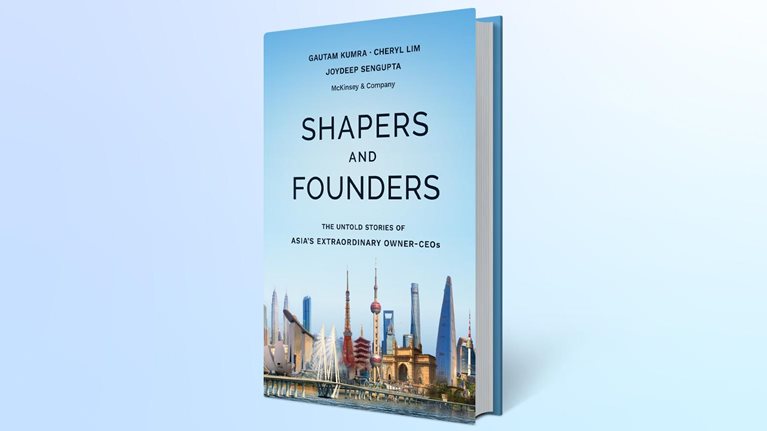
Shapers and Founders: The Untold Stories of Asia’s Extraordinary Owner-CEOs, a new book by McKinsey, illustrates how retaining their entrepreneurial edge and bringing the right people into the organization has allowed them to manage the difficult task of cultivating the speed, principles-based decisiveness, bold thinking, and challenger mindset that are needed in the modern marketplace.
In this episode of the McKinsey Future of Asia Podcast series, Jennifer Chiang talks to one of the authors of the book, Gautam Kumra. An edited version of the conversation follows.
Jennifer Chiang: Who is this book written for?
Gautam Kumra: It will be relevant to various audiences. As the world’s center of gravity shifts toward Asia, there’s a lot of interest in understanding the region, which consists of a fragmented set of heterogeneous markets. First, a Western audience might like a glimpse into what it takes to create value out of Asia. So, it’s going to be relevant to Western leaders, especially CEOs competing with Asian owner-CEOs and who want to collaborate with them. It will also be relevant to students and other leaders because there are lessons about how to lead a successful and fulfilling business life in Asia.
Jennifer Chiang: The book discusses six behaviors that owner-CEOs practice. How did they manage to stay true to their convictions and ambitions? What was their perspective on scaling without losing soul?
Gautam Kumra: They recognize that having an entrepreneurial core made them successful. As they scale their businesses, they recognize the need to bring in more professional talent and to put more structure in place. However, they want the muscle of entrepreneurship without creating bureaucratic complacency.
An example is what Sanjiv Bajaj has done at Bajaj Finserv. Out of virtually nothing, and in a relatively short period of time, they created one of India’s most valuable diversified financial conglomerates. Sanjiv talks passionately about accountable empowerment, constantly breaking the organization into smaller teams, delegating decision-making down to the customer-facing frontline, and pushing back against overcentralization. His simple yet nimble people management and performance evaluation allow scaling without bureaucracy.
Another example, Mukesh Ambani, is known for saying the scale of their ambition is more than the size of the egos on his team. There is no room for politics. They collaborate across functions and silos to feel like a small nimble company.
Jennifer Chiang: CEO-founders in Asia have achieved great success in a somewhat counterintuitive way, which I find fascinating. Why do you think that is?
Gautam Kumra: What differentiates them is their ability to operate in the traditional, hierarchy- and consensus-driven Asian market ecosystems, yet move with speed and decisiveness, which is not an easy task when scaling. In the book, we discuss their ability to scale without losing their entrepreneurial core, which involves being principles-based, speed- and decisiveness-oriented, bold in thinking, having a challenger mindset, and recognizing the need for bringing professional [talent] into the company, too.
Of course they listen to all constituencies, but then they move fast and decisively, being bold but not reckless. In my view, all these elements together form the entrepreneurial core of who these successful founder-CEOs are. As they scale their organizations and need to bring in professionals, it can obviously be challenging not to lose that entrepreneurial core. So, for them it is very important to manage this constant tension, no matter how big the business. And that's why we talk in this book about how to scale without losing that soul.
Jennifer Chiang: Would professional CEOs who run very large established organizations or even aspiring CEOs be able to gain insights from this book? What are some obstacles they might face in their careers as compared to owner-CEOs?
Gautam Kumra: I think many excellent professional CEOs already embody a number of these principles. For example, their approach to innovation. Many excellent CEOs around the world will simultaneously drive continuous improvement and look for opportunities to disrupt the market. One [difference] is the length of the timeframe, because when you’re an owner-CEO not about to sell your company, you can almost think in perpetuity, including about the next generation. That’s hard to replicate if you’re a professional CEO hired on a contract with a specific term.
The second thing that is not easy to replicate is the speed of decision-making, because professional CEOs have stakeholders. Any major consequential decision must be endorsed by the management team and approved by the board, while a majority shareholder or owner-CEO is often able to carry that kind of decision much faster because of their position—their ownership. The best owner-CEOs will draw great ideas from the board, but they’re not dependent on the board as much as a professional CEO is.
Shapers and Founders
Jennifer Chiang: In the Asian business landscape, family-owned businesses are prevalent, making succession important. What is your opinion on this?
Gautam Kumra: Owner-CEOs have a unique challenge. They must manage the transition of their business, but also manage the transition in relation to their family. Professional CEOs don’t have to worry as much about the family aspect. I think all the founders we interviewed have a deep desire to build a legacy that will outlast them. Looking for who will replace them can be complicated. It can either be someone in the family or looking for a professional CEO. Each option comes with its own unique pros, cons, and challenges. Unlike professional setups, the transition from an owner-CEO to the next generation usually takes much longer.
Then there is a second, largely parallel, stage about how to build an institution that would outlast a founder. Its many elements include governance and developing a pipeline of managers and potential board members, a culture that can stand multiple generations, and a good performance ethic with clarity around decision-making and performance management.
Jennifer Chiang: You have known many of the founders interviewed for this book for a long time. During the research, did you gain any new knowledge about them?
Gautam Kumra: A few things surprised me. I thought some of them were big risk takers because they’re entrepreneurs and they’ve done some unusual things. For example, Mukesh Ambani put $25 billion into building Jio, which was a capital-intensive bet to get into a new industry at a time when they had no position in [that sort of] business.
However, when you ask these owner-CEOs about taking such big risks, they don’t think it was reckless. They say they had thought through the worst-case scenario. One interviewee said, “If I don’t lose my capital, I’m willing to lose some profit.” Another said, “I’m willing to lose some money, but I’m never going to lose my reputation.” When listening to their stories, I felt I was talking to people who have a much more nuanced and calibrated sense of risk taking. They are not taking reckless risks. They know they can survive the worst case. I was surprised about the way they think about that.
I was also surprised by their amazing ability to get extraordinary performance out of seemingly ordinary people, and that they are not persuaded by what I would call “resume value”—the institutions you went to, your academic pedigree—typically how multinationals would hire people. Frankly, the owner-CEOs are looking for a can-do attitude. One of them said, “I hire for character, not competence.”
I'm also amazed by their relentless drive to build their business and become better at what they do. For example, Mukesh Ambani at Reliance has taken [his father’s business] to a completely different level. He learned from his father that it’s not about creating billions of dollars for yourself, but to create an impact on billions of people in India. That scale of ambition really struck me, as well as the transformation of their portfolio. They have strategically advanced the company to align with the needs of India. Going from capital-intensive oil and gas businesses to investing in consumer businesses, then new energy businesses, and now embracing AI, they have shown that even elephants can dance, and at a big scale. They balance this ambition with constant and strong purpose-led short-term execution. They embody the value of time and have managed to get extraordinary performance by making people feel part of the family and part of the Reliance ecosystem of making the impossible possible.
Jennifer Chiang: I think one of the extraordinary experiences of researching and writing this book was going behind the scenes into the mindsets of these extraordinary leaders.
Gautam Kumra: I had the good fortune when I started my career at McKinsey more than three decades ago to work with these owner-CEOs. I found that they are actually quite relationship driven. They recognize that, at the end of the day, companies don’t do business, people do. And their ability to make a decision fast and act on it is very satisfying to work with. It’s been a fascinating journey to observe how these people do it. And I think many of their principles are also relevant for us as owners at McKinsey.
Jennifer Chiang: Collating the research for the book enabled us [to] discover that they are one of the most resilient groups of people and are willing and able to deal with ambiguity. I think we are on the cusp of a complete transformation of the way we do business. The book presents the wisdom these extraordinary founder-CEOs have accumulated over many years, and provides a glimpse into their view of the world. I think it’ll be very rewarding to watch them navigate their organizations into the future for many years to come.
Gautam Kumra: You raise a very important point. I am much more confident in the ability of this set of owner-CEOs to navigate the future than almost any other category of CEOs. I’ll tell you why. The level of uncertainty in the world has never been higher and will likely become even more so, increasing the need to move with speed and agility. So, when you combine the ability to navigate an uncertain environment and move at speed with continuous learning and decision-making, I think these owner-CEOs are well positioned to thrive in this new AI era.