Asia’s owner-CEOs punch above their weight. Over the past two decades, they have accounted for nearly half of the value created among the top decile of Asian companies, outperforming every other ownership category. Noticing this pattern over recent years, partners at McKinsey’s Center for CEO Excellence interviewed 30 of the top owner–CEOs in Asia to find out why.
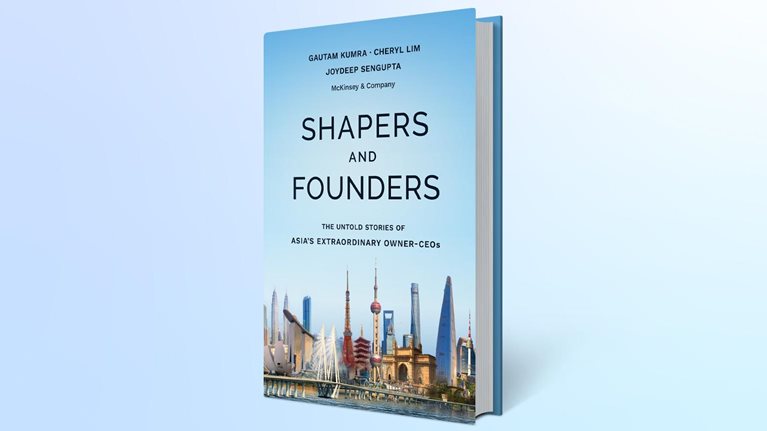
They uncovered a consistent set of behaviors and traits, despite the founders’ differing backgrounds and the diversity of the region. These findings have been distilled into a soon-to-be published playbook, Shapers and founders: The untold stories of Asia’s extraordinary owner-CEOs, aimed at helping global entrepreneurs, CEOs, investors, and board members build top-performing entities while leading with humbleness and joy.
In this episode of the McKinsey Future of Asia Podcast series, Jennifer Chiang talks to one of the authors of the book, Cheryl Lim. An edited version of the conversation follows.
Jennifer Chiang: Hello, everyone. I’m Jennifer Chiang, a director at the McKinsey Center for CEO Excellence, based in McKinsey’s Taipei office. I’m also a core part of the team for the upcoming book. In this episode, I speak to Cheryl Lim, one of the coauthors. Cheryl is a partner in the Kuala Lumpur office, where she also serves on the founding team of the McKinsey Center for CEO Excellence. Welcome, Cheryl.
Cheryl Lim: Thanks, Jen.
Jennifer Chiang: Cheryl, what led to the research underpinning this book?
Cheryl Lim: The genesis of the book stemmed from the work we do at the McKinsey Center for CEO Excellence. When we founded the center about four years ago and started working with CEOs across different regions, we noticed there were commonalities in the trends and traits of those in Asia.
Then, once we had decided to bring out the book, we began looking at the top companies globally, trying to understand which companies have been major value creators over the past two-plus decades. Deep-diving into Asia, we looked at company archetypes and discovered that companies driven by founders and entrepreneurs have a disproportionate impact in terms of value creation. We started wondering whether there is something inherently different about the Asian context and whether owner–CEOs are fundamentally different from professional CEOs.
Jennifer Chiang: For you personally, what findings stood out that you’ll take with you as you lead?
Cheryl Lim: I found it interesting that there are some consistent traits, even though Asia is so vast, with a diverse range of backgrounds, age groups, and ethnicities. We have a chapter in the book in which we talk about the traits that bind the founders, but there are a few that struck me in particular.
The first one is the degree to which these founders are so curious about life and the people around them. They are continuous learners who believe that they can learn from anyone. This is not just a personal philosophy; it’s one they try to embed in their respective organizations as well. I think this speaks to their humility and the recognition that they’re not always the smartest person in the room.
They are amazing relationship builders. These founders know that you don't succeed on your own but with the network of people you build around you, your immediate teams, as well as your stakeholders and partnerships.
And then there’s their vast energy. I was struck by how these founders are doing work that they derive joy and energy from. They take such joy in their work. Increasingly we say we need to manage energy above time, doing things that recharge and drive us. For these founders, joy in work is a clear source of renewal for them. Pretty much all of them said the same thing: There is one life. They see no delineation between work and life.
Another thing is that they can hold contradictions in their minds. They can take a big-picture, long-horizon view along with a microscopic view of day-to-day work. They make big bets and, because of their disciplined stress-testing, they are able to take something that seems like a crazy bet and make it tangible and manageable. They are also very thoughtful about where to spend their time and how to move the needle.

Shapers and Founders
Jennifer Chiang: Tell me about a conversation with one of the founders that has stayed with you.
Cheryl Lim: It’s hard to pick just one because there are so many amazing stories. I was struck that, despite the fact that they are giants in their industries, these people are incredibly humble. One, for example, when asked what he would like to be remembered for, he said, “I won’t have a tombstone since I’m Hindu, but if I had an epitaph on my tombstone, I would like it to say, ‘He built a company in which people were the best they could be.’” That was such a powerful statement. It is amazing that for all this man has achieved, this is he how he wants to be remembered.
I think that is something to be considered globally, because there’s a talent crunch. Things are changing so much that it is essential we support and unleash the power of our people.
In fact, Jen, I would love to hear what story stuck with you.
Jennifer Chiang: The stories that have stayed with me the most are always the more personal ones. I was struck by the fact that many of these founders started from humble beginnings. We sometimes forget the childhood stories that shaped them and gave them those universal traits. They had the hunger, but there was also the commitment and sacrifice that their families undertook for them to reach their goals.
For example, one of the founders’ mothers took him and his brother to the United States to pursue an education. She stayed while they were studying, even though she couldn’t speak English. This gave him such a sense of gratitude and allowed him to be able to marry Western and Eastern philosophies, which became a unique management style.
Cheryl, both of us are women leaders. In the book, out of the 30 interviewees, there were only three women founders. Can you comment on that?
Cheryl Lim: The reality is that the pool of female CEOs in general is small, and the number of female founders is even smaller. There are many reasons for this, from societal expectations and caregiving responsibilities to structural barriers in terms of access to funding or entrepreneurial opportunities.
That said, the number of female interviewees we had for the book does roughly track global norms. Women remain underrepresented at every level of the corporate pipeline. The challenge now is to ask, “How do we keep making it easier, not harder, for talented women to achieve success?”
The lessons from the book are not gender specific because work is what gives all these founders purpose. However, women often have to execute these behaviors under very different circumstances. They still carry a dual burden of a disproportionate share of family and caregiving.
If there is a message for aspiring female CEOs, it’s not that you need to work harder, nor that you need to sacrifice more; it’s about being intentional. We discovered that the founders we worked with are very intentional about where they invest their time, where they get their energy from, and how they build support systems around them.
Jennifer Chiang: Thank you so much, Cheryl, for being with us on the podcast today. We hope readers have got a glimpse into what the book is about and that everyone has a chance to read the book.