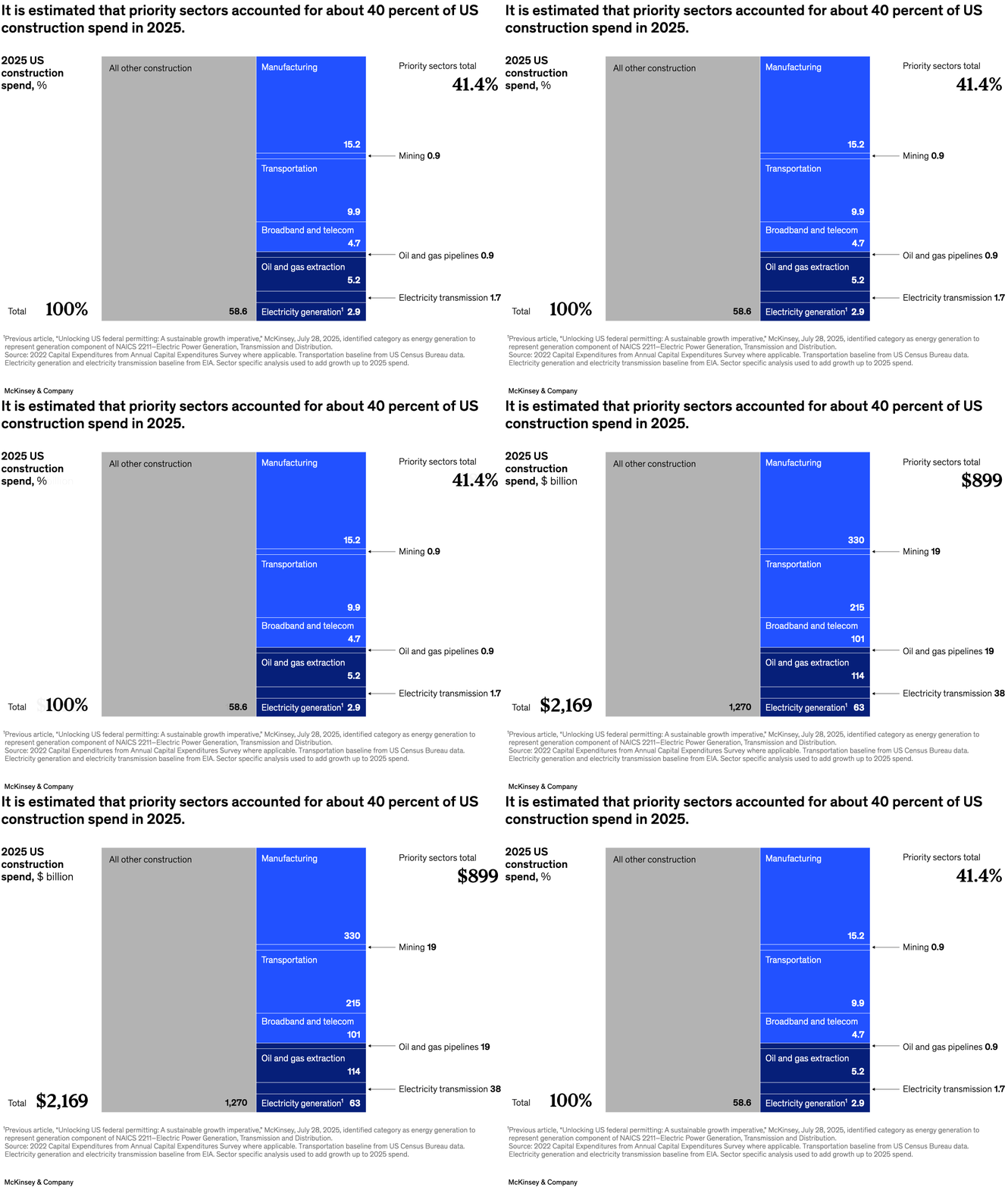
In the United States, projects requiring federal permitting are concentrated in eight sectors that accounted for an estimated $900 billion in construction underway in 2025. That’s about 40 percent of the approximately $2.2 trillion total. Permitting delays ripple unevenly across states depending on their industry mix. In a permitting-constrained market, companies that treat permitting risk as seriously as they treat construction risk will convert capital into productive assets fastest—and the competitive edge may come from pipeline clarity, not pipeline size, note McKinsey’s Bob Sternfels, Adi Kumar, Daniel Ahmoye, Eric Kutcher, Jose Luis Blanco, and coauthors.
Image description.
Two-panel chart showing estimated US construction spending in 2025, initially as percentages and then as dollar values, with an animation transitioning between the two views. Priority sectors account for 41.4% of total construction spending, equivalent to $899 billion of $2.17 trillion. Manufacturing represents the largest priority sector at 15.2% ($330 billion), followed by transportation at 9.9% ($215 billion), oil and gas extraction at 5.2% ($114 billion), broadband and telecom at 4.7% ($101 billion), and electricity generation at 2.9% ($63 billion). Electricity transmission accounts for 1.7% ($38 billion), while mining and oil and gas pipelines each account for 0.9% ($19 billion). All other construction represents 58.6% ($1.27 trillion). The animation alternates between percentage and dollar-value views while retaining the same sector breakdown.
Source: 2022 Capital Expenditures from Annual Capital Expenditures Survey where applicable. Transportation baseline from US Census Bureau data. Electricity generation and electricity transmission baseline from EIA. Sector specific analysis used to add growth up to 2025 spend.
End of image description.