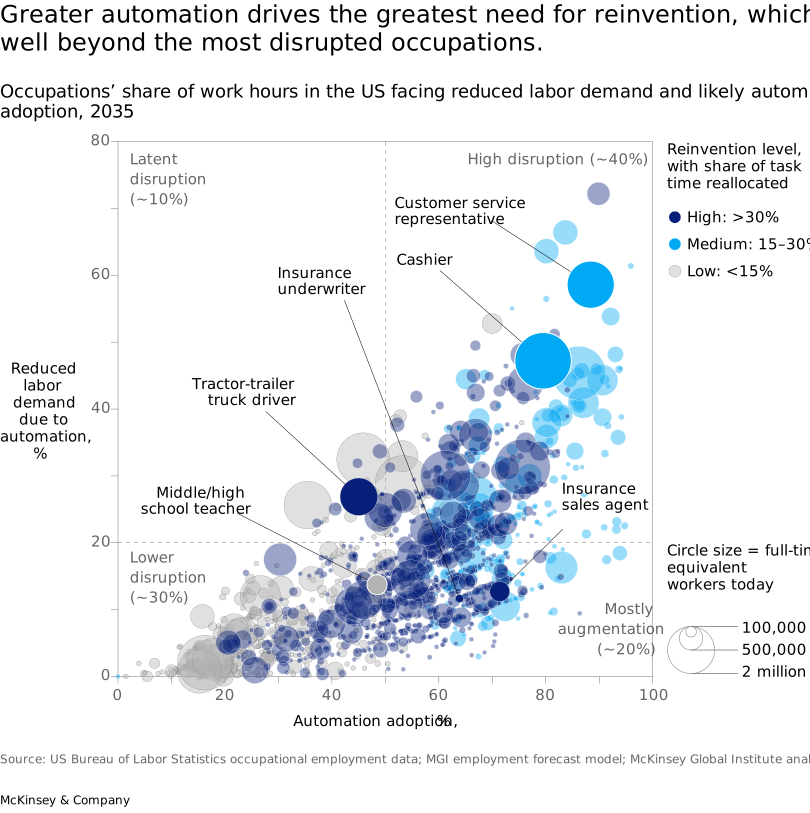
AI and automation are reshaping the US workforce, and they could propel changes in job responsibilities even where employment remains stable, grows, or declines. McKinsey’s authors Maria Jesus Ramirez, Kweilin Ellingrud, Tanguy Catlin, Anna Kortis, and Diego Castresana find that more than 70 percent of US workers could need to reinvent how they work as automation changes the mix of tasks they perform. About 25 percent of workers could see more than 30 percent of their task time reshuffled or shifted to new ones. Workers who learn how to collaborate with AI systems and redesign workflows may increase their job mobility as technology improves.
Image description.
Exhibit 1
Image description:
A square scatterplot shows an array of about 1,800 circles of various sizes, mostly clustered in a band from the bottom left to the top right. It plots individual occupations' share of work hours in the US facing reduced labor demand and likely automation adoption in 2035. The horizontal axis shows automation adoption from 0 to 100 percent and the vertical axis shows reduced labor demand due to automation from 0 to 80 percent. Bubbles are grouped by reinvention level: high reinvention above 30 percent task time reallocated, medium reinvention 15 to 30 percent, and low reinvention below 15 percent. Reference lines at 50 percent adoption and 20 percent reduced labor demand due to automation divide the chart into latent disruption at about 10 percent, high disruption at about 40 percent, lower disruption at about 30 percent, and mostly augmentation at about 20 percent. Six occupations are labeled, including customer service representative, cashier, and tractor-trailer truck driver.
End of image description.
Source: US Bureau of Labor Statistics occupational employment data; MGI employment forecast model; McKinsey Global Institute analysis
End of image description.