Branded Content by WIRED and McKinsey
AI is changing business, but successful transformation requires far more than adopting new technology. WIRED Global Editorial Director Katie Drummond sits down with Dan Swan, senior partner and global leader of McKinsey’s Tech & AI group, to explore what separates organizations that are creating measurable business value from those simply experimenting with AI. Together, they discuss the principles behind McKinsey’s Rewired playbook, how leading companies like Toyota and DBS are approaching AI transformation, why agentic AI is reshaping the future of work, and what CEOs need to do today to build lasting competitive advantage.
The following is an edited transcript of their conversation.
Katie Drummond: A few years ago, McKinsey authored Rewired, a playbook for how companies actually transform in the age of digital and AI. Since then, that thinking has only gotten sharper and more urgent.
Most companies aren’t actually transforming. They’re buying software and calling it a transformation. The ones getting it right are doing something fundamentally different. They’re rewiring how their people, their workflows, and their leadership operate. That research draws on years of McKinsey client work with companies like Toyota and DBS. Dan advises clients globally, and he’s here to walk us through what’s actually working, what isn’t, and what most leaders are still getting wrong.
Let’s start with a lightning round of questions before we get into this.
Katie Drummond: What is the most active text thread you’re on right now?
Dan Swan: The one with my family. I’m one of four, and my parents have 11 grandkids. With 21 people, there’s always something going on that’s interesting.
Katie Drummond: What is a piece of technology that changed your life?
Dan Swan: I was an early adopter of fitness wearables. I’m now about seven and a half years into taking at least 10,000 steps every single day. In the last couple of years, I’ve been learning about my sleep patterns and exercise-related strain and recovery. So it combines two of my favorite things: being active and data.
Katie Drummond: What does the algorithm know about you, other than your sleep and fitness habits?
Dan Swan: That my engine is always going. The way my brain works and that I love jumping from one thing to the next.
Katie Drummond: What’s one short-term prediction, something that you think we’re going to see in the next three to six months?
Dan Swan: People have gone from thinking that AI is interesting to now wanting to scale. I think we’re going to turn the next page over the next three to six months. It’ll be about the ROI of AI. People are increasingly focused on the return right now. The investment piece will be especially interesting. What’s the cost of a token versus the benefit you get from investing in that token? It could be a real game changer.
Katie Drummond: What’s a piece of tech you wish existed but doesn’t yet?
Dan Swan: We’ve so democratized innovation, so anything I think of, I’m sure someone out there is thinking about it and doing it. But I’ll stay in the wellness arena. I’ve tried multiple times to track my nutrition and hydration, and I’ve never been able to stick with it. So if there were a way to automatically track nutrition, I’d be game.
Katie Drummond: That’s super interesting; there will be an AI solution for that for sure.
Dan Swan: I’ll be an early adopter.
From AI transformation to business transformation
Katie Drummond: Let’s talk about Rewired. Why this book and why now?
Dan Swan: The first version of Rewired was all about digital transformation, and this one is about how companies are adopting AI and seeing success from it. The other thing that’s been interesting is that some of what we learned about driving a successful digital transformation is also true for AI transformation. It’s more than just the technology. It requires the people. Separating the facts from the hyperbole is really important.
Katie Drummond: As the book was coming together, you were looking at a lot of companies seeing real competitive advantages from AI. What are they getting right? What are they doing differently that others could learn from?
Dan Swan: One is this notion of focus: finding two or three domains—business areas or processes—where they can really focus to drive change rather than spreading it across the entire organization.
Historically, a lot of people were pursuing what we would call use cases, which were very small things. You tried a pilot, but it didn’t scale, and you could never find it on the P&L. So it led to frustration. The idea of a domain is an end-to-end process. If you take domains such as customer service and reimagine them, there are typically multiple different use cases that bundle together. You’re tackling something big enough that it can actually make a difference and move the P&L.
The second thing we’ve seen is the importance of fundamentally changing a process or building a new business.
Last, it’s treating it like a real business transformation, not just a technology transformation. We’ve seen a real difference with people who think about it more holistically.
Katie Drummond: The idea is that it’s not just about a company spending a bunch of money on AI; it’s actually about transformation and catalyzing real change. Can you talk a little more about that?
Dan Swan: There’s a subtle nuance between asking, “Where can I apply AI?” and asking, “What is the business problem I need to solve, and how can AI help solve that business problem?” When you come at it from that second lens, you’re really thinking about fundamental transformation. Then it becomes: “What can the technology do? What do I need my people to do? What are the capabilities of the organization?” It fits together much more holistically than “I have a new tool that I want to point in some direction” when you don’t really know where to point it.
Katie Drummond: You also mentioned the importance of focus. How can leaders identify those areas of focus?
Dan Swan: From a company or CEO perspective, it’s actually no different from any transformation you’ve done in the past. You have to understand the opportunity, how much it’s worth, what investment is required to get there, and whether it’s important to transform the business in that area. But a lot of people don’t go through the process of identifying those two or three areas.
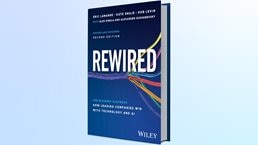
Rewired, Second Edition
This updated edition offers brand-new insights into cutting-edge AI solutions—and what it takes to implement them—as well as the new economics of digital and AI transformations.
The CEO mandate: Asking better questions
Katie Drummond: What’s something a CEO should take away from Rewired?
Dan Swan: You’ve got to be able to ask really good questions. A CEO or any senior executive can set a great tone just by asking, “Did you use the LLM [large language model] to check your answer here? How did you start? Which tool did you use?” One of the best things I’ve seen is when a CEO takes someone who is more junior in the organization and says, “Come show me how you do it.”
Apprenticeship has never been more important. How do you have good business judgment? How do you communicate? Those are more important than ever in this tech- and AI-based world. But it’s also an opportunity for those of us who have been around the block a little longer to have earlier-tenure colleagues share with us, because we can learn from them on a lot of these fronts. It sets a wonderful tone for what the rest of the organization can do.
Technology and AI: Two sides of transformation
Katie Drummond: Your title is global coleader of Tech & AI. I thought that was interesting because you’re saying tech and AI, not one or the other. Why pair them together?
Dan Swan: In our experience, the line between those two things is either blurring or completely disappearing. The idea of bringing business enablement through AI together with the core technology you need to run your business has never been more important. And when we look back at some of our best transformations with clients, those two things worked hand in hand to make them successful.
Katie Drummond: We talked a little about the difference between spending a lot on AI versus transforming. But when you look at companies actually getting a return on that investment and seeing real results, are there distinguishing factors that stand out?
Dan Swan: We’ve really found that the business owners—for example, the chief procurement officer, if it’s procurement—have to be all in on transforming. It has to be their initiative, their effort, not something that’s happening to them. So senior leadership and buy-in are critical.
The people who are going to use the tools and capabilities need to be fully embedded in the work, making it their solution rather than something that’s happening to them. And the final thing is tracking whether you’re getting the benefit and impact—and, if you’re not, why.
Second, we’ve seen a clear focus on building the capabilities of the people who are going to use the tools and assets. We’ve seen this in technology transformations going way back. There’s a lot of good money spent that sits on a shelf. The people who are going to use the tools and capabilities need to be fully embedded in the work, making it their solution rather than something that’s happening to them. And the final thing is tracking whether you’re getting the benefit and impact—and, if you’re not, why.
Toyota: Start with a business problem and rewire around it
Katie Drummond: I want to talk about Toyota and get really specific. They had a VP who asked, “If Amazon can track a $10 book, why can’t we track a $40,000 car?” Walk us through what happened after that.
If Amazon can track a $10 book, why can’t we track a $40,000 car?
Dan Swan: I love the quote because it didn’t start with “What can the technology do?” It started with “We have a real business problem.” They built a digital twin that replicated their entire supply chain. Think about the process to procure parts, make, and deliver two and a half million cars. The digital twin could process the order of a billion decisions in 15 minutes. What used to take 100 people and 75 distinct spreadsheets was packaged into one digital twin.
It created about $800 million of value, mostly through increased throughput and getting the car to the right place at the right time. The idea of bringing that to life was super powerful and impactful for them.
It didn’t start with “What can the technology do?” It started with “We have a real business problem.”
Katie Drummond: One of the things that stands out to me from that Toyota example is that they brought their own people into the process of building the digital twin. Talk us through why that stands out to you.
Dan Swan: One of the failure modes we’ve seen in AI is when someone builds a tool and then hands it to the person who’s supposed to use it. AI has hallucinations and other challenges. So it was important that everybody who was going to have access to and use this capability really trusts it. From day one, hour one, sales executives, manufacturing experts, and planning experts were involved. Not only did they help create a better solution, but they were also the evangelists and change agents for the rest of the organization when it was ready for prime time. We think that’s an absolute best practice, and it was really cool to see in the Toyota example.
Katie Drummond: I think it’s so interesting to think about that in the context of transformation and of technology becoming ingrained in an institution’s culture, rather than being something foisted upon a group of employees or a company. It becomes internal to the organization.
Now I want to turn to agentic AI, which is obviously a huge topic. It’s something we’re covering at WIRED on a daily basis, and it runs through a lot of your research as well. Why are you spending so much time on it? Why is it so different from what we’re looking at now in the context of AI?
Agentic AI and the new role of humans: Changing how work gets done
Dan Swan: Pre-agentic AI was largely about taking how things work today and making them faster and smarter. Agentic AI creates an opportunity to change how things work and have agents interact with one another. It takes a process that has existed and, rather than simply trying to speed it up, fundamentally creates a new process where these agents interact to create a closed-loop process. It changes the game for AI, but it also changes how people have to interact with agents and AI more broadly.
Katie Drummond: Dan, one of the concepts at McKinsey that you’ve been advancing is the idea of humans above the loop rather than humans in the loop. Can you explain that to us?
Dan Swan: With more traditional AI, you’d have a human side by side, checking every step of the process and actively involved in the “do loop,” so to speak. This new view from an agentic AI perspective is that you put the human above the loop. They provide context, orchestrate, and check to make sure things don’t go out of whack, rather than being side by side. It elevates the role of the human to sit on top of the agentic process.
The agentic ladder: From assistance to transformation
Katie Drummond: Another concept you’ve talked about is the four-rung agentic ladder. Can you explain what that means?
Dan Swan: The first rung is using an LLM to ask a question. You get a great answer, and it makes you more productive. The second rung is using it within existing software, for meeting summaries, et cetera. The third and fourth rungs are about either fundamentally transforming a process or building a new business.
Katie Drummond: You’ve also observed that most companies are stuck on rung two. Why is rung two such a trap?
Dan Swan: I think rung two is a trap for a couple of reasons. One is that it gets completely democratized. When you see a technology like this, it’s natural for an entire company to want to embrace it. With meeting summaries and other uses, everybody looks at it and says, “Oh my gosh, that was super helpful. My life got easier. I have time to think about something else or do something different.” So people fundamentally appreciate it. It also doesn’t require any hard decision-making. We’re seeing more and more transitions to people approaching rung three and four. But that’s the whole notion of Rewired: The real focus on the two or three domains is the breakthrough.
Katie Drummond: I have to ask you about AI slop, a phrase everybody uses now. I’d love to hear how companies that are getting this right are dealing with it. What works?
Dan Swan: For a lot of clients and companies, what we see is simply being intentional about it. If you have an agent, how do you give that agent context? How do you measure its inputs and outputs clearly? How do you track whether it’s hallucinating and adjust? How do you help it continuously improve? If you do that, these agents have the capability to learn over time. And the amount of slop within your organization can be drastically reduced.
Rewiring the way we work: From analytical skills to AI fluency
Katie Drummond: McKinsey is advising plenty of clients on AI transformation and agentic AI, but you’re also living it internally. What have you learned from your own teams?
Dan Swan: The currency is shifting from really good analytics and being amazing at using a spreadsheet to being really good at asking questions and prompting. How do you structure the problem and work through it with an LLM or whatever tool you’re using in a way that gets you the outcome you need?
I think it comes back to something that’s been a core part of McKinsey problem-solving: understanding the level of conviction you need to feel that you’ve got the right answer. For us, sometimes it means being 80 percent right and then testing and trying to see what happens. That’s where good business judgment still really matters.
Capabilities that compound: The DBS example
Katie Drummond: Toyota was all about supply chain. DBS is a bank, a completely different context. What makes the DBS story stand out for you?
Dan Swan: What stands out about DBS is how they thought about it as a fundamental transformation from day one.
Katie Drummond: You’ve said that capabilities compound. What did that look like at DBS?
Dan Swan: They started with the two or three priority domains they wanted to tackle. They made progress on those, but they did it with the vision that they would, then they moved to four to six domains, and so on. The next priority domains were tackled more quickly, as they got smarter about how to do it. The organization was receptive and understood how it worked. When you talk about capabilities compounding, not only did they start sooner, but they were building the next set of capabilities, or those next domains, much faster. It continues to expand their competitive advantage.
Katie Drummond: You said something really interesting there: The organization was receptive. That is no small feat. What did DBS get right organizationally, on the human side, that other companies might miss?
Dan Swan: DBS had a long history of technology-based transformation. They had laid the foundation in a really positive way: “When new technologies are out there, we’re going to adopt them.” It became embedded in how the organization works.
So when new technology came along, it wasn’t “What are we doing here?” It was “This is the next chapter of the book we’ve been writing,” which I think is really powerful. The second thing is that, from the beginning, they said “This is a people transformation.” Technology is absolutely core to it, but this is a people and human transformation. They thought about it from the employee perspective, and I think it made a huge difference in their ability not just to get the first wins on the board but to move really fast after that.
Technology is absolutely core to it, but this is a people and human transformation. They thought about it from the employee perspective, and I think it made a huge difference in their ability not just to get the first wins on the board but to move really fast after that.
AI in sports: A new performance cockpit
Katie Drummond: You’re a sports fan, and professional sports often sit at the edge of performance analytics. What parallels can a CEO draw from that world?
Dan Swan: We’ve found sports to inspire people and motivate CEOs. McKinsey’s QuantumBlack, the leading-edge AI part of our organization, did work in sailing, with the America’s Cup, and more recently with Team Visma | Lease a Bike, all around the cutting edge of creating that linkage between analytics, AI, and performance.
The notion of creating an AI cockpit that sits between a coach and a cyclist has been transformative. Factors like the terrain, weather, roads, bikes, and tires can drastically influence decisions.
AI transformation is a people transformation
Katie Drummond: I know you also spend a lot of time advising clients on the human resources function. I’m curious about why. It’s obviously not the department people would automatically associate with AI.
Dan Swan: I think there are three parts to this. One is the mindset of the organization going into a transformation like this. Getting the communication right about what you’re setting out to do and why is super important. If people come into it with a negative lens or attitude, you can be behind the eight ball before you even start. That’s an important role for HR.
The second is the people’s capabilities. The skills you need to do your job a year from now will be quite different from the skills you needed a year ago. Training and capability building are therefore a huge part of what HR does.
And the third is simply how the organization works. How things get done is fundamentally different in a lot of situations, and it’s important to be intentional about it.
Resilience and adaptability in an AI world
Katie Drummond: We’re both parents. What do you tell people who are worried about the next generation?
Dan Swan: People who are quick to learn and adapt when new things hit, and who aren’t stuck in the way things used to work, consistently do better. Being a creative problem solver, being able to communicate, being empathetic, and relating to other human beings—all of those things will remain important no matter what the technology continues to do.
My kids would laugh at me giving advice to other parents, but I think it’s about finding the balance. We want to immerse them in the technology, but we also want them to learn the things we all learned. Some of that is creativity, self-play, and things you simply don’t learn in front of a screen. So what I talk to my kids about, and what I talk to my clients about, is: Can we be resilient, and can we be adaptable? If we can be those two things, I think we’re going to be set up for success.
The CEO’s role in the AI era
Katie Drummond: What’s one thing a CEO should take away from this conversation?
Dan Swan: I’m going to cheat and have them take away two things. One is that the technology is pretty remarkable, and you need to embrace it. The second is that your role has never been more important: the ability to think about this as a business transformation and really set that expectation with your entire organization.
Katie Drummond: Five years from now, when we’re looking back at this moment, what do you think we’ll be able to see very clearly that’s harder to see right now?
Dan Swan: I think we’ll be able to see that the change is durable. The technology is going to last and fundamentally change what we do and how we do it. Companies that embrace it now, think about the lessons, and get out in front of it will have a durable advantage.
Your role has never been more important: the ability to think about this as a business transformation and really set that expectation with your entire organization.
Control+Alt+Delete: A final word on technology
Katie Drummond: We always close these conversations with a little game we invented at WIRED. It’s called “Control+Alt+Delete.” What piece of technology would you love to control, alter, and delete?
Dan Swan: The control, I’ll say, is self-driving capabilities. I spend a lot of time on the road, and the ability to make that productive time would be a game changer for me.
I’d alter how kids interact with screens to give them balance: allowing kids to be savvy in AI technology while also having them go outside, play, learn how to be creative, work with peers, and interact with others.
And then for the delete, I’m going to go back to sports. I was a tennis player in college. I’m still involved with the International Tennis Hall of Fame, so the legacy of history and everything is important to me. And I love automatic line calling in tennis because you’re never going to get a line wrong. But it makes me sad not to have line umpires, men and women, on the side of many professional tournaments anymore. That makes me a tiny bit sad.
Katie Drummond: Now they can’t have the tantrums and throw the racket around anymore.
Dan Swan: Exactly. I mean, we all grew up loving John McEnroe. The yelling and screaming brought it to life. It’s harder to argue with the screen. So that’ll be the one I’ll delete.
Katie Drummond: That’s a really good one. I’ve never heard that one before.
Related Articles

From AI table stakes to AI advantage: Building competitive moats

The AI transformation manifesto