

Does it make business sense to invest in sustainability these days? Would it be better to wait?
Companies across industries are grappling with these questions. Against a backdrop of higher capital costs, geopolitical fragmentation, trade and energy disruptions, and slower infrastructure deployment, waiting can seem like the most rational choice. By waiting, a company can preserve optionality, avoid being locked into current technologies, and potentially benefit from future cost declines. And if, in the meantime, it falls short of its public commitments to decarbonize, it won’t be the only one: The Science Based Targets initiative removed nearly 240 companies from its committed list in 2024 for failing to validate targets within required timelines. Six of the largest US banks have left the Net-Zero Banking Alliance over the past 18 months. And most industries aren’t on track to meet their stated targets.1
Yet, for many companies, taking a wait-and-see stance on sustainability could be a strategic mistake. Our analysis shows that, in certain contexts, the highest-ROI option is to invest in sustainability initiatives today—in part because geopolitical events and regulatory developments are reshaping the economics of decarbonization (see also, “The new ‘whys’: A pragmatic case for climate optimism”).
Leading companies are making only the decarbonization investments that generate financial returns and, in some cases, doubling down on those initiatives even as they pull back elsewhere. For example, chemical giant BASF adjusted its green transformation investment to €1.2 billion for 2026–29 and assumes that most of the associated capital expenditure will be incurred after 2030. The company expects its investments in renewable energy to “reduce dependencies on volatile global markets and lead to comparatively lower carbon abatement and energy procurement costs.”2 The consumer goods manufacturer Unilever revised its plastics reduction target from 50 percent to 30 percent, while raising its Climate & Nature Fund commitments to €0.76 billion in 2025, from €0.67 billion a year earlier.
These companies are exiting the decarbonization initiatives that don’t pay, while deepening their commitment to those that do. The business case is not uniformly strong across all levers, so a rigorous approach to identifying what works is critical. Equally important: being disciplined about execution.
The business case for action
In places where carbon is becoming a direct business cost—particularly in Europe—early movers can create structural advantage. In certain cases, the economics increasingly favor action, and the penalty for delay is becoming quantifiable. The following three dynamics are at work.
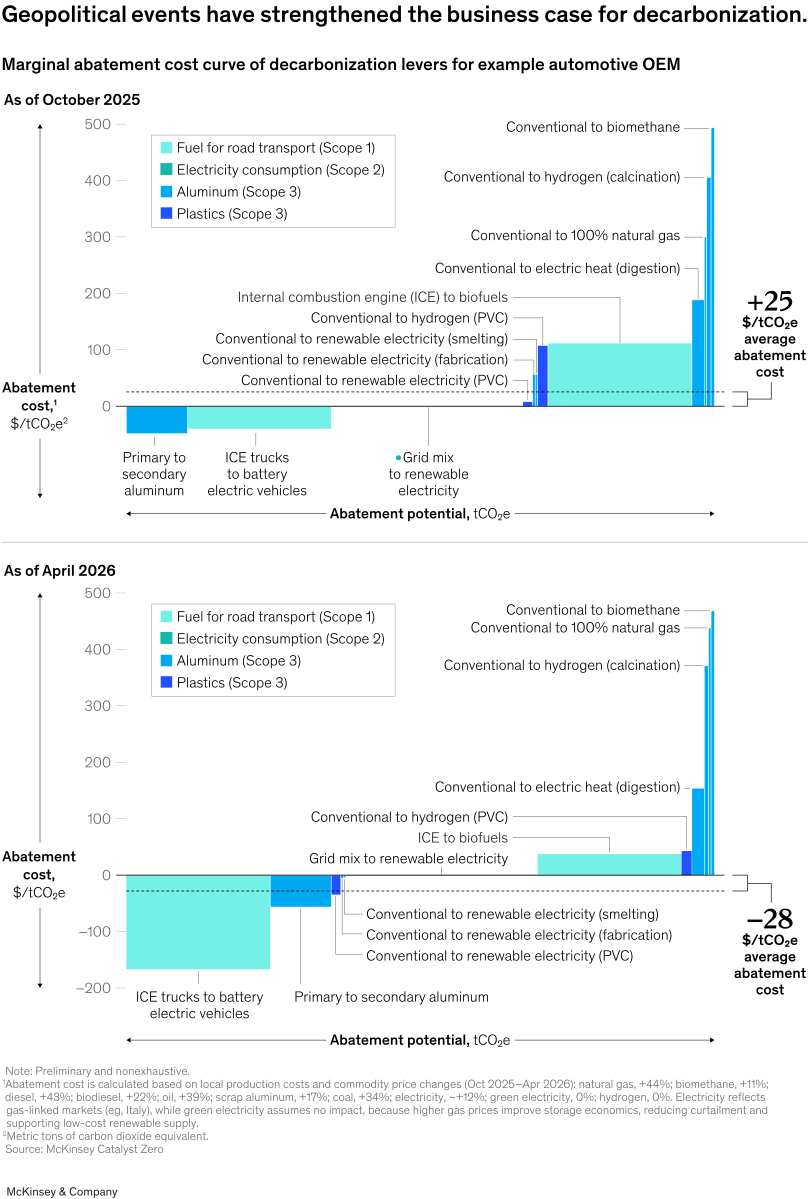
Electrification and renewables reduce exposure to fossil fuel price volatility
Helsinki-based stainless steel manufacturer Outokumpu offers a case in point: Its electric arc furnaces use substantially less energy than conventional steelmaking and rely primarily on electricity, which can be hedged, rather than on coke and coal. Outokumpu’s CEO expects the implementation of the Carbon Border Adjustment Mechanism (CBAM), which we discuss further below, to further reinforce the company’s “sustainability leadership in stainless steel and ferrochrome while delivering financial benefits.” In a world where geopolitical tensions and trade disruptions show no signs of abating, diversified energy portfolios carry lower embedded risk that compounds in value over time (exhibit).
Carbon costs are becoming a permanent business expense
The EU Emissions Trading System (ETS) is phasing out free allowances by 2034 (though a July 2026 European Commission proposal would extend the deadline to 2038). Simultaneously, CBAM applies a carbon price to imports in six sectors: cement, iron and steel, aluminum, fertilizers, hydrogen, and electricity. Our analysis shows that for large cement producers, this represents up to €1 billion in annual value at stake by 2030 at projected carbon prices of €150 per metric ton of CO₂. Importers without verified emissions data default to penalty-level benchmarks, inflating CBAM liability by up to 60 percent versus those that have invested in supply chain transparency.
This is already shaping procurement decisions. Stegra (formerly H2 Green Steel) says the timeline for its plant in Boden, Sweden, is under review, even as more than half of its initial production volume is already contracted. Customers include BMW and Mercedes-Benz, which have said that purchasing Stegra’s steel would help them reduce supply chain emissions; Mercedes-Benz also describes the partnership as helping to create a “regional and resilient steel supply chain.”
Low-carbon supply is constrained
For low-carbon steel, the gap between stated demand (from companies with binding commitments) and available supply is projected to reach approximately 35 percent by 2030. For aluminum, that gap is approximately 31 percent.3 Companies that secure offtake agreements now are locking in access and cost positions. Those that wait will face rising premiums, the precise trajectory of which will depend on how fast supply scales.
In regions where carbon costs are on a fixed escalation schedule and low-carbon supply is physically constrained, the option value of waiting can erode faster than the option value of flexibility. The Swedish steel company SSAB’s recent decisions reflect this calculus: SSAB withdrew from negotiations for up to $500 million in US federal support for a planned hydrogen-based iron project in Mississippi, while continuing its €4.5 billion investment in an electric steel mill in Luleå, Sweden, now designated an EU strategic net-zero project.
Beyond Europe, the case for decarbonization often rests on growth and energy security rather than carbon cost. India—which imports roughly 85 percent of its oil and 40 percent of its primary energy—reached 50 percent non–fossil fuel power capacity in June 2025, five years ahead of its Paris Agreement target, and added 55 gigawatts the following year, its largest-ever annual increase.4 For companies, moving early on decarbonization can offer growth, supply security, and cost advantages.
How leading companies are executing
Identifying the right initiatives is only the first step. Capturing their full value requires disciplined execution.
Decarbonization plans today are often insufficiently integrated with financial planning, accountability is distributed without a single point of delivery, and investment requirements remain uncertain. These are company-level execution challenges—distinct from the broader macro headwinds—that add cost, time, and risk of failure. A few companies are beginning to distinguish themselves by their execution capabilities.
Prioritizing by business case, not by emissions volume
Leading companies rank decarbonization initiatives by cost savings, margin protection, and risk reduction—then execute the most attractive ones at pace. They first build credibility and funding through initiatives that pay for themselves, and then tackle harder abatement. For example, we helped a European automotive OEM identify a pathway to deliver approximately 400 kilograms of CO₂e reduction per vehicle at an abatement cost below €100, turning decarbonization from a cost center into a competitive input. The key was integrating cost, resilience, and sustainability into a single sourcing approach. Where these dimensions overlap (and, in our experience, they overlap in 30 to 40 percent of metal categories), a supplier switch simultaneously reduces cost, improves supply security, and lowers carbon intensity.
Working with suppliers
With Scope 3 representing the largest gap in decarbonization targets, progress requires action across supplier ecosystems. Leading companies are embedding carbon into procurement decisions, securing low-carbon offtake agreements, and investing in emissions verification. In Europe, verified supplier data can cut CBAM liability by up to 60 percent compared with default benchmarks, making supplier engagement one of the highest-ROI actions. Companies re-baselining Scope 3 using actual vendor data instead of estimates are finding actionable opportunities to reduce both emissions and costs.
Building execution infrastructure
The organizations successfully converting plans to results are building financial integration (internal carbon prices on capital expenditure decisions), granular measurement (emissions data at the SKU or component level), and delivery governance (centralized tracking with clear accountability). Companies currently pursuing all three can more clearly demonstrate ROI, which funds the next round of investment.
The sustainability reset is changing the basis of competition. We expect that many of the next decade’s leading companies will be those that identify where sustainability creates value—and move more nimbly than their competitors to capture that value.
- In our analysis of publicly disclosed near-term absolute decarbonization targets across approximately 200 of the largest emitting companies in 12 high-impact industries and all major regions, only half of the industries are on track to meet stated targets on Scopes 1 and 2; the remainder require moderate acceleration. On Scope 3, almost all industries are off track. Consistent with CDP Target Accountability Tracker (2024) findings.
- “E1 Climate change,” BASF report 2025, BASF, February 27, 2026; “E1 Climate change,” BASF report 2024, BASF, March 21, 2025.
- McKinsey analysis based on stated corporate commitments versus committed production capacity. Note: reflects demand from companies with binding or stated targets, not demand at any price. Directionally consistent with Mission Possible Partnership and Responsible Minerals Initiative assessments.
- Indian oil market report: Outlook to 2030, International Energy Agency, 2024; “India achieves landmark 300 GW non-fossil fuel power capacity,” Ministry of New and Renewable Energy, Government of India, August 9, 2026.