When pursuing spin-offs, most business leaders are targeting growth and improved financial performance for both the parent and the divested company.1 These transactions, as complex as they are, represent substantial opportunities to do both of those things—with the added benefit of creating more value for shareholders.
AbbVie’s spin-off from Abbott Laboratories in 2013, for instance, gave both companies the flexibility to specialize in those areas that made the most competitive sense: For Abbott, it was a focus on diversified healthcare products. For AbbVie, it was a focus on research-based pharmaceuticals and biologics. The result was two independent companies, both of which have shown strong performance in the first decade post-spin-off: AbbVie has achieved a compounded annual return of 21.65 percent, and Abbott is at 15.83 percent. The separation allowed each company to pursue distinct strategies and be more effectively valued by investors.
A key question for managers in any spin-off, however, is whether to sell business units as is or pursue improvements that could help attract potential buyers and drive up the sale price.
At the height of deal discussions, management teams on both sides are typically focused on addressing the needs of stakeholders, employees, customers, suppliers, and regulators while managing immediate market reactions. It can also take them time to establish the spin-off’s management team, a critical step for ensuring that any restructuring plans are in line with the entity’s longer-term strategic plans.
Thus, the question of whether to restructure assets is often tabbed for “later”—when the deal closes and the immediate, tactical work of the spin-off is done.
Nowadays, that may be too late.
Since the last time we explored this topic, more than five years ago, restructuring has become not just a lever for optimizing a deal ahead of close but also an ongoing hedge against cost volatility created by higher interest rates, tighter credit, inflation, and so on. We believe that being able to create more value from restructuring is no longer just a nice option for managers to explore; depending on industry and market context, it’s often necessary for growth.
Our research suggests that it pays to restructure before spin-off—because the companies that do so tend to outperform those that don’t.
A closer look at the restructuring research
What do we mean by restructuring? Every spin-off requires a standard set of actions to prepare the asset for separation and to execute the transaction. For the purposes of this article, however, restructuring refers to the additional changes required to improve the business’s readiness to operate and compete successfully as a stand-alone company. That can include redesigning the organization, redefining decision rights, building stand-alone corporate and support functions, resetting the cost base, upgrading management processes and governance, and strengthening commercial or operational capabilities that were previously embedded in the parent company. In other words, restructuring goes beyond preparing the asset to separate; it prepares the company to perform.
We examined spin-offs with a value greater than $1 billion between 2008 and 2025 across a range of industries. Specifically, we focused on the variance in the performance of the companies in these deals prior to and two years after the divestiture. To determine whether the timing of restructuring materially affected performance, we compared companies that incurred higher restructuring expenses prior to spin-off with those that reported higher restructuring expenses after the spin.
Companies that had invested more in restructuring in the four quarters prior to divestiture tended to see a 2.5 percent improvement in total shareholder returns in the two-year period following spin-off.2 Conversely, companies that incurred higher restructuring charges after spin-off saw an almost 3 percent decrease in shareholder value (Exhibit 1).
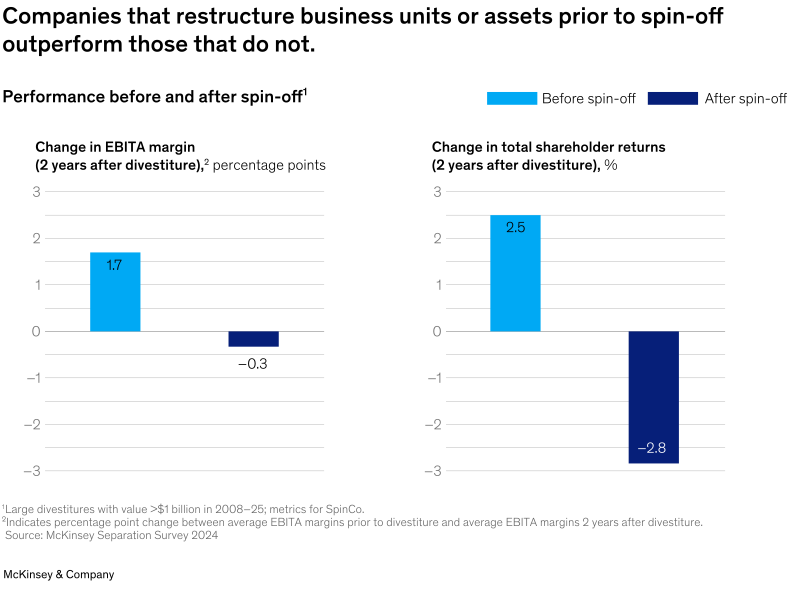
Operating margins were affected as well: Companies that restructured prior to spin-off saw an almost two-percentage-point improvement in their average EBITA margins two years after the transaction, while those that restructured post-spin-off experienced a less than one-percentage-point decrease.
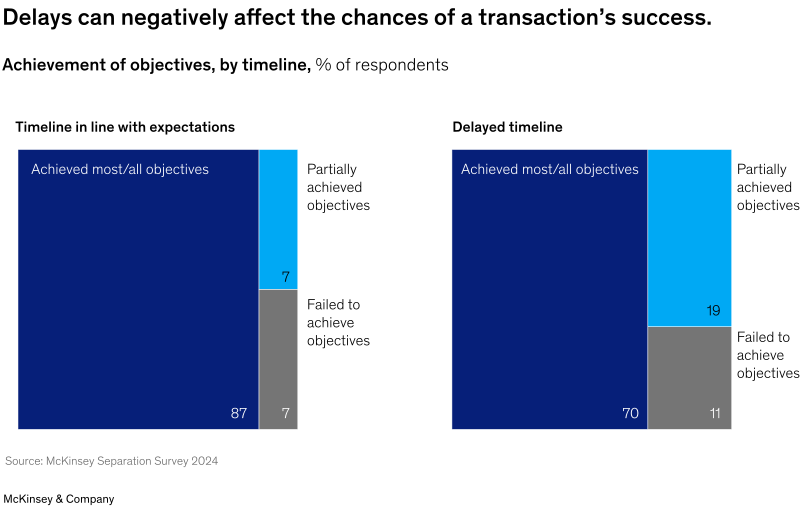
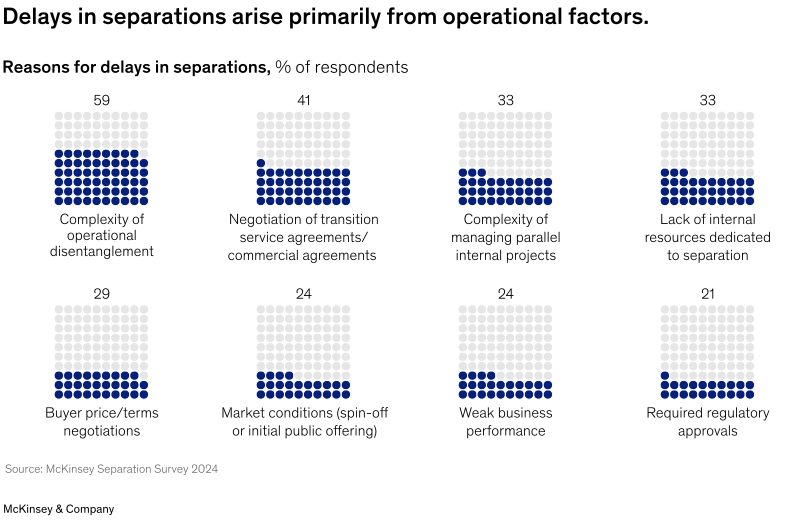
What’s more, our most recent separations survey revealed that delayed separations are less likely to achieve their growth and financial performance objectives than those that aren’t delayed (Exhibit 2). In our experience, restructuring before spin-off could help managers reduce such delays and increase the odds of creating more shareholder value, more quickly. Operational disentanglement and negotiations over service agreements were the most often cited reasons for delayed separations (Exhibit 3). Restructuring an asset’s operations prior to spin-off could help address these and other challenges.
Foundational principles for restructuring before spin-off
The reasons for restructuring may change from deal to deal, and the growth and performance improvement opportunities may present themselves differently, but there are several foundational (if familiar) principles for companies looking to create the most value from spin-offs.
Activate the new business strategy as soon as possible
Deal teams and business leaders should emphasize the strategic and operational improvements from the spin-off at the outset. Consider this example: A diversified industrial company spun off one of its commodity businesses. Long before close, the executive team in the divested business unit began reducing its general and administrative expenses, moving toward a flatter organizational structure, improving its management of working capital, and otherwise operating with a leaner mindset. By the time the deal had closed, the divested unit was ready to stand on its own and was already realizing positive earnings.
Similarly, a global technology company spun off a slower-growing business unit to focus on its core operations. In the months before the spin-off, the team prepared the new business to operate independently by putting new IT systems in place, defining clear roles and responsibilities, and narrowing its focus to a smaller set of key customers and products. As a result, the new company was ready to operate on day one. Within two quarters, it was making faster decisions, improving pricing, and converting more sales—driving earlier-than-expected revenue and margin growth.
Don’t forget about the long-term implications of short-term decisions
If leaders aren’t careful, speedy separations can inadvertently lead to overly complicated operational and financial issues. One pharmaceutical company, for instance, created a series of redundant legal entities to house assets being divested; senior leaders thought doing so would simplify and speed up the separation process. However, the way the deal was structured forced the company to take on extra IT, legal, financial-reporting, and other costs, which proved to be a huge drag on the pharma company’s post-close earnings and on its ability to launch its new strategy. A better approach is for senior leaders to take a beat and consider all potential exit options and buyer requirements: Which are truly no-regret moves, and which may require more information before committing to an exit strategy?
Identify and manage cost structures ahead of separating
Before finalizing organizational structures, management teams from both the parent company and the divested business unit should perform rigorous benchmarking of their cost structures, looking at operating models used by “target” peers rather than the parent company’s peers. Some companies pursuing spin-offs have turned to zero-based budgeting, while others have adopted a private equity mindset when looking at cost structures. While they may be time consuming, such benchmarking exercises can uncover areas of inefficiency and highlight new ways of working.
Before spinning off a major business unit in 2024, a large industrial company implemented a lean operating model that emphasized rigorous cost benchmarking and efficiency initiatives. Senior management introduced new ways of working (such as regular stand-ups, a focus on value streams, and standardized processes) alongside new mindsets (including continuous learning and customer-centric thinking). As a result, the company was able to eliminate waste and reduce lead times before and shortly after the transaction closed. Through this disciplined approach, the newly independent business achieved double-digit growth in revenue, profit, and cash flow within its first-year post-spin-off.
The message from our research is clear: The leaders who succeed with their divestitures, spin-offs, and separations are those who identify opportunities early—and act before the deal is done.



This article is adapted from the 2019 article “A case for restructuring before spin-off.”
This article was edited by Roberta Fusaro, an editorial director in the Boston office.
Related Articles

Achieving win-win spin-offs