In the challenging business of distressed credit management, deployment of AI is accelerating. At both retail and commercial banks, AI agents are helping humans perform tasks that range from holding conversations and recommending payment terms to retrieving policies, generating compliant correspondence, and automating administration. Many organizations have already seen meaningful gains in productivity and the customer experience.
Yet a clear divide is emerging. While many banks have successfully completed AI use cases, relatively few have transformed how their credit organizations operate. This reflects a broader trend across industries. McKinsey’s latest annual State of AI Survey finds that fewer than one in three organizations have started scaling AI across the enterprise, and only 7 percent have fully deployed the technology.1 Banking executives often tell us they struggle to fully embed AI into customer journeys, operating processes, and management systems.
Looking ahead, the banks that turn AI deployment into market-leading solutions will go beyond implementing individual use cases. They will redesign the customer assistance operating model itself. That will mean integrating AI into workflow orchestration, decision support, governance, and frontline execution.
The critical pivot is from AI assistance to AI orchestration, in which intelligent systems coordinate work fully across operations. The prize for getting it right will be a productive balance among credit management, customer financial health, and long-term relationships.
Four credit challenges
In a tough credit environment, banks face four significant challenges. The most prominent is credit portfolio distress across economies. In the United States, levels of serious delinquency have plateaued at high levels. In the second quarter of 2026, automobile loan balances entered 90-plus-day delinquency at an annualized rate of 3 percent and credit card balances at 7 percent, the same high level as a year earlier and well above pre-2022 rates.2 Europe has seen a rise in early-stage delinquencies across most countries compared with a year ago.3 Meanwhile, in Brazil, Latin America’s largest credit market, household delinquency on nonearmarked credit has increased by more than 40 percent over the past 18 months to a record 8 percent.4
The second challenge is unit economics. Financial institutions are under pressure to reduce cost per unit recovered and ensure their customer assistance operations are scalable for a potential macroeconomic downturn. Competition from digital-native players puts additional pressure on operational performance.
The third challenge is conduct risk. In 2024, US debt management generated more than 200,000 complaints to the Consumer Financial Protection Bureau, up from approximately 110,000 in 2023. Most institutions lack AI-orchestrated and supervised systems that could ensure regulatory compliance by design and prioritize fair treatment at all times.
Finally, there is pressure to improve service levels, not least because happier customers are better customers. In our experience, digital-savvy borrowers given a practical digital route to tackle arrears are 20 to 30 percent more likely to pay than those reached by outbound calling alone.
Building blocks for an agentic operating model
The next evolution in customer assistance will be an agentic operating model through which specialized agents collaborate across the customer assistance life cycle. We see five interconnected building blocks that agents can partially or fully automate (Exhibit 1). In the near future, agents will continuously interpret customer and portfolio information, make or recommend decisions, initiate actions through existing systems, hand over to other agents or employees, and learn from outcomes.
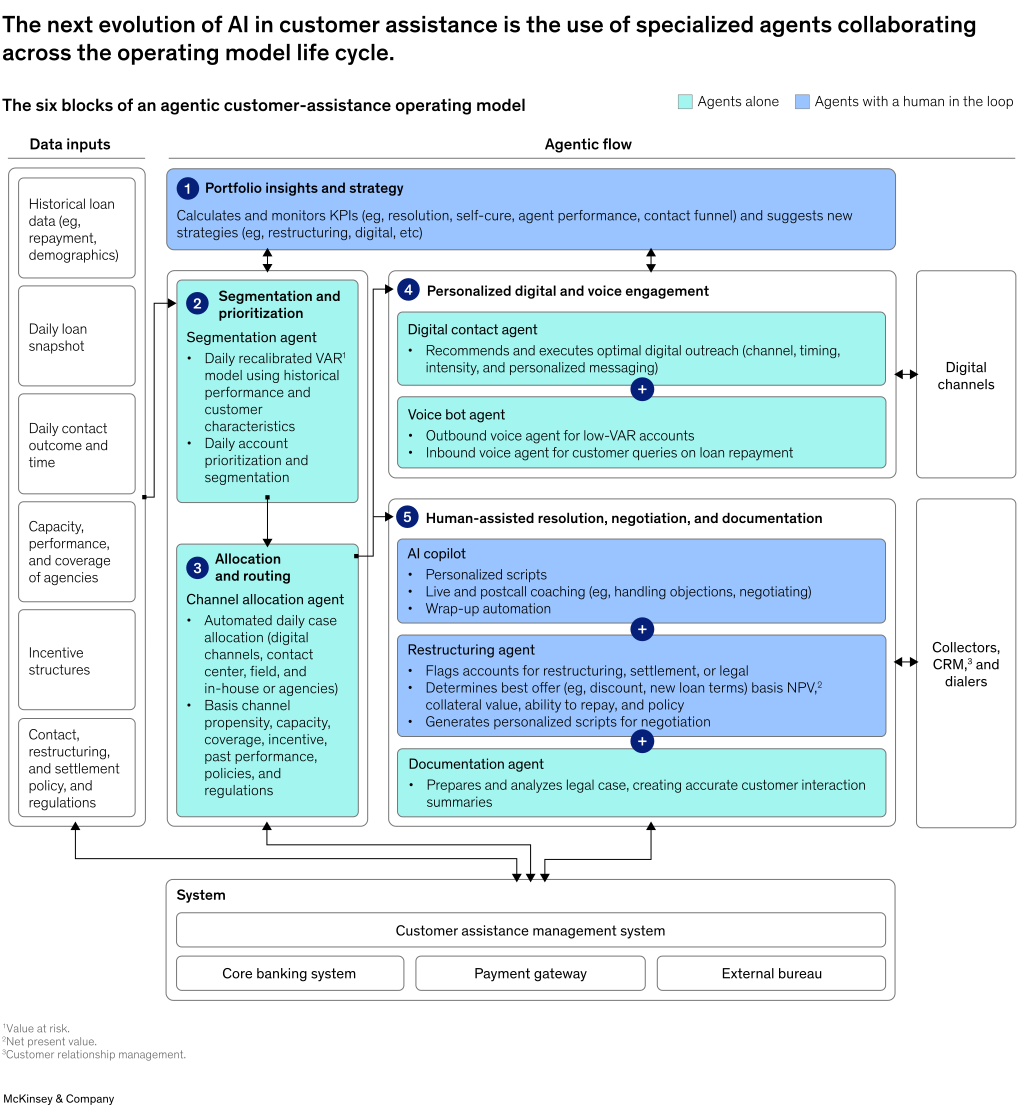
This does not mean that AI will replace core systems. Rather, it will operate as an intelligent and dynamic orchestration layer. Below we drill down into each of the five building blocks of operational opportunity.
1. Portfolio insights and strategy
An insight and strategy agent will oversee end-to-end portfolio performance and orchestrate corrective action. It will monitor financial and operational KPIs, including cure rates, contact funnel performance, agent effectiveness, cost per dollar recovered, and treatment outcomes. It will also identify where strategies should change dynamically, for example, sharpening focus on restructuring or shifting to digital channels for specific at-risk segments. This will transform debt management strategy from a periodic exercise into a process of continuous optimization.
2. Segmentation and prioritization
A segmentation agent will combine repayment history, daily positions, contact outcomes, the most recent customer conversation, and bureau and behavioral data. It will use that analysis to recalibrate self-cure and value-at-risk models. Upstream of delinquency, the same agent will scour the performing book for early signs of distress and flag accounts for opportunities to make a support offer before a customer misses a payment.
3. Allocation and routing
An allocation agent will choose whether each account should be treated through digital channels, a voice agent, an in-house agent, a field or external agency, or a specialist team.
Drawing on segmentation agent input, the agent will estimate channel propensity while accounting for case complexity, customer circumstances, agent skills, human capacity, and historical performance. It will allocate next steps in line with regulatory requirements and policies. As new information emerges, the agent could reroute or escalate, turning allocation from a monthly rules-based exercise into a continuous orchestration process. For example, if a customer cannot be reached through digital channels after three attempts, the agent can allocate the case to a third-party agency. If a customer expresses interest in restructuring, the agent can automatically refer them to a specialist team.
4. Personalized digital and voice engagement
When accounts are suitable for digital customer assistance, digital contact agents will determine the appropriate timing, contact intensity, and personalized messaging, and then execute outreach through digital channels. Timing will vary based on a customer’s response history or segment, enabling the agent to adapt the next action based on the customer response or lack thereof.
Voice agents will handle low-exposure outbound calls and routine inbound servicing queries. They will hand the call over to a human agent when the call becomes too difficult or when the customer asks for it. That said, many customers will prefer an AI-based voice agent for some conversations, such as those relating to sensitive matters.
5. Human-assisted resolution, negotiation, and documentation
For cases requiring human judgment, an AI copilot will prepare personalized scripts before the call, listen to the conversation, and make observations based on customer tone of voice, as well as providing real-time coaching to the human agent. It will capture accurate call dispositions and suggest or automate the next-best action. It will also personalize solutions based on what the customer can afford and automatically trigger a reminder call to follow up.
A restructuring agent can play two distinct roles. The first is workflow automation: The agent identifies customers who may be eligible for restructuring or settlements, checks the relevant policies, and selects the most suitable option from a predefined set of rules (such as a standard discount or new loan terms) based on factors including affordability, ability to repay, willingness to repay, net present value (NPV), collateral value, and policy constraints. It then prepares a personalized offer for the customer. The second role is judgment support: Drawing on historical data from similar cases, the agent enriches the case and may suggest an exception or nonstandard terms, much as an experienced reviewer would. These recommendations remain subject to a final human decision.
How much autonomy and where?
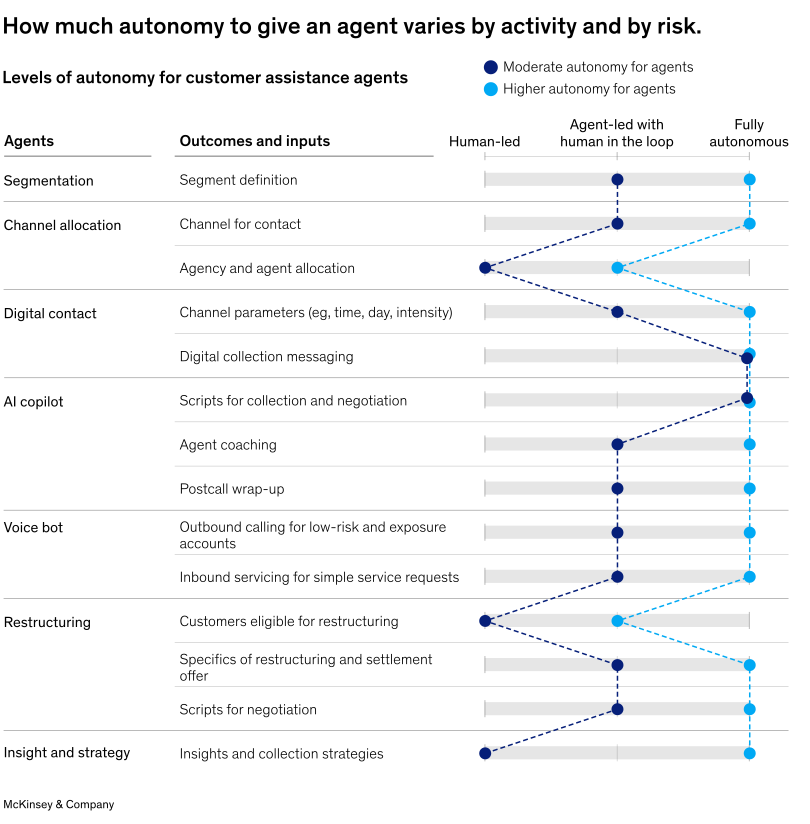
An agentic operating model does not imply that every activity becomes fully autonomous. The appropriate degree of autonomy will be contingent on the nature of the decision and the institution’s risk appetite. In addition, banks can progressively expand autonomy as capabilities, controls, and confidence mature. Each link in the customer assistance value chain offers a spectrum of autonomy choices (Exhibit 2).
In assigning levels of autonomy, leading banks often consider a number of factors:
- Where the activity is sufficiently standardized, observable, and low-risk, agents can make and execute decisions without case-by-case human approval. For example, agents would define customer segments, allocate cases to channels (with parameters such as timing and intensity), define scripts for digital and call-based assistance, run end-to-end voice bot calls, coach agents, and wrap-up after calls.
- For higher-risk activities, or those requiring human judgment, the agent can still produce the output, with a human reviewer to accept or modify it. For example, when a restructuring case falls outside standard rules, the agent can suggest an exception or nonstandard terms based on similar historical cases, while a human makes the final decision (where the bank may want to control discounts to avoid moral hazard). Human review may also be needed to allocate cases to external agencies (where broader context beyond available data might affect these decisions).
- Some activities may remain fully human-led, with no agentic input. For example, a bank may choose to automate rules-based restructuring offers while keeping judgment-based decisions, such as exceptions and nonstandard terms, entirely with its human experts.
There are two important nuances:
- The autonomy described above applies only to case-by-case decisions; the customer assistance strategy team should exert full control over guardrails.
- Agents will still have built-in guardrails to escalate to humans. For example, a digital contact agent may autonomously choose the timing and wording of a routine reminder but escalate a customer response that indicates vulnerability.
Getting started through MVPs
To get started, leading financial institutions think in terms of a minimum viable product (MVP) that delivers short-term impact:
- MVP 0: Experiment with isolated AI use cases. Start with stand-alone AI applications to build momentum and demonstrate early proof of value. Potential use cases include tools for coaching agents, summarizing conversations, and automatically generating scripts.
- MVP 1: Build the first integrated customer assistance flow with multi-agent orchestration. This should have a well-defined scope and focus on relatively simple activities. Connect multiple AI-enabled tasks across the end-to-end customer journey. Examples include a predelinquent or early-bucket portfolio requiring customer segmentation, prioritization, in-house agent-level allocation, script generation, and capture of customer outcomes from voice calls to automate wrap-up and the next-best action. The agent may connect with the bank’s systems (customer relationship management systems, dialers, the debt management system, and core banking) or implement a batch mode of data ingestion. There would be limited customer-facing use cases, such as an end-to-end customer assistance voice bot, which will come at the next stage.
- MVP 2: Expand to the full portfolio across most assistance journeys, including the most complex, with a large proportion of human-in-the-loop, case-by-case approvals. For example, build agents for restructuring and add agents to automate legal case documentation. Where integrations with the bank’s systems are not already available, build them. Expand customer-facing use cases, for instance by deploying a voice bot that handles a substantial part of customer interactions and hands over to a human agent where appropriate.
- Fully fledged solution: Make agents fully autonomous for a large proportion of activities. Extend orchestration across the customer assistance life cycle, with agents continuously monitoring changes in customer and portfolio conditions, determining treatments, coordinating channels and teams, executing permitted actions, and learning from outcomes.
Five questions every executive should ask
Rather than asking whether AI pilots are performing, executives should consider whether their organizations are fundamentally improving how customer assistance operations are performed. Five questions are key:
- Are AI agents orchestrating decisions and handoffs across the customer journey, or are individual use cases still operating largely in isolation?
- Do our governance, technology, data, and operating model allow us to scale from individual use cases to end-to-end orchestration with the appropriate risk management tools in place?
- Have we determined where AI can act autonomously, where human approval is required, and what guardrails govern those decisions?
- Are we measuring enterprise outcomes such as cure rates, customer satisfaction, employee productivity, and cost to recover, rather than isolated pilot metrics?
- What organizational barriers are preventing us from scaling?
From distress to financial health
The winners in distressed credit management will use AI to create a step change in how they engage with customers. They will deliver personalized advice and education proactively, efficiently, at the right moment, and through the right channel. As a result, a typically unpleasant interaction will become a positive experience at a moment of truth—one that builds trust and loyalty while improving the health of the portfolio.
Institutions that deploy the most sophisticated models or launch the greatest number of pilots will not define the next era. The winners will be those that most effectively redesign how customer assistance is delivered, how employees work, and how decisions are made across the enterprise.