The rapid rise of gen AI has captured the world’s imagination and accelerated the integration of AI into the global economy and the lives of people across the world. Gen AI heralds a step change in productivity. As institutions apply AI in novel ways, beyond the advanced analytics and machine learning (ML) applications of the past ten years, the global economy could increase significantly, improving the lives and livelihoods of millions.1
Nowhere is this truer than in Africa, a continent that has already demonstrated its ability to use technology to leapfrog traditional development pathways; for example, mobile technology overcoming the fixed-line internet gap, mobile payments in Kenya, and numerous African institutions making the leap to cloud faster than their peers in developed markets.2 Africa has been quick on the uptake with gen AI, too, with many unique and ingenious applications and deployments well underway.
Across McKinsey’s client service work in Africa, many institutions have tested and deployed AI solutions. Our research has found that more than 40 percent of institutions have either started to experiment with gen AI or have already implemented significant solutions (see sidebar “About the research inputs”). However, the continent has so far only scratched the surface of what is possible, with both AI and gen AI. If institutions can address barriers and focus on building for scale, our analysis suggests African economies could unlock up to $100 billion in annual economic value across multiple sectors from gen AI alone. That is in addition to the still-untapped potential from traditional AI and ML in many sectors today—the combined traditional AI and gen AI total is more than double what gen AI can unlock on its own, with traditional AI making up at least 60 percent of the value.
Africa is ready to unlock growth and productivity from gen AI
Analytical AI is already indispensable in several industries, with ML solutions solving analytical tasks such as classifying, predicting, clustering, or evaluating data faster and more effectively than humans. Now, with gen AI’s broad utility and revolutionary ability to convincingly mimic the human ability to create, including writing text, producing digital art, and composing music, the excitement about the potential of the technology has surged globally and the economic impact is expected to be substantial. McKinsey estimates that gen AI could add $2.6 trillion to $4.4 trillion to the global economy annually across 63 use cases analyzed.3
The application of gen AI and AI more broadly already has significant momentum in Africa, and African institutions are rapidly catching up with, and in some cases leading, global developments. Businesses and governments are incorporating gen AI in their technology strategies, and many are using it to solve some of Africa’s most pressing problems in novel ways. For example, across Africa, AI-driven translation services for local languages that are underrepresented on the internet, such as Amharic, are being used to improve cross-cultural communication, increase access to information, and enhance social cohesion.4 In Kenya, gen AI is being used to create personalized learning pathways for students, with the goal of improving academic performance, increasing engagement, and providing tailored educational experiences.5 In South Africa, a local start-up is using proprietary AI models and tools, including GPT-4, to help small-business owners better understand their finances and automate the production of easily understandable reports and dashboards.6
Although many gen AI applications in Africa tend to be in the experimental or developmental phase, several organizations have already successfully implemented AI and gen AI at scale and fully transformed workflows. For example, in Nigeria, a mobile telecommunications provider has been scaling a chatbot that functions as a digital assistant to improve customer experience. It can answer questions, provide personalized recommendations and 24/7 access to information, and help customers activate products or services, check their balances, and buy airtime. In South Africa, several financial services providers have been hyperpersonalizing their outbound sales campaigns and significantly cutting down internal time to market using gen AI.
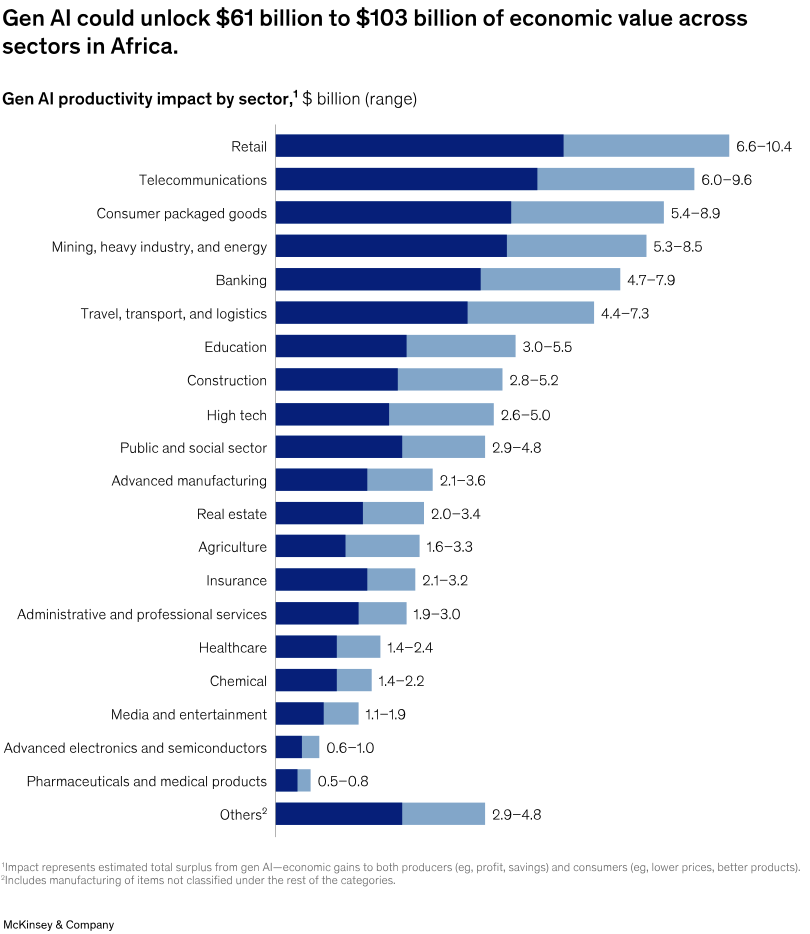
Gen AI adoption still differs significantly by sector, with more-digitally-mature sectors, such as technology, telecommunications, and financial services, having the highest levels of AI and gen AI adoption. Common gen AI use cases in these sectors are already going beyond simply distributing copilot licenses to employees to intentionally boosting productivity and improving customer and employee experience. However, relatively few organizations have implemented software engineering use cases at scale throughout the software development life cycle, let alone tested agentic AI with autonomous agents.7 Significant value, therefore, remains to be tapped. We estimate that at-scale deployment of gen AI could unlock $61 billion to $103 billion of additional economic value across Africa and across sectors (Exhibit 1).
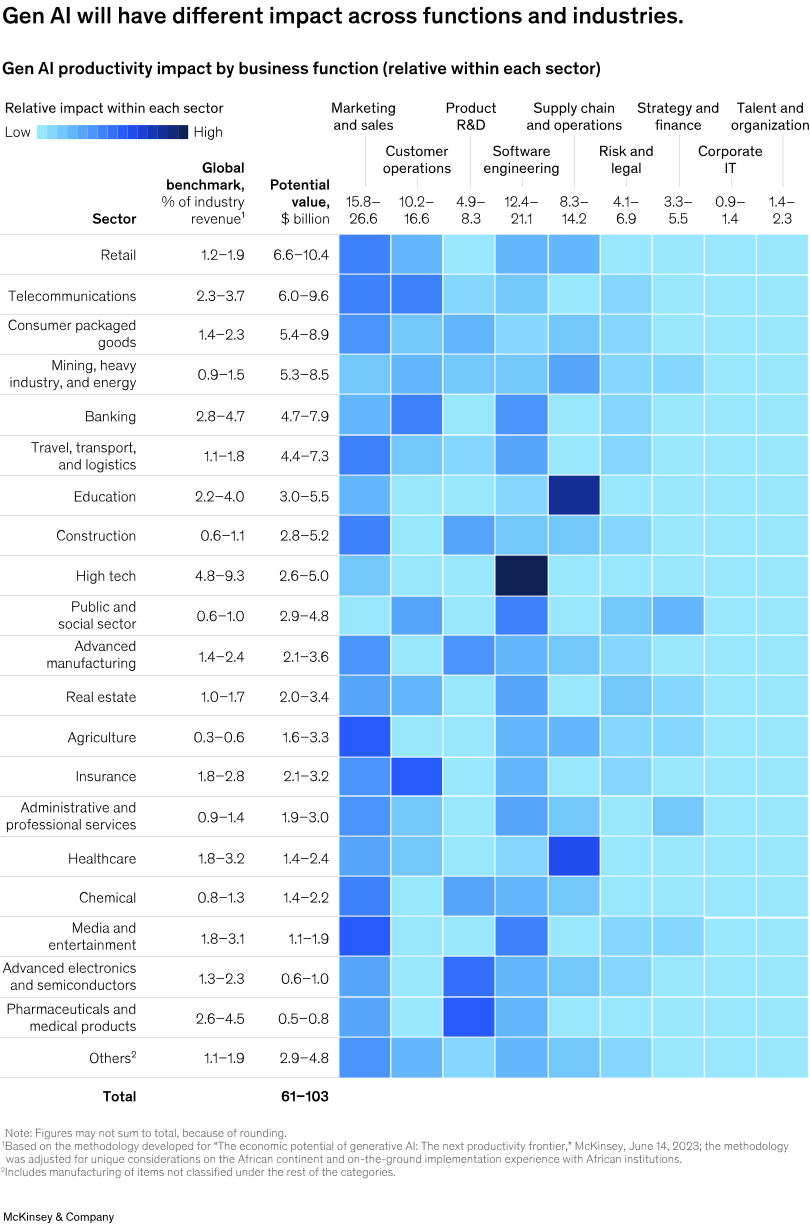
The magnitude of gen AI’s impact is likely to differ by sector and function (Exhibit 2). For example, in retail and consumer packaged goods, it is expected to be strongest in marketing and sales, while in banking and the public sector, its largest impact will likely be in customer operations and software engineering. In insurance, gen AI’s largest impact is expected in customer operations, and the telecommunications sector also expects a large impact in this area, as well as in marketing and sales.
African front-runners are showing us how it’s done but are still just scratching the surface
More than half of the economic potential from gen AI in Africa is concentrated in sectors where there are already front-runners: banking; retail; consumer packaged goods (CPG); telecommunications; insurance; mining, heavy industry, and energy; and the public sector (including healthcare). In each of these seven sectors, there are organizations that are doing pioneering work in advancing the application of gen AI in their industry. However, these use cases represent just the tip of the value iceberg. Below, we explore noteworthy developments and opportunities for fully scaling the impact of gen AI in these seven sectors.
1. Banking opportunity: From idea to impact
Around the world, the banking industry’s unique access to large amounts of customer data has created fertile ground for a range of innovative AI use cases along the entire banking value chain. Access to this data allows the sector to glean valuable insights into customer behavior and preferences, positioning it to leverage AI, including gen AI, to improve critical functions, such as customer service, credit risk, and fraud detection.
Several banks in Africa have started to seek productivity gains through gen AI by distributing copilot licenses to employees in customer service, risk, and IT. Some are going much further. For example, a number of sub-Saharan banks are using gen AI to hyperpersonalize outbound sales campaigns to replace generic marketing messages (copy) and cut down on time to market and lengthy review processes.
One bank has turned to large language model (LLM) agents to simulate a conversation between the copywriter and the customer to generate the best possible copy for individual customers. Data scientists were upskilled in copywriting and collaborated with risk, legal, compliance, and marketing to ensure the models could produce the right content and generate reports to show that the copy satisfied all requirements. A microsegmentation approach captured key client value propositions for each segment, and personalized content was balanced with human review of all copy. The result was an improvement in campaign effectiveness and especially efficiency.
Other banks are unlocking value in the risk and credit functions. For example, an Egyptian bank is using gen AI to automate the drafting of credit memos for large and midsize lending cases. A South African retail bank is using AI across the risk value chain for risk identification and assessment, document vetting, decision-making, and monitoring, making it possible to address regulatory requirements faster and more accurately. Another pan-African bank is even using gen AI to document and understand dependencies in legacy code from the 1970s, and is testing its use in application migration across programming languages and systems.
Up to a $7.9 billion opportunity for African banks
Most African banks, however, have yet to move their gen AI use cases beyond the proof-of-concept stage. Our analysis indicates that deployment of gen AI across the banking value chain could help unlock $4.7 billion to $7.9 billion in economic value for African banks (see sidebar “Gen AI use case examples for banking”).
For example, in marketing and sales, relationship managers (RMs) and frontline agents can use gen AI tools to better engage customers with more personalization and appropriate-tone-of-voice prompts, while corporate and mid-cap RMs can use it to automate account plans. In operations, there are opportunities to automate and enable customer service activities and related back- and middle-office services. There are also opportunities in risk, legal, and support functions, such as human resources.
In technology, promising use cases lie across the full software development life cycle, from customer or business needs and thoughtful prompts in natural language to requirements (epics, user stories, acceptance criteria) to contextual user interface (UI) designs, user experience (UX), and architecture to draft code and test cases. We’ve named this opportunity “idea to impact,” which signifies more than a tool but rather a complete technology and business operating model shift.
To move beyond the proof-of-concept stage and embrace this shift, banks could focus on fully unlocking the value in one or two domains through at-scale deployment, including implementing new workflows to drive adoption.
2. Retail opportunity: An AI-guided shopping experience
Across the world, the adoption of gen AI stands to enhance the entire consumer-facing retail value chain. The use of gen AI and AI broadly is optimizing the design of market research and customer experience and has the potential to ensure that the right product offers reach the right customers at optimal times, boosting customer satisfaction and sales efficiency. Additionally, gen AI can enhance customer experience by, for example, improving in-store operations and customer service and optimizing store design.
Many African retailers are unleashing AI across their operations. But even with analytical AI, there is still a lot of value on the table, especially in such core areas as pricing, promotions, and assortment. Some are, however, experimenting with gen AI beyond traditional areas. Prominent retailers with a well-established physical presence across the region have expanded into the online market and are reimagining the shopping experience with gen AI–powered conversational bots that act as personal shopping assistants.
Online retail has grown rapidly in Africa and is expected to increase even further, with Chinese and American digital disruptors entering the market. In this dynamic space, both grocery and apparel retailers are finding that gen AI–enabled conversational and personalized experiences are key drivers of success. These smart-shopping assistants have significantly improved several key metrics of the online shopping experience, including time to check out and user effort, by more than 50 percent by reducing screens and clicks, and they have the potential to improve basket size and online adoption.8
Up to $10.4 billion in potential value for African retailers
The race is on between digital disruptors and incumbent offline retailers going digital, and gen AI can be a key differentiator. Our analysis suggests that gen AI could unlock $6.6 billion to $10.4 billion of economic value in Africa’s consumer-facing retail sector, with opportunities across the value chain (see sidebar “Gen AI use case examples for retail”).
Opportunities include next-gen customer shopping experiences, generating marketing content, hyperpersonalized sales campaigns, and enriched customer insights. They also extend to store operations, layouts, and in-store experience; commercial support in making decisions about merchandising and suppliers; and across the software development life cycle. There are, however, significant challenges, including poorly integrated data sources and a lack of reliable data; complex supply chains, which can lead to inefficiencies and higher operational costs; and Africa’s diverse and fragmented markets, which make it challenging to implement uniform platforms.
3. CPG opportunity: Faster and deeper insights with streamlined processes
Gen AI has significant potential to enhance the entire CPG value chain. Certain areas, such as procurement, are especially well positioned to leverage it for efficiency and cost savings through real-time vendor analysis, cost benchmarking, and predictive modeling. It could also support decision-making by providing data on assortment, for example, and suggesting possible strategic recommendations. Additional use cases could include accelerating the product pipeline by minimizing the time and cost involved in ideation and design iteration while also optimizing operations and managing supply chains. It can also provide enhanced insight into the manufacturing process, aid in optimizing production costs, and support negotiations through automatic cleansheeting.
Multinational CPG companies in Africa are already using gen AI to engage consumers with creative content and personalization. One food and beverage company is deploying AI across the supply chain to optimize operations in real time and to fuel data-driven decision-making with digital twins. African CPG players, however, have yet to fully exploit their analytical AI opportunities, which moves the gen AI discussion a bit further out of reach.