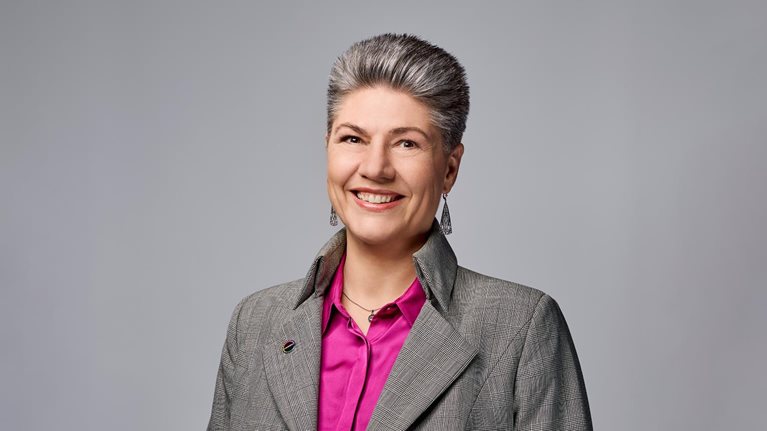
As expectations for marketers rise, LinkedIn’s CMO, Jessica Jensen, argues that AI’s next chapter will be defined less by experimentation than by results. She and McKinsey senior partner Dianne Esber explore how AI is changing the growth mandate, where it can create leverage across B2B marketing, why human judgment and trust become more valuable as content proliferates, and what LinkedIn’s labor-market signals suggest about the future of skills and work.
The following transcript of their conversation has been edited for clarity and length.
The new growth mandate
Dianne Esber: What are you seeing at Cannes, and what are some of the trends people are really talking about?
Jessica Jensen: I think we’re in the “proof is in the pudding” phase with AI.
Every CMO is in the hot seat to grow revenue faster than before, reduce head count, cut costs, market to new audiences, get content into large language models (LLMs), and sell to agents. I like to call it the “CMO blender” that we’re living in.
When I’m speaking with CMOs, a lot of the conversation is about how we’re reformatting our teams to embrace AI and drive value from it. We’re trying to help our customers realize that the best B2B work is emotional.
Dianne Esber: What advice would you give CMOs today?
Jessica Jensen: Some of our teams are technically savvy and jump in, learn the tools, and build amazing things.
You need to think about which tools address which jobs to be done, against which goals, and with what training. You can’t have your engineering team do the training for your marketers. You have to have marketers learn and train marketers.
Experimentation serves a purpose, but it will not get you where you actually need to be. What are the top jobs to be done? Expanding your customer base? Growing engagement? Conversion? Pipeline management? What are the right AI tools and agents to build for those priorities? And are you tracking the metrics month after month to know that you are winning?
That level of intentional, and sometimes invasive target setting is what is required.
Where AI creates leverage
Dianne Esber: What do you see as AI’s potential in B2B, and how do you see creativity evolving?
Jessica Jensen: I think AI’s potential is almost infinite. Think about synthetic research and insights creation, combining sales and marketing data sets, “agentification” of targeting and nurture programs, and everything you can connect between sales and marketing. That area is so ripe.
AI can also make measurement more rapid, visible, and fruitful. And for creative ideation, testing, and rapid iteration at scale, it’s invaluable.
If you’re running a global business, things that used to take months and millions of dollars can now be done with AI. We’re using it to cover 60 countries at a time.
For the right purposes, we’re also getting close to the point where AI-generated images and video can be integrated into campaigns. I still believe human creativity and human judgment rule the day today and will in the future. But what you can scale and build creatively is pretty remarkable.
The human advantage
Dianne Esber: LinkedIn has a unique view into skills and how work is changing globally. What should marketers and other leaders be paying attention to?
Jessica Jensen: We have 1.3 billion people and 70 million companies on LinkedIn, so we have quite a bit of data on work, labor, and job skills.
Here’s something that tends to shock people: AI skill requirements in job listings have risen 113 percent in the last year. Yet the number of people on LinkedIn who have AI skills on their profile is 4 percent.
If you have AI skills, why aren’t they on your LinkedIn profile? Are you creating videos that demonstrate what you’re learning and what you’re building with AI? That is how you build credibility.
But I also want to make a plea for quality writing; clear and effective speaking; negotiation; and human engagement. Those are skills we hire for, and they are mandatory.
If you combine those with AI, you are a diamond.
When content is abundant, human voices matter more
Dianne Esber: AI is making content much easier to create. What will make content stand out when there can be infinite variations?
Jessica Jensen: People will trust you if they can see you, hear you and feel your personality, your passion, your expertise, and your honesty. What are you struggling with? What’s hard?
You do have to produce content to be visible in LLMs. That is very important for discovery. But people buy from people, and people trust people.
That means using creators to tell your story since people trust creators they follow. It means asking whether the people who know your brand best are sharing that story themselves.
Dianne Esber: You live that yourself on LinkedIn. How do you think about the balance between being authentic and being overproduced?
Jessica Jensen: People do not trust corporate tools spouting corporate “toolery.” People trust people who have a point of view, a personality, maybe even occasionally a sense of humor.
Do you have something interesting to say that is helpful to other people? And can you do it in a compelling, human way?
When I joined LinkedIn, I wasn’t a video sharer. But once you do it 20 times, it becomes like brushing your teeth. You’re just talking to the world and sharing something that’s on your mind.
Rewiring marketing for performance
Dianne Esber: The companies seeing real impact are rewiring processes and rethinking functions from an AI-first perspective.
People often think of AI transformation as a technology journey. In reality, these big transformations are people transformations.
Jessica Jensen: I think it’s 80 percent people and 20 percent technology. Actually, probably 20 percent data, 10 percent technology, and the rest is people.
Good reasons for optimism
Dianne Esber: Amid so much uncertainty, what signals are you seeing that make you optimistic about the future?
Jessica Jensen: I am super-bullish on the ability of AI and creativity to help teams get rid of so much drudgery and do really interesting, important work in a new and liberating way.
New roles are emerging. I also oversee the economics group at LinkedIn and our labor data. AI is producing more jobs now than it’s killing, and that’s true of any major technological change. LinkedIn’s Economic Graph research supports that view. Its latest analysis finds that, in the near term, AI is creating more jobs than it is replacing, including 1.3 million new AI-related jobs globally from 2023 to 2025.
We’re also going to have more portfolio careers. You might be a creator and run a small business and do some part-time consulting work, then go full-time somewhere for a couple of years while still being a creator.
The “anding” of careers is amazing. Young people today might say, “I have five jobs at the same time. I do them all from my phone.”
That is becoming a way of life.