After several years of postpandemic normalization, e‑commerce has reasserted itself as the primary growth engine for retail and consumer businesses. This resurgence is unfolding against an uneasy macroeconomic backdrop. European consumers remain cautious: nearly three‑quarters report trading down in response to inflationary pressure, and growth across many retail categories has slowed.
Yet within those constraints, digital commerce continues to expand—growing at an estimated 5 to 7 percent annually, largely driven by marketplaces—and is projected to remain one of the most competitive arenas of growth globally over the long term (Exhibit 1).
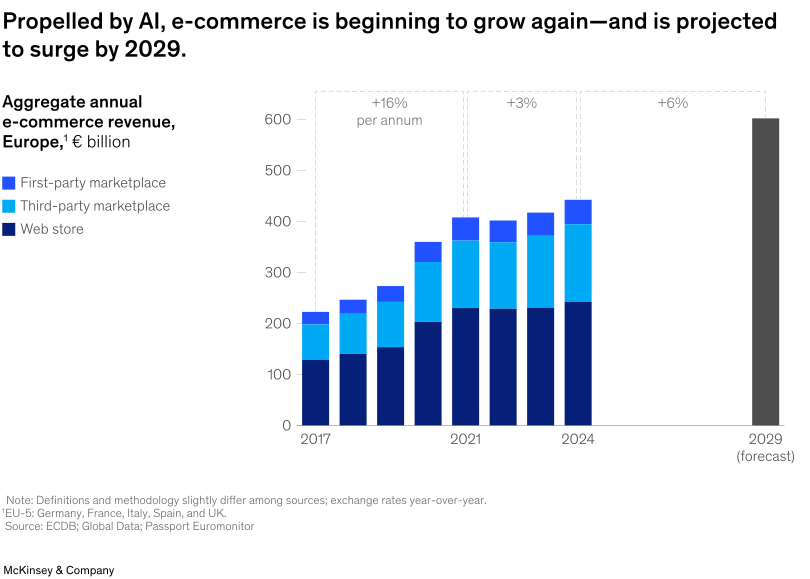
What distinguishes this cycle from earlier waves of e‑commerce growth is not demand alone, but capability. Artificial intelligence has moved from the periphery of retail operations to the center of value creation. Generative models are reshaping discovery, content, and customer interaction. Analytics are turning pricing, assortment, and fulfillment into continuously optimized systems rather than periodic decisions. And agentic AI—systems that can reason, plan, and act—are beginning to take on parts of the shopping journey themselves.
The result is a structural shift in how commerce works. The interface between consumers and retailers is changing. The economics of growth are changing. And the basis of competitive advantage is changing with them.
In this article, we outline five shifts reshaping the e‑commerce agenda, examine how AI can help leaders navigate—and capitalize on—those shifts, and describe the organizational moves required to turn intelligence into sustained advantage. Along the way, we share perspectives from senior leaders at some of Europe’s most influential retailers, reflecting how these changes are already playing out on the ground.
Five shifts reshaping e‑commerce
AI is the next paradigm shift in e‑commerce. Just as we moved from catalogs to online, from online to mobile, and from mobile to platforms, AI will fundamentally change how customers shop and how we serve them.
Across markets, business models, and categories, five shifts are emerging that will define the next phase of digital commerce. While retailers and brands are entering this period from very different starting points, the pressure to adapt is universal. The winners will be those that convert disruption into leverage—using intelligence, scale, and speed to build deeper customer relationships and more resilient operating models.
Agentic commerce is changing the playing field
E‑commerce is moving beyond interfaces designed solely for humans. AI is no longer confined to recommendation engines or back‑office optimization; it is increasingly becoming an active participant in the buying process itself.
Today, many consumers already rely on AI‑powered tools to help them search, compare, and evaluate products. What comes next is more consequential. Agentic systems—AI that can interpret intent, evaluate options, and execute multistep actions—are beginning to shop on consumers’ behalf. Rather than browsing pages or scrolling feeds, customers may increasingly delegate tasks such as finding the best offer, reordering staples, or assembling a full basket that meets specific constraints on price, brand, delivery speed, or sustainability.
I foresee three distinct customer journeys evolving: One segment prefers the traditional shopping experience, often cautious about AI and data privacy. Another embraces hyperpersonalized recommendations, especially influenced by social media. Finally, a new “headless commerce” model, where AI assistants shop seamlessly on behalf of users across multiple platforms.
This shift changes how competition works. Instead of competing primarily for clicks or attention, retailers increasingly compete to be selected by algorithms acting on behalf of consumers. Product data, pricing logic, availability signals, and fulfillment reliability all serve as inputs to automated decision‑making. Platforms and brands that are legible, trusted, and consistently performant gain visibility; those that are not risk being bypassed.
The value at stake is substantial. McKinsey research suggests that by 2030, global B2C retail could see $3 trillion to $5 trillion in orchestrated revenue flowing through agentic commerce models. And consumer interest already is on the rise. Recent McKinsey research shows that 38 percent of European consumers now use gen AI tools to help research products and services and decide what to purchase. For leaders, this requires a shift from optimizing front-end experience alone to ensuring back-end systems—product data, pricing logic, and fulfillment reliability—are machine-readable, trusted, and consistently performant.
Commerce becomes media and media becomes commerce
The traditional separation between inspiration, marketing, and transaction is breaking down. Increasingly, consumers encounter products, form preferences, and complete purchases within the same digital environment—often within seconds.
In practical terms, this means shopping experiences are becoming feed‑based rather than page‑based. Products appear alongside entertainment, education, and social interaction. Short‑form video, live streams, and creator content do not simply drive traffic to e‑commerce sites; they are the storefront.
TikTok Shop’s expansion in Europe is only the most visible expression of this broader shift. As discovery and transaction converge, retailers must operate simultaneously as merchants and publishers—developing creative capabilities, content production engines, and feedback loops that allow them to respond to cultural moments in real time.
Our goal is to make every online interaction feel as thoughtful and crafted as our jewelry. It sounds simple, but it’s incredibly difficult to execute at scale.
In this environment, relevance, not reach, becomes the scarce resource. AI increasingly determines which content is created, which variants are tested, and which messages are shown to whom, turning creativity itself into a data‑driven growth lever.
Retail media emerges as a structural margin lever
As customer‑acquisition costs rise and traffic becomes more valuable, retailers are rethinking how they monetize attention. Retail media has evolved from a side experiment into a core commercial engine.
At its simplest, retail media allows brands to promote products within a retailer’s digital environment. At its most advanced, it becomes a fully fledged advertising business—one that combines first‑party shopper data, high‑intent audiences, and direct visibility into sales outcomes. This allows advertisers to see not just who was exposed to an ad, but whether it actually led to a purchase.
This culture of continuous tech innovation drives us forward and builds the basis for our advertising business.
Building these networks requires new capabilities: privacy‑compliant data governance, sophisticated on‑site merchandising formats, and commercial teams that operate more like agencies than traditional retail sales. But the economics are compelling. Media margins can be up to ten times higher than core retail margins, creating a self‑funding engine for further digital and AI investment.
Omnichannel is reinvented through intelligence
Consumers have long moved fluidly across online and offline channels. What has changed is retailers’ ability to manage that complexity in real time.
AI is giving omnichannel strategy a new edge. By integrating behavioral, transactional, and operational data, leading players are optimizing pricing, promotions, inventory, and service across entire journeys rather than isolated touchpoints. Orders are dynamically routed between stores and warehouses; availability, pricing, and delivery promises adjust continuously based on demand and capacity.
Customers don’t think in channels, and neither should we. Omnichannel means unified pricing, promotions, and service—and optimizing for the entire customer journey, not just individual touchpoints.
While use cases vary by category—styling continuity in fashion, consultation in beauty, efficiency in grocery—the underlying shift is consistent. Intelligence increasingly replaces manual coordination as the mechanism that holds the system together.
Chinese disruptors pose a systematic, multifront challenge
Competitive pressure from China is reshaping expectations on price, speed, and integration. The threat is not monolithic, but it is persistent and multifaceted.
On one front, manufacturer‑led brands are moving up the value chain, pairing supply chain mastery with growing brand‑building sophistication. On another, low‑cost platforms are redefining value by compressing delivery times, expanding assortment, and eliminating intermediaries. At the same time, large China-based platforms are exploring entry into Western markets through partnerships and alliances.
We are navigating in an increasingly competitive market with new giants with deep pockets entering. Our strategy is to build a brand with character, create customer love, and deliver on promises like trust, quality, and relevance.
Not all retailers are equally exposed. Premium and experience‑led players retain defensibility through trust, curation, and service. This is especially powerful in an omnichannel world where differentiation can be obtained in other channels. Some retailers are experimenting with curated marketplaces that integrate Chinese supply while maintaining Western standards of quality and customer experience.
From experimentation to enterprise value: The AI levers that create advantage
In the early days of AI adoption, many retailers focused on isolated pilots—chatbots here, demand forecasting there. What distinguishes today’s leaders is not experimentation, but integration. AI is increasingly deployed as a set of interconnected levers that reinforce one another economically. Four value levers stand out (Exhibit 2).
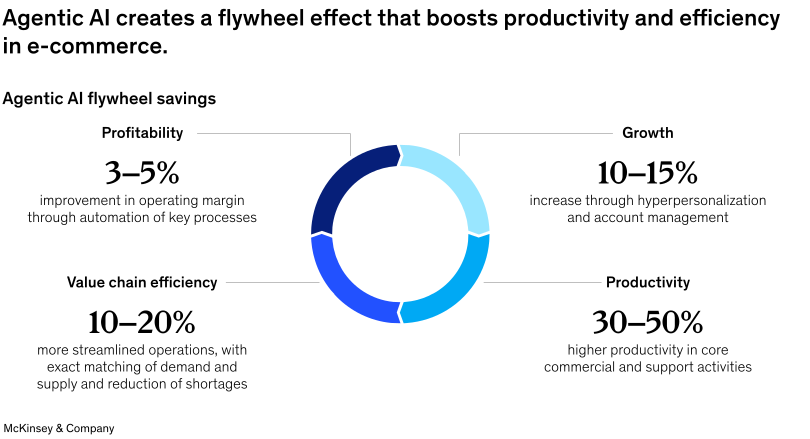
- Growth: personalization and intent‑based, conversational commerce. Generative and predictive AI enable experiences tailored to each customer, moment by moment. Next‑best‑offer engines combine behavioral and contextual data to deliver double‑digit uplifts versus static segmentation. Conversational shopping assistants guide discovery and checkout, increasing conversion and basket size directly on the retailer’s site. Leading retailers report conversion rates of 50 percent and greater through on-site AI bots compared with the regular shopping channel. At the same time, AI‑generated creative allows retailers to test thousands of localized campaign variants, turning media into a learning system rather than a fixed plan.
- Productivity: automation that scales talent. The largest near‑term value pool lies in productivity. In customer care, generative copilots handle routine inquiries and summarize interactions, reducing handling time by 40 to 60 percent while improving satisfaction. At a leading sportswear company, AI copilots in customer service reduced handling time by more than 40 percent while improving first-contact resolution. And in back-office functions, many retailers and brands have started to see the impact of agentic AI and gen AI. In finance, AI automates reporting, forecasting, and reconciliation, freeing up significant manual capacity and allowing for a focus on higher-value-adding tasks. In HR, AI‑driven sourcing and screening dramatically compress recruiting cycles. These are structural shifts in how work gets done, not incremental efficiencies.
- Margin: precision in pricing, assortment, and media. Daily trading of millions of SKUs is now empowered through a merchant AI agent. AI‑driven pricing algorithms continuously balance competitiveness and profitability, typically improving gross margins by two to five percentage points. Predictive assortment models localize product mixes, reducing markdowns and stockouts by 15 to 30 percent. Retail media adds a further margin engine, monetizing traffic through targeted, measurable advertising with economics far superior to core retail.
- Supply chain and omnichannel intelligence. Predictive demand planning aligns production, inventory, and fulfillment with near‑real‑time precision. Retailers applying AI in supply chain management have reduced inventory costs by 10 to 20 percent and stockouts by up to 30 percent, while improving service levels and lowering emissions. At a leading omnichannel retailer, AI-based demand and inventory optimization reduced stockouts by more than 25 percent while lowering working capital requirements. For omnichannel players, AI dynamically routes orders across stores and warehouses to minimize cost and maximize reliability.
Individually, each lever creates value. But when they work together, they form a flywheel. Better personalization increases engagement and media yield; richer media data improves demand signals; improved demand signals sharpen pricing, assortment, and inventory decisions; and stronger operational performance feeds back into customer experience. Each interaction generates data that improves the next decision. Once in motion, this flywheel compounds advantage over time—creating proprietary intelligence, faster learning, and economics that are difficult for competitors to replicate.
From insight to execution: The emerging leadership agenda
Across sectors, leading companies are translating these shifts into a focused set of moves. For retailers, five actions stand out:
- Make your business “agent ready” to create an agentic shopping experience: Ensure product data, pricing, availability, and fulfillment signals are structured, accurate in real time, and accessible so AI agents can reliably select and transact on your assortment.
- Build a content and media engine, not just campaigns: Shift from episodic marketing to always-on content production powered by AI, with rapid testing of formats, creators, and messages tied directly to conversion.
- Stand up retail media as a profit and loss (P&L) for scale, not a pilot: Treat retail media as a core business with dedicated leadership, clear monetization logic, and tight integration into merchandising and pricing decisions.
- Embed AI into daily trading decisions: Move from periodic planning cycles to continuous optimization of pricing, promotions, and assortment—supported by merchant-facing AI tools.
- Rewire the operating model, not just the tech stack: Align incentives, decision rights, and workflows so that AI insights are systematically acted upon and not overridden or ignored.
Companies that incorporate these moves early are already seeing a step change in growth, margin, and speed. If technology creates the potential, outcomes are determined by execution. Indeed, even when retailers deploy similar AI tools, results diverge sharply. The difference lies in how deeply intelligence is embedded in everyday decision‑making. That’s where Rewired comes in.
Building on our firm’s global transformation research, McKinsey’s Rewired framework provides a practical blueprint for turning AI-powered strategy into scalable capability. The essence is simple but demanding: rewire how decisions are made day-to-day—embedding AI into pricing, content creation, media allocation, and supply chain planning while aligning teams and incentives around these systems. Crystal-clear ambitions backed by solid business logic and strong executive leadership are essential. So are robust data foundations and sound governance.
The bottom line: The next era of e‑commerce will be defined not by technology alone, but by how effectively leaders combine intelligence with judgment. Advantage will accrue to those who move early, integrate deeply, and invest where learning compounds. For CEOs and their teams, the mandate is clear: Treat AI not as a set of tools, but as the foundation of the commercial system itself. Those who do will help define the markets that others merely compete in.


.jpg?cq=50&mw=767&car=16:9&cpy=Center)