Belgium has one of Europe’s most prosperous populations, high life satisfaction and household wealth, strong research capabilities, and an economy built on world-class industries spanning pharmaceuticals, heavy industry, food, and logistics. Yet over the past three decades, the country’s economic focus has drifted as employment has moved to low-productivity sectors, while the most productive ones have seen declines.
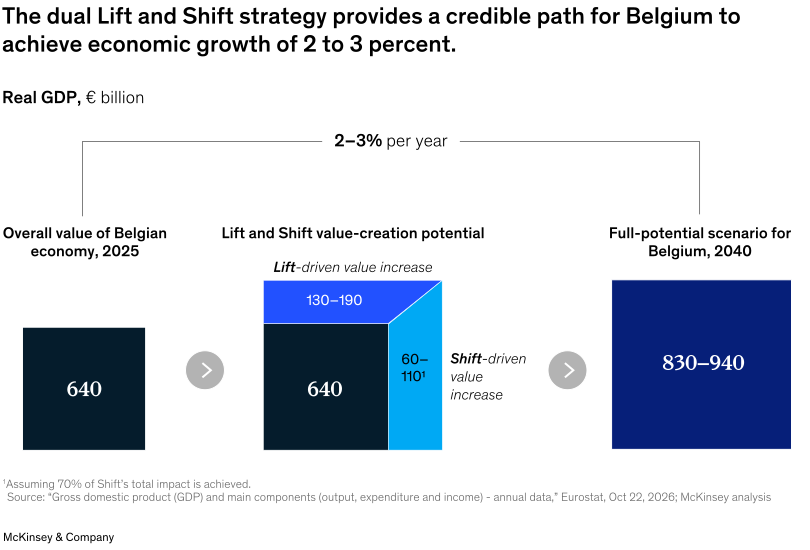
This drift is not inevitable, and Belgium has an opportunity to address it. This report sets out a bold vision in which Belgium more than doubles its economic growth from about 1 percent annually currently to 2 to 3 percent per year by 2040. Such growth would create new jobs, raise skill levels, and build out infrastructure for energy, ports, tech, and more.
The key to achieving this vision will be boosting productivity growth, along with raising the employment rate. Belgium is a productivity leader in Europe, but its productivity growth rate has dwindled over the past three decades.
Two major initiatives at the intersection of AI and Belgium’s most promising industrial sectors could help reverse the trend. The first, which we call “Lift,” aims to increase the effectiveness of everything the country already does, including through significantly accelerated investment in automation, robotics, and AI. The second, “Shift,” focuses on high-impact opportunities in seven sectors: recycling, biopharma, defense and aerospace, AI and tech, quantum technology, construction, and logistics.
These initiatives will require a coherent national strategy to improve the ease of doing business in the country and ensure more affordable energy, among other changes. They would also have major implications on the job market and require scaled-up workforce training at all levels.
Belgium is a highly innovative place, and some of these actions are already starting to happen. Much more is needed, with the private sector and government working together in a concerted effort to lift the country’s prosperity and prospects. In short, Belgium needs to be bold—and now is the time to start.
This article is an abridged version of the full report, which can be downloaded here.
Regaining lost momentum
Belgium has strong foundations on which to rebuild a leadership position as one of Europe’s most dynamic economies—including world-class industries, a central location in northwestern Europe, and research excellence—and it has long been a productivity powerhouse (Exhibit 1).
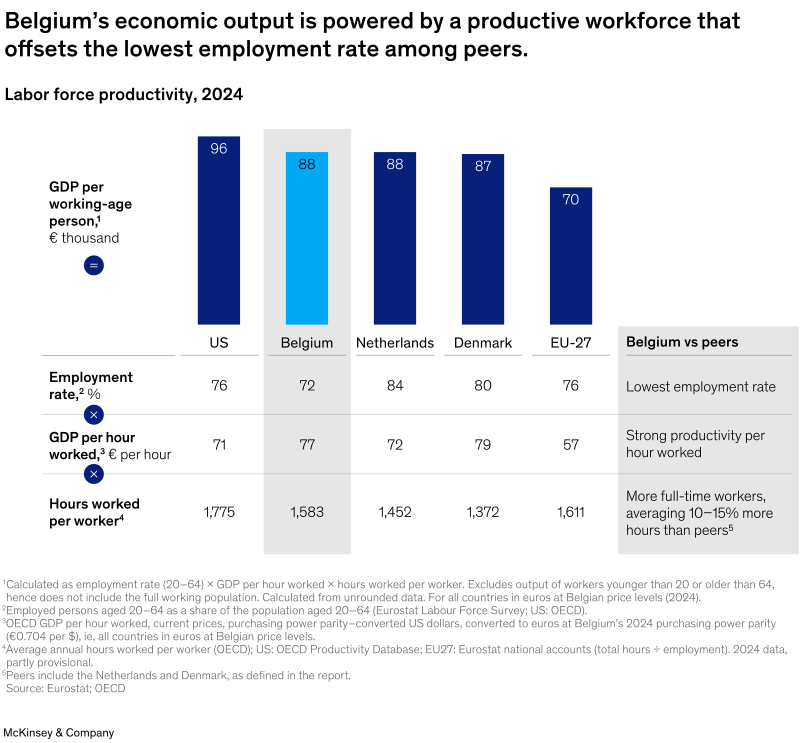
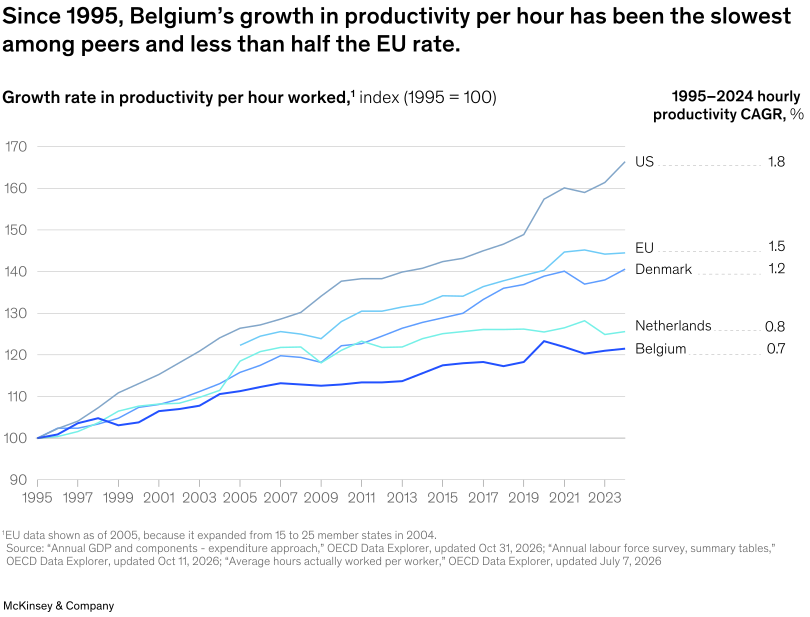
But today, Belgium faces a productivity growth challenge. The country’s economic output is powered by a workforce that is among the most productive in Europe, but its relatively high productivity level is primarily a legacy effect, dating back to the sustained productivity growth the country achieved in the 1960s to 1980s. Since that time, Belgium’s productivity growth slowed and stayed near zero for more than a decade after the 2008 financial crisis as employment and investment shifted more toward lower-productivity sectors. Productivity per hour worked has grown by just 0.7 percent annually on average since 1995, less than half the EU rate1 (Exhibit 2).
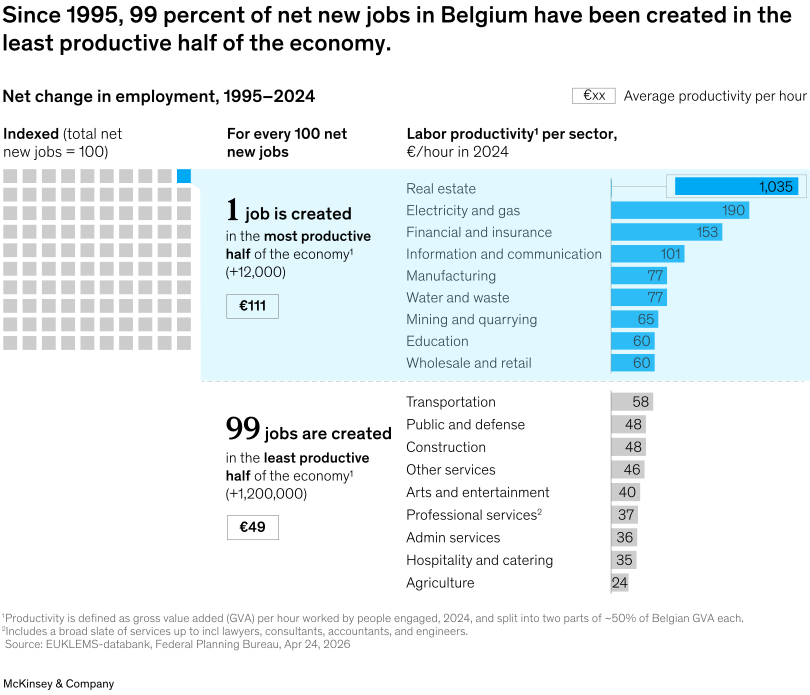
Two trends underlie this declining productivity growth. The first is a marked shift toward service sectors, several of which are funded through public expenditure, including administrative services. Almost all net new jobs created in the country since 1995 are in the lowest-productivity sectors (Exhibit 3).2
The second is that productivity in internationally competitive, high-productivity sectors that contribute to economic growth, exports, and the tax base has been growing more slowly in Belgium than in some other countries.
As a result, Belgium’s industry share declined from 30 percent in 1995 to 22 percent in 2021, while the services that replaced industry have lower productivity growth than in peer countries. Even high-productivity services in Belgium generate an annual productivity growth of just 1.1 percent on aggregate, below the EU average and about one-third the rate in the United States.
A credible path to more than doubling Belgian growth
The ambition to more than double economic growth in Belgium over the next 15 years is unapologetically ambitious but also within reach. Together, the Lift and Shift initiatives could unlock €190 billion to €300 billion in additional yearly GDP by 2040 (Exhibit 4).
Lift: Rewiring Belgium to raise the productivity of all existing economic activity
The Lift strategy would rewire the Belgian economy to achieve substantial productivity gains across all sectors through a significantly accelerated adoption of available operational excellence, digital, and various forms of AI.
We assume that Belgian productivity could rise 20 to 30 percent by 2040. The McKinsey Global Institute’s automation model estimates that up to 56 percent of work hours in Belgium could potentially be automated using currently existing technologies, and that levels of 26 percent could be achieved as early as 2030. In sectors where adoption of earlier productivity-uplifting techniques has been low or slow, AI can serve as a catalyst and an opportunity to catch up.
Economic gains are assumed to come from being able to do more with the existing workforce and reallocating 100 percent of affected workers across the economy. There could also be more employment in existing sectors where higher efficiencies lead to lower costs and more demand for products or services. In addition, new jobs would be created to operate and implement new technologies.
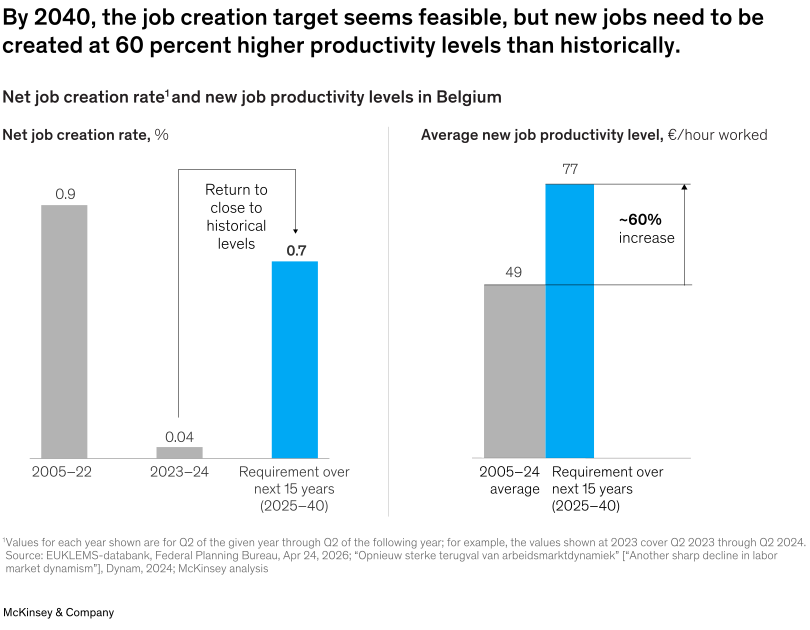
While the scale of the required job creation and redeployment effort is significant, it is in line with Belgium’s historical achievements for both net and gross new jobs. The more challenging task will be to create these new jobs in sufficiently high-productivity activities to realize the foreseen GDP growth (Exhibit 5). Over the past 20 years, the average productivity of net new jobs was about €49 per hour worked.3 This would need to rise to at least €77 per hour worked in the future.
Shift: Developing high-growth and high-productivity ecosystems
Whereas Lift modernizes what Belgium already does, Shift is a national industrial strategy to drive growth by expanding into activities with outsize GDP growth opportunities, mostly in intrinsically high-productivity sectors. It would move the economy back to a healthier balance with more high-productivity sectors, such as industry and manufacturing, and a smaller share of low-productivity sectors.
We prioritized seven exemplary ecosystems that, together, are expected to materially contribute to GDP. The total sum of the seven Shifts, after applying a capture rate of 70 percent, adds €60 billion to €110 billion of uplift potential by 2040. All things being equal, this would prevent further decline and potentially add five to six percentage points to the share of industry and manufacturing in the economy.
Some of the ecosystems build on existing and distinctive strengths. For example, Belgium has productive steel, refinery, and waste recycling plants, which would be the foundation for materials recycling and provide a boost to the broader heavy-industry sector. Biopharma could build on activity already taking place in Belgian universities, research labs, clinical trial ecosystems, and production facilities (Exhibit 6). Beyond these seven ecosystems, there are of course other sectors that are vibrant and have significant growth potential. One of them is the agri-food sector. It constitutes a diverse group of world-leading players along the entire value chain. It aspires to catch the wave of new food innovation, including healthier nutrition, and attract more investments to grow local capabilities and value creation.
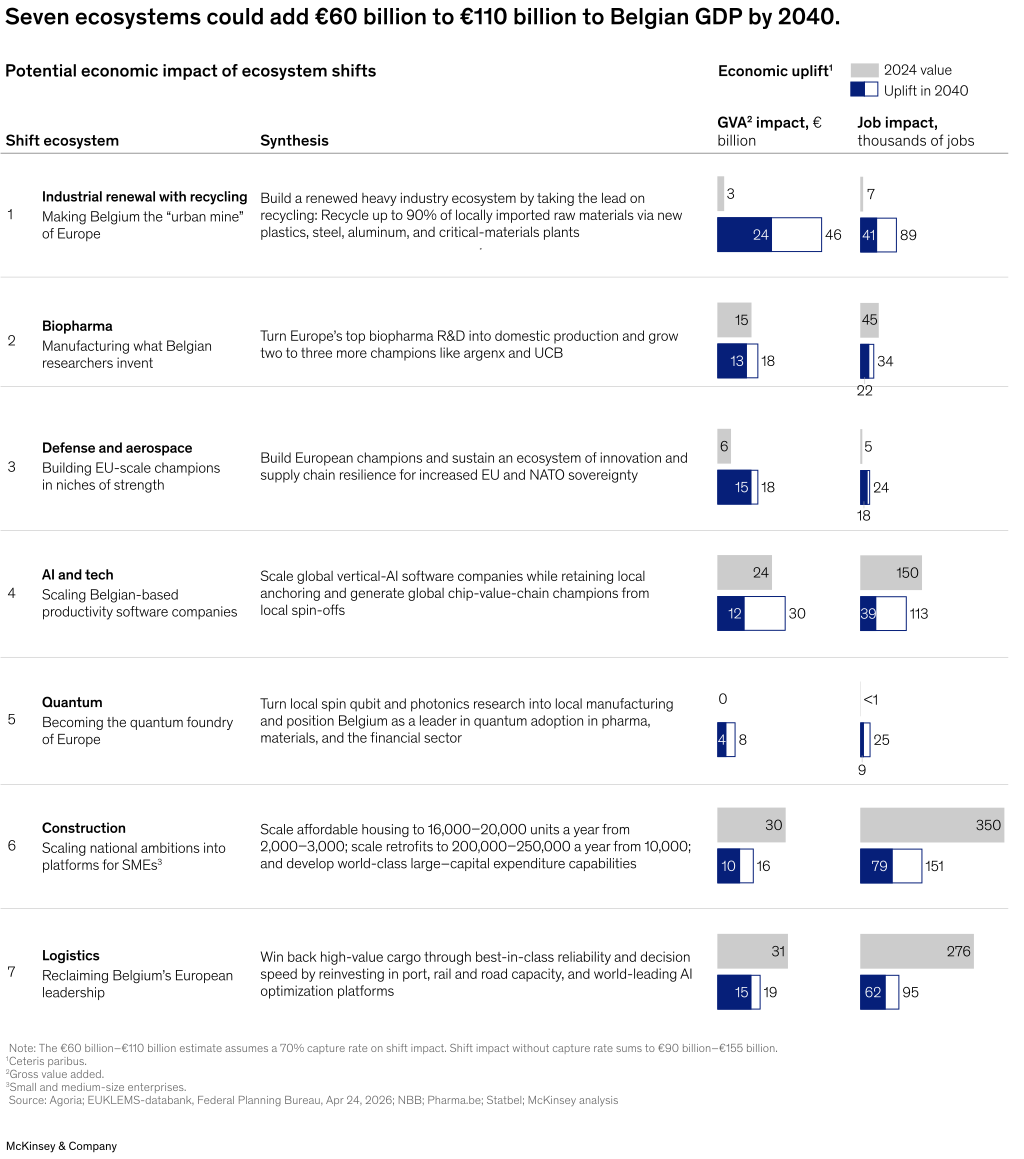
Industrial renewal with recycling: Belgium has a market opportunity to build on its existing strengths in materials recycling to become the circular-material market leader, or “urban mine,” in northwestern Europe, particularly in plastics, base metals, and critical materials. The ambition is to recycle 90 percent of all materials used and imported in Belgium,4 along with some of the waste and materials used by France, the Netherlands, and other neighbors. Achieving this could raise gross value added (GVA) by between €24.0 billion and €46.0 billion, compared with €2.7 billion today, according to our estimates. Belgium already has large integrated operators with global reach, as well as a long tail of more than 1,500 specialized recyclers. To step up into a European leadership role, Belgium would need to build a new industrial base across manufacturing and logistics hubs for prioritized materials, anchoring state-of-the-art plants and technology domestically.
Biopharma: Belgium is already a powerful force in biopharma science, with annual biopharma R&D spending of €5.7 billion and exports of about €78 billion,5 but the sector is under pressure: Commercialization value is leaking offshore in part because of high production costs. The opportunity is for Belgian companies to manufacture locally far more of the inventions produced by Belgian R&D researchers. To do so, Belgium would need highly advanced technology coupled with the effectiveness practices outlined in the Lift section. Adopting world-class capital expenditure practices would also reduce the cost of construction and equip manufacturers with “plants as a product” solutions to expand more rapidly and cheaply. If the industry seized this opportunity, Belgium by 2040 could serve as a top three global hub for high-value life sciences R&D and manufacturing. In such a scenario, existing majors would have multiplied, driving a thriving ecosystem that would link world-class hospitals, cutting-edge research institutes, and global life sciences champions across vaccines, cell and gene therapy, nuclear medicine, and more. In all, we estimate that Belgium’s biopharma industry has the potential to increase GVA by €13 billion to €18 billion by 2040.
Defense and aerospace: Belgium hosts an active ecosystem of defense manufacturing that produces high-end components for advanced EU and NATO equipment. At a time of rising defense spending in NATO countries and growing hybrid warfare that uses cyber and drones, Belgium has an opportunity to build defense businesses, make investments, and create high-value new jobs, both in its existing defense capabilities and in adjacencies in which the country has distinctive capabilities. Supporting the consolidation of midsize companies would help position them as leaders in their subsector. Larger champions also typically act as M&A platforms to propel innovative start-ups to industry scale. Close collaboration between the government and businesses could help position Belgian companies in large-scale supranational procurement programs and encourage foreign expert manufacturers to establish a footprint in Belgium. We estimate the potential uplift to the aerospace and defense sector in terms of GVA at between €13 billion and €18 billion in 2040. To realize it, Belgium would need to establish itself as a top-shelf location to develop, test, and produce military equipment and applications.
AI and tech: While Belgium is home to imec, a world-leading semiconductor R&D center, it doesn’t yet have a global company that commercializes the fruits of that research. Belgium’s total information and communications technology sector, spanning hardware and software in addition to AI, generated €24 billion in value in 2023, or around 4 percent of the Belgian economy.6 Software is experiencing growing momentum, with companies such as Odoo and Collibra achieving European or global scale while others are pioneering AI-powered software for robots. Ghent, which hosts Wintercircus and is home to four of Belgium’s unicorns, now ranks among the ten densest tech cities globally.7 The opportunity for Belgium is to scale such AI-native ecosystems with the aim of producing more locally anchored champions. For hardware, building a commercialization ecosystem around next-generation chip, photonics, and edge-AI research could develop scaled companies with a footprint in Belgium. We estimate the potential uplift from AI technology in terms of GVA to be between €12 billion and €30 billion in 2040.
Quantum technology: Belgium has a strong foundation in the industries in which quantum technology is expected to have an impact, including chemicals and pharmaceuticals, but for now, few Belgian companies are experimenting in this field. Belgian companies thus have an opportunity to create meaningful competitive advantage by adopting quantum technology across three growth horizons in the next decade. As with AI, the ambition is to translate Europe’s leading research into commercialization. Belgium has made headway in early manufacturing of spin qubits and quantum chips. Now it has the opportunity to build on Belgian research proficiency, gather public support, and build existing quantum talent as a launchpad to start and scale pilot projects. With the race still open, we estimate the potential uplift from quantum could potentially contribute €4 billion to €8 billion in GVA to the Belgian economy by 2040.
Construction: We see three potential major opportunities for the construction sector: first, a ramp-up of affordable housing; second, an acceleration of energy retrofitting for old, poorly insulated building stock; and third, an increase in construction productivity and delivery speed of large-scale capital expenditure projects overall. For affordable housing and energy retrofitting, the sheer scale of the endeavors would provide small and medium-size enterprises in Belgium an opportunity to considerably raise their productivity and move into state-of-the-art construction methods. A broader effort to raise productivity would enable the other strategies in this report: Industrial investment, logistics infrastructure, and new technology facilities all depend on assets that have to be built quickly and at a cost that can be earned back. An important question would be whether the sector could mobilize sufficient manpower to achieve such scaling. If it were able to do so, the uplift to the sector in terms of GVA could be about €10 billion to €16 billion in 2040, according to our estimates.
Logistics: Belgium has a uniquely favorable position to act as a logistics hub, given its geographical location and dense infrastructure of roads, rail, and canals, including the Port of Antwerp-Bruges, a major European gateway, as well as Liege and Zaventem Airports and the second-densest rail network in Europe.8 Logistics has long been a strong point for the economy and currently generates €31 billion in value, or 6 percent of Belgium’s GDP.9 The challenge is that Belgium has been losing out to competitors in attracting high-value cargo. Underinvestment in both physical assets and digital tools has increased congestion and reduced reliability, further compounded by certain aspects of existing labor regulations and intramodal friction. The opportunity for Belgium to reclaim its leadership in European logistics hinges on large-scale reinvestment in infrastructure. This includes both AI-enabled optimization and decision-making platforms for multimodal cargo flows, as well as investment in new capacity and solutions and continued engagement with key international trading partners. We estimate the potential uplift to the logistics sector in terms of GVA at €15 billion to €19 billion in 2040.
What it will take
Belgium will need a coordinated national industrial strategy if productivity and growth are to rise sharply. Such a national strategy would foster investment, reduce risk, and improve returns by creating longer-term and relatively more stable frameworks in which business can operate and grow. Here, we focus on four recurring elements in our analysis of what it would take to achieve the vision spelled out in this report: ease of doing business, talent, energy, and capital. We also quantify the investment needed to deliver on the ambition outlined in the report.
Ease of doing business: Enabling investment conditions
Belgium needs to be an easier place to do business—a fact openly acknowledged by the country’s political leadership.10 Entrepreneurs and business leaders often mention a converging set of challenges including administrative costs per employee that are estimated to be eight times higher for smaller companies than larger ones,11 and fragmented permitting processes. Business leaders also cite a relatively high tax burden on labor along with automatic undifferentiated wage indexation. Improving the ease of doing business and the cultural appraisal of conducting it in Belgium would thus be critical to realize the economic ambition outlined in this report and attract global investors and capital allocators to “Choose Belgium.”
Talent: Step up learning at all levels to prepare the workforce for the 2040 economy and beyond
One of the two conditions required to more than double GDP in our modeling is a sharp boost in labor activation: The working population would need to increase in absolute terms, rising from about 4.9 million people to 5.4 million, bringing the employment rate from 73 percent to 80 percent. Among the implications of the Lift and Shift initiatives is that types of skills and jobs would change substantially. We estimate that 50 to 70 percent of jobs would require up- and reskilling, and that by 2040 around 2.3 million new entrants into the job market would need to be equipped with the right skill sets. All told, more than five million people would need some form of training or retraining.
Such large-scale redeployment would require an ambitious transition for the country’s education and training systems in three respects. First, workforce skills requirements would need to be better aligned with the labor market’s needs. Second, both the capacity and offerings of the training and education ecosystems would need to be improved. And third, Belgium would need a cultural shift toward lifelong learning, in which adults continue to adapt their skills to the changing demands of the work environment.
To achieve these ends, Belgium would need to simultaneously strengthen the foundations built in K–12 schools, community colleges, and universities; better connect education with the workplace; increase participation and effectiveness of adult learning and reskilling; and expand the pipeline into the fields in highest demand.
Energy: Making energy in Belgium more affordable
We quantify a scenario in which Belgium reaches an ambitious 80 percent electrification level, exceeding European targets.12 While achieving this goal will not be easy, we consider it to be an essential enabler in shifting to a more prosperous society. It would substantially reduce Belgium’s dependence on fossil fuel imports and allow for a more affordable and controlled cost of energy.
A long-term holistic energy strategy would likely be required to create the environment for investment and build in the right incentives for both industrial and household consumers. Such a strategy could be built on three pillars: first, stepping up energy efficiency by reducing losses and electrifying at scale; second, maximizing generation of domestic renewables; and third, making the energy system more flexible, through deployment of batteries, modularization of demand assets, and network investments. Achieving these objectives would be in part a government responsibility, but it would also require significant private capital.
Capital: Further scale solutions for long-term (infrastructure) financing and growth capital
Belgium does not lack capital; the challenge is how effectively it is intermediated toward productive investment for some particular financing needs. Belgium’s financing model remains heavily bank-intermediated and less developed at two important frontiers.
First, Belgium has a relatively small domestic pool of institutional capital and lacks a proven, repeatable mechanism to bring foreign institutional investors into large projects such as public–private partnerships. Second, Belgium has a gap between vibrant early-stage innovation, characterized by institutions such as imec and VIB, and mature growth capital. Private and venture equity investment in 2024 represented just 0.3 percent of GDP, below the EU-15 average of 0.5 percent.13 Funds tend to be smaller, and Belgian pension funds allocate only about 8 percent of assets to alternatives, versus an EU-15 average of 11 percent.14
Ultimately, scaling these efforts should unlock a virtuous cycle: Better industrial projects to finance will draw more capital, and more capital will unlock more projects.
Focused investment: A critical enabler
We estimate that investments needed to deliver all of the Lift and Shift initiatives will total a cumulative €650 billion to €900 billion by 2040, or about €50 billion to €65 billion extra per year versus today’s €150 billion. Overall, we estimate Belgium’s investment-to-GDP ratio would need to increase from 24.4 percent today to 27.4 percent by 2040. Belgium could also consider rebalancing its investment from lower-productivity assets to more-productive ones. A rise of three percentage points roughly coincides with an uplift to GDP growth of 1.0 to 1.5 points. Such investment levels would bring Belgium closer to other high-end manufacturing economies such as South Korea, Japan, and Switzerland. It would also be close to Belgium’s pre-1980s level of about 26 percent.15
Sparking the momentum
The bold vision outlined in this report does not need to wait. From a timing perspective, it will be important to deliver on Lift right away, because Shift could take five years or more to bear fruit. The fundamental enablers will also need to be in place: An upsurge in manufacturing can only happen with more affordable energy and a stronger talent pool, for example, and a national strategy that brings together such enablers.
That being said, we find that almost half of Belgium’s GDP growth opportunity, or €100 billion to €150 billion, lies within the direct remit of companies themselves. A majority of the Lift impact and substantive portions of Shift initiatives could be undertaken without the need for new (or reduced) regulations at the national and EU level. A further 20 percent are a shared responsibility between companies and policymakers, requiring targeted and proactive regulatory interventions, according to our analysis. The remaining 30 percent of opportunities are where real structural reform at national and European levels would be needed.
The key is now to kick-start momentum. If economic stakeholders can concentrate efforts over the next two to three years to debottleneck and launch some large projects, this would mark a significant step forward, essentially putting in motion a flywheel.
This bold vision for Belgium will also require a shift in culture, or mindset. The initiatives we have detailed will need to start with a sense that the country has unique gifts and excellent prospects, and that greater ambition can help unlock the prosperity that everybody desires. Some early and tangible wins will build momentum and carry the good feeling beyond Belgium’s borders to foreign investors and others. “Choose Belgium” can be much more than a slogan; it needs to become a reality. The good news is that there are paths forward to a compelling and bright future. Our initiatives represent just one of those paths. Whichever way is ultimately chosen, now is the time to get going.
Related Articles


A new future of work: The race to deploy AI and raise skills in Europe and beyond