Healthy longevity is having a moment. What comes next?
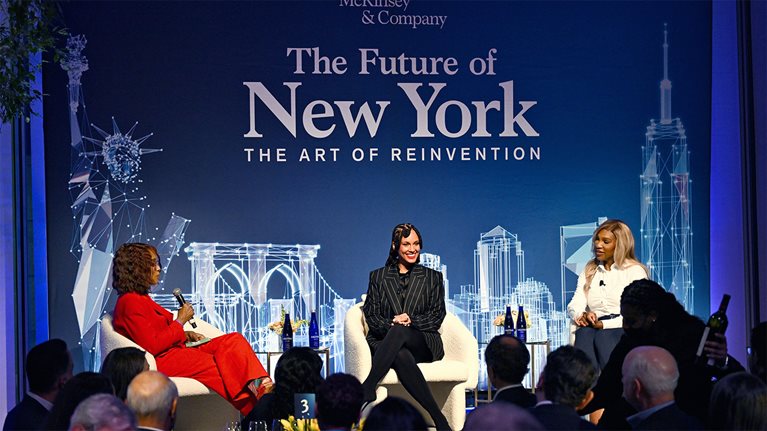
The panel, from right: moderator and Time correspondent Alice Park; David Sinclair, professor of genetics at Harvard Medical School and cofounder of Life Biosciences; Sutton Foster, Tony Award–winning actress, performer, and wellness advocate; and Jamey Millar, executive vice president of US Operations at Novo.
From breakthroughs in biology and medicine to growing interest in how we eat, move, sleep, work, and connect with others, healthy longevity is attracting attention from scientists, businesses, investors, and consumers. Advances in healthcare are opening new possibilities, while research underscores the role that our behaviors, environments, and social connections play in shaping health over a lifetime.
What could happen if those forces came together?
That question brought more than 50 executives representing a dozen sectors to the New York Historical Society for McKinsey’s fourth Future of New York Summit. This year’s theme, “The Next Frontier: Health, Technology, and Human Progress,” explored how scientific innovation, healthcare, and the broader drivers of health can help people live healthier for longer—and create new opportunities for economic growth.
“New York has always been a place where talent, capital, institutions, and ideas converge to create what comes next,” says Ida Kristensen, managing partner of McKinsey’s New York office and Northeast region. “Healthy longevity presents another opportunity to bring those strengths together—improving how people live while creating a potential new engine of innovation and growth for the city.”
New York as a proving ground

New research presented at the Summit by the McKinsey Health Institute (MHI) points to an unusual convergence in New York: scientific talent, investment, and consumers eager to experiment with new approaches to their health.
The New York region has attracted more than $12 billion in life sciences venture capital and more than $3 billion in National Institutes of Health funding. Twenty percent of leading longevity researchers are based in New York City.
An MHI survey of 3,000 New Yorkers also found that 40 percent consider healthy longevity a top priority. Across income groups, New Yorkers spend 23 percent more on longevity-related products and services than their national counterparts. Among high-spending New Yorkers who express interest in a given longevity product or service, stronger evidence of product effectiveness increases their intent to purchase by more than ten percentage points.
“New York has an unusual concentration of scientific talent, capital, and sophisticated consumers who are eager to experiment and demanding about evidence,” says Lucy Pérez, senior partner and global leader of MHI. “That creates an opportunity for the city to become a proving ground for healthy longevity—where we learn what works, build trust, and scale the ideas that deliver real impact.”
Pérez described a potential flywheel in which demand drives innovation, innovation generates evidence, and evidence builds trust that attracts further investment and demand.
Building trust as the science advances
The conversation continued with a panel moderated by Alice Park, senior health correspondent at Time, featuring David Sinclair, professor of genetics at Harvard Medical School and cofounder of Life Biosciences; Sutton Foster, Tony Award–winning actress, performer, and wellness advocate; and Jamey Millar, executive vice president of US Operations at Novo.
For Sinclair, trust will be essential as longevity science advances and consumers encounter a growing volume of health information and claims.
“There is enormous interest in taking greater control of our health, and also a great deal of confusion about what is credible,” says Sinclair. “Scientists have a responsibility to communicate what the research actually tells us, where the uncertainties remain, and help people make informed decisions with their doctors.”
Sinclair also discussed an experimental gene therapy being studied at Life Biosciences that targets the optic nerve. The approach grew out of research into epigenetic reprogramming and has progressed from animal studies to human clinical trials.
“We’re beginning to test ideas about aging that would have seemed extraordinary when I entered this field,” he says. “There is still a great deal to learn, especially about what translates safely to people, and that makes rigorous research and evidence more important than ever.”
Health beyond the laboratory
For Foster, healthy aging is both personal and professional. At 51, the Tony Award–winning actress, singer, and dancer has spent decades in a career where her body is an essential part of her work. She says her relationship with fitness, aging, and wellness continues to evolve.
“I’m excited about what this stage of life can bring,” says Foster. “My body has changed, my priorities have changed, and I’m learning to listen to both. For me, healthy longevity is about having a long, active, fulfilling life filled with new experiences and opportunities.”

MHI’s research found that New Yorkers place particular value on social and spiritual health alongside physical and mental health.
“Connection, community, movement, creativity, and purpose have become increasingly important to me,” Foster says. “There’s so much information coming at us. Sometimes the most meaningful thing is listening to your body and to one another.”
Foster also reflected on questioning the pressure to continually say yes professionally and making deliberate choices about where to put her time and energy.
Making healthy longevity more accessible
MHI’s research also surfaced a significant challenge: the desire for good health is widespread, while health outcomes vary considerably.
The average lifespan across New York City can vary by more than a decade, from about 75 years in some neighborhoods to 88 years in others.
Disparities also emerge across income, race, and gender. Women are less likely than men to rate their physical and mental health as excellent or very good, despite similarly high interest in healthy aging. The gap is particularly pronounced among women ages 45 to 55, who are ten to 13 percentage points less likely than other women to rate their physical, mental, and social health that highly.
Millar noted that health equity and disparities, access, and affordability are rooted in some of the biggest challenges of our health care system—such as access to glucagon-like peptide-1s (GLP-1s). Coverage varies even among people with employer-sponsored insurance, requiring employers and other stakeholders to weigh near-term costs against longer-term health benefits.
“Healthy longevity requires a long-term view,” says Millar. “The decisions employers, healthcare companies, policymakers, and other stakeholders make today can shape health outcomes and quality of life years into the future. Creating broader access will require those groups to work toward shared objectives and incentives.”
Connecting New York’s strengths
New York has significant scientific expertise, investment, healthcare institutions, entrepreneurs, and consumers interested in healthy longevity. The opportunity is to connect those strengths, establish evidence about what works, and expand the benefits across communities.
The panel’s final exchange offered a reminder that progress can also begin with familiar choices. Asked what they do in their own lives, the panelists pointed to exercise, sleep, time outdoors, nutritious food, relationships, and activities that bring them joy.
Foster offered her essentials: “Sleep, water, exercise, nature, creativity. Joy. Happiness. Friendship. Games. Play. Laughter. Curiosity. Adventure. Travel.”
Park closed with a fitting observation: Amid rapid advances in medicine and longevity science, some of the factors that can contribute to healthier lives “don’t cost anything and are already here.”
For New York, the opportunity is to build on both the breakthroughs still to come and the resources already at hand. By connecting science, investment, healthcare, and the broader drivers of health, the city could improve lives, accelerate innovation, and establish healthy longevity as a powerful new engine of economic growth.
This blog post was written by Avichai Scher, an editor in McKinsey’s New York office.