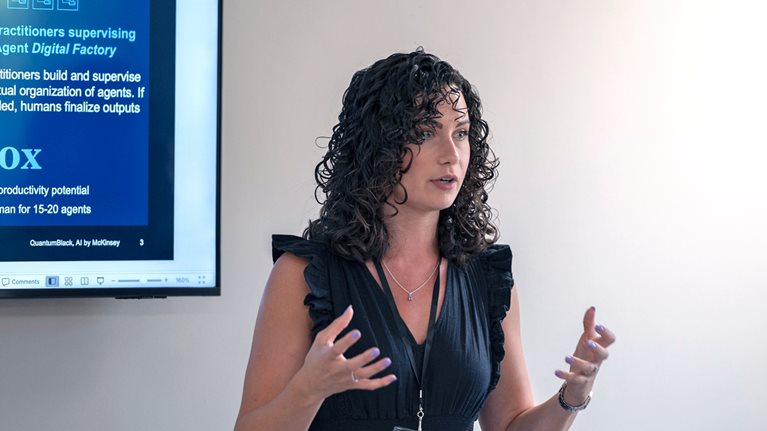
From philosophy to AI: How Eliza Spinna helps McKinsey build new ways of working
When Eliza Spinna was studying philosophy, she never expected a future career experimenting with innovative AI tools.
Now a McKinsey senior business analyst, her work sits at the center of one of the biggest efforts to rewire the firm: helping consultants move beyond using AI for one-off tasks to building entirely new workflows with it.
“Coming to McKinsey was a pivot for me,” she says. “I loved the creativity of the humanities and the analytical rigor of philosophy, but I also was passionate about working in the education space and knew the firm served universities.”
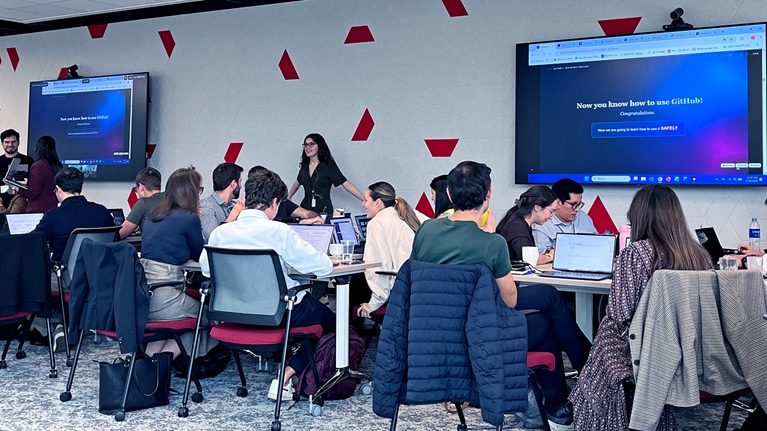
She joined the firm as a business analyst in 2023 and spent two years working with university leaders on strategic initiatives to expand access to higher education. The work was a natural fit, combining her passion for education with her structured approach to problem solving. But when the opportunity arose to spend a year helping the firm advance its adoption of cutting-edge AI, Eliza decided to take it.
“I could have chosen a safer path, but I decided to try something completely new,” says Eliza. “McKinsey gave me the structure and support to step outside my comfort zone.”
As part of a one-year rotation program for senior business analysts, she joined a team working to discover the full capabilities of emerging AI tools and bring them into the everyday work of McKinsey consultants.
“I wanted to not only understand how AI was transforming how we work but make sure everyone, especially those without a technical background, has access to these skills, which will be critical for the future of work,” she says.

From campus to real-world impact
You can join as a business analyst (BA), fellow, or intern. Many colleagues stay for a few years before attending graduate school or leaving for further work experience.
In practice, that means researching emerging technologies, evaluating how they might fit into the way McKinsey consultants work, then piloting capability-building training.
Eliza founded an ambassador program that empowers early adopters to serve as change agents, giving them forums to share tech with their teams, practices, and offices. She also works closely with McKinsey’s senior leaders to help them build AI fluency and with the firm’s risk teams to understand and disseminate the latest guidance around AI safety.
For Eliza, this work draws directly on her background: “Philosophy taught me how to break down problems and take on bigger questions about purpose, judgment, and human behavior, which still shapes how I work,” she says. “AI is evolving quickly, and there’s often no single right answer. My background taught me to be comfortable with complexity, honest about what I don’t know, and eager to keep learning.”
Those skills matter in a role like hers, where the ability to think critically is just as important as technical fluency.
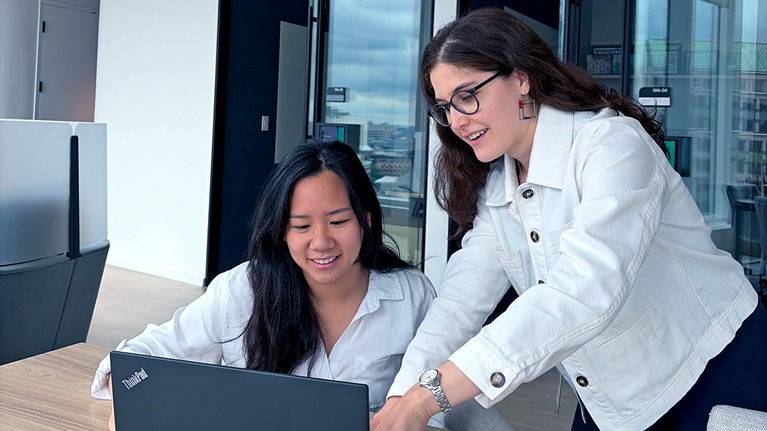
For Eliza, successful AI adoption is ultimately less about the specifics of a technology tool than the behaviors around it, like understanding context, shaping prompts, and designing workflows with a human-in-the-loop mindset. “AI tools are only as successful as the humans driving them,” Eliza says, “and human skills like creativity, awareness of context, clear communication, and judgment are even more valuable in an AI-enabled world.”
Her perspective is also shaped by her own experience stepping into unfamiliar technical territory and learning not to underestimate what she brought to the table.
“At McKinsey,” she says, “it’s that mix of perspectives that makes teams stronger.” Her team spans both technical and nontechnical backgrounds, and her humanities training helps her communicate effectively and translate complex ideas. “When you bring people with different backgrounds together, you get better answers.”
As AI reshapes the workplace, Eliza believes technical fluency will matter across every role—not just for engineers or specialists. What matters most, she says, is leading with curiosity, thinking deeply and critically, and contributing from your own perspective.
“Your unique abilities are your superpower,” she says.