AI Agents at Scale: A data scientist’s journey to transform clients with tech
As a principal data scientist at QuantumBlack, AI by McKinsey, I build AI solutions that solve business problems for clients. I focus on our Agents at Scale, a factory of AI agents working together to take on large, complex digital transformations.
Here’s how I landed in this field, a look at the complexity of AI agents working together, and what the fast pace of change means for the future.

Why machine learning and agents spark my curiosity
When I started my undergraduate degree in mathematics, I was convinced my future lay in finance. During my internship at an investment bank, I searched for a team that used data to predict future outcomes. To my surprise, I didn’t find what I was looking for.
Out of curiosity, I picked up a book on the subject during my final year at university—and I was hooked. Suddenly, I saw how data could be used to predict, simulate, and solve real-world problems and pursued a master’s degree in data science and machine learning.
When I discovered QuantumBlack at a conference in London, its vision of applying advanced analytics to complex business challenges resonated with me, and I joined soon after completing my studies.
At my core, I’m analytical. I like hard facts, numbers, and exploring all possible pathways before making a decision. Machine learning is a natural extension of that mindset—it’s about using data to understand how the world works and to tackle big problems elegantly. Over the years, my career has taken me across industries and applications, but I’ve always been drawn to challenges without obvious solutions. That curiosity eventually led me to the Agents at Scale work we’re pioneering at McKinsey.
Building Agents at Scale
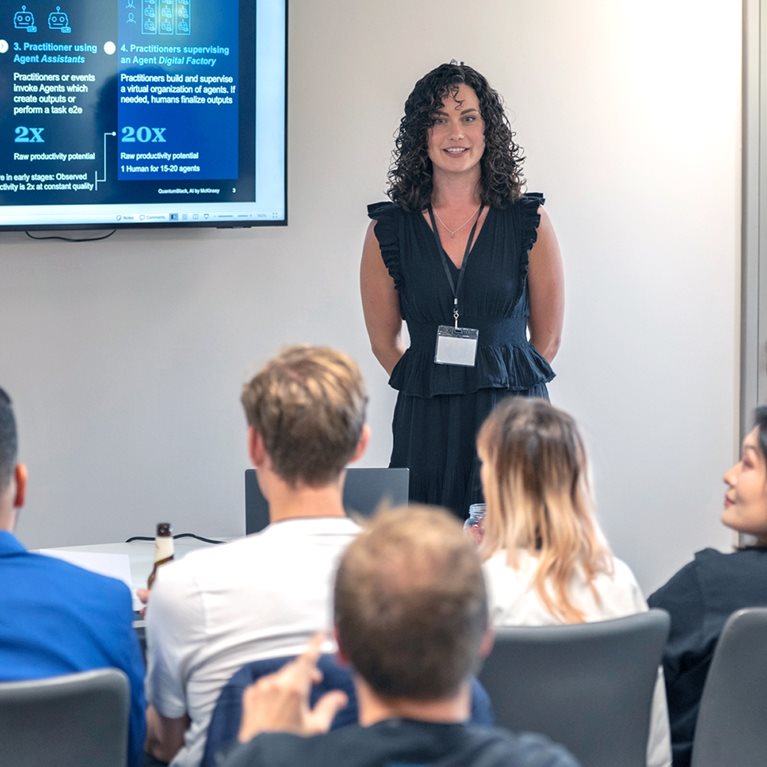
When I joined the team working on what we called LegacyX, our goal was to use generative AI to modernize legacy technology. That project became the foundation for what is now Agents at Scale. It brings various agents, which are self-directed AI systems used for specific goals, together to work in teams to automate large, complex processes.
I’ve had the privilege of being part of the journey from the beginning, watching the work evolve from early experiments to the deployment of sophisticated, specialized agentic AI workforces.
One project I’m especially proud of involved modernizing a client’s legacy Common Business-Oriented Language (COBOL) mainframe. Their system had been in use for more than 20 years, and very few people understood how it worked. We took on the challenge of re-architecting 15,000 lines of COBOL into under 1,000 lines of modern Java. The transformation wasn’t about line-by-line translation; it was about rethinking the entire architecture of the system. That’s where agents came in.
This work goes far beyond building technology—it’s about unlocking value for clients and their people.
A factory of agents at work
I often describe this process as a digital factory floor—done by agents we’d built. On one side, agents combed through COBOL code, decoding decades of business logic. Their work was digitally handed to architect agents, who reimagined the design in modern, modular patterns, and flagged questions where human validation was needed. Coder agents then brought those designs to life in Java, producing clean, efficient, and maintainable code. At the far end of the floor, tester and fixer agents ran the new code in a sandbox, automatically detecting and correcting errors, much like a quality assurance team working continuously without breaks.
The handoffs between these agents were seamless. Each one had a clear role, but the real power came from how they built on each other’s outputs. To make this possible, we integrated tools, enabled by the Model Context Protocol (MCP) system, which allowed tester agents to execute, validate, and repair code autonomously. Debugging—traditionally a painstaking process—became dramatically faster and more scalable.
We achieved over 90 percent accuracy, meaning less than 10 percent of the code required human correction to achieve functional equivalency. Even more striking, the process was twice as fast as manual modernization, even though we were still building and refining the agents as we worked. And, by simply giving the agents different instructions and roles and building a slightly different factory, we can apply them to many other processes, such as identity verification.
Bridging tech and business

This work goes far beyond building technology—it’s about unlocking value for clients and their people. A major part of our role is bridging the gap between cutting-edge technology and industry expertise. Many clients have little prior exposure to agentic systems, so we focus on designing processes with them, validating outputs together, and helping them build the capabilities to sustain the work long after we leave.
There’s tension here with companies’ in-house coders, who want to keep coding. But their jobs as coders don’t go away—what they code will change, and a lot of tedious tasks will be automated.
These are still early days for agentic systems. Will we evolve toward single “master agents” that can spin up specialized teams as needed? How can we improve user experience and build greater trust in these systems? And how do we ensure they remain safe, unbiased, and interoperable?
A year ago, I was only experimenting with agents. Today, I’m deploying them with clients and helping them reimagine their operating models. The pace of change is exhilarating, and I’m optimistic about how this work will reshape how organizations function and what we can achieve together.