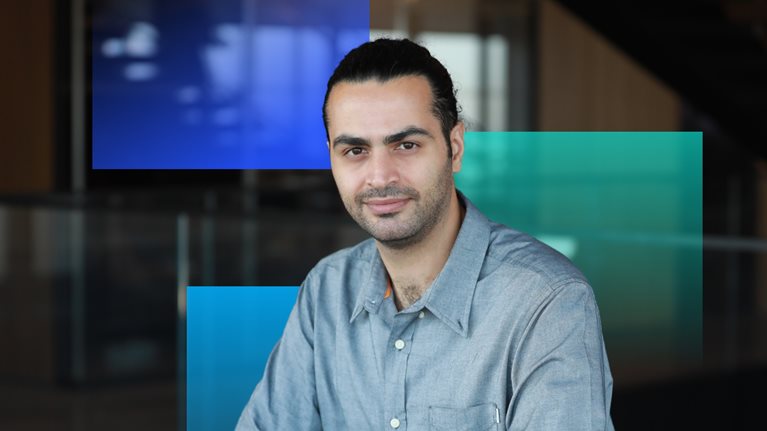
Building AI that delivers today: A McKinsey innovator’s journey
I grew up in Ottawa, the capital city of Canada. After studying engineering science at the University of Toronto, I joined McKinsey as a business analyst in 2018. I now work with QuantumBlack (QB), McKinsey’s AI arm, coleading our Generative AI Lab, a community of over 250 data scientists and software engineers that partners with our clients to reach their goals using AI. I also lead QB’s global machine learning R&D agenda and contribute to QB’s partnership ecosystem with other exciting innovators.

How patterns—and people—led me to AI
Growing up, I spent a lot of my free time practicing piano, playing chess, and solving math problems. What drew me in was the thrill of finding patterns, whether in a Bach prelude or a chess endgame. With some friends, we went as far as to call ourselves “mathletes”: people who took math probably a bit too seriously and treated it like a sport. When I discovered data science, I was excited because it was a way to continue to find patterns and solve meaningful problems while working with others. I knew I had found my path.
I joined the firm in the digital and analytics space, working on agile transformations, data governance, IT operating models, and customer journey reimagination. After leading a project with QB bringing together product managers, data scientists, and software engineers, I decided to do an internal rotation leading QB’s R&D team. That spark led me to pivot fully toward developing technologies that could one day transform how clients work.
This was a bit risky career-wise because the R&D group was new and had only existed for a few months at the time. It was up to us to define our roadmap and how we would measure our impact. Although there was some uncertainty, I was learning a lot and enjoyed the topics we covered, ranging from large language models to data-centric AI to machine learning operations. I made the jump.
R&D, rewired: innovation with immediate impact
At McKinsey, building new technologies looks different than in a software company or an academic lab. They may be developing innovations that take five years to build. Our development horizons are more short-term, focused on proven technologies to meet immediate client needs. Our goal is to drive experiments that will deliver impact tomorrow—not five years from now. We bridge the gap from long research cycles to scaled industry applications.

We get creative with our clients. We look at perennial problems our clients face and challenge ourselves to reimagine workflows with the latest technologies. What are the implications of the latest release of foundation models? When should we use agentic AI versus not? How do we foster end-user trust in AI? These are the kinds of questions we tackle with our clients to solve the “unsolvable.” Our lab helps us quickly test and iterate to figure out what really works.
How we build AI with—and for—our clients
AI offers a rare opportunity to rethink work itself. But meaningful transformation always begins with understanding how work is done today. That’s why we invest heavily in workshops, interviews, and job shadowing to deeply understand our clients’ day-to-day realities.
Take, for example, a recent tool we developed to help a client dramatically reduce the handling time of a legal process. Over several months, we spent more than 200 hours with lawyers, legal assistants, and administrative staff—observing how they worked and uncovering pain points. During design workshops, we surfaced unexpected insights: how lawyers preferred information to be structured, or how thoroughly they scrutinized AI-generated results.

With AI and agentic automation, we helped streamline a back-office legal process from taking almost a year to a couple of weeks. That impact came not just from the technology itself, but from how we engaged the people who would use it. We put users in the driver’s seat, incorporating their feedback throughout the build and making them co-creators of the solution. As a result, they felt real ownership and trust in the tool.
When people stay at the center, AI becomes more than a tool—it becomes a trusted partner in progress.