The United Kingdom’s productivity gap is a management problem, and this management problem is a talent problem, and this talent problem is a geography problem.
The UK’s productivity gap is a well-documented and persistent economic challenge. The most recent OECD data shows the UK generates $86 of GDP per hour worked, a figure materially below that of Germany ($103) and the United States ($105). Recent revisions to growth rates have not changed the fact of the UK’s lagging absolute productivity levels. This gap has significant consequences, reducing the fiscal headroom available to governments to implement policy and acting as a persistent drag on living standards.1
Our previous piece demonstrated a connection between national GDP per hour worked and the adoption of management systems by a nation’s businesses; it also showed that the United Kingdom is not implementing these management systems as well as comparable economies, even though the practices are well documented and widely understood. The same data exposes a split between London- and non-London-centric industries: London-centric industries are more likely to have implemented better management practices and so would likely benefit from the associated increased productivity.
According to research on behavioural change and our experience serving clients around the world, a group-level change in behaviour requires that at least 25 percent of a group advocate and behave differently. For a ten-person leadership team in an operational setting, that means a minimum of three people must have the drive, intellectual capability, knowledge, skills, and expertise to change the way an organisation runs day to day. People with this combination of capabilities are scarce. We observe that this top talent is created mainly through two routes: leaders cultivated from the shop floor up and executives with higher education who developed knowledge, skills, and expertise through varied early-career roles.
Operationally intensive firms outside London have limited access to the second pool of top talent. High-paying roles account for 40.8 percent of jobs in London, versus a national average of 23.2 percent, and their numbers are growing more than two and a half times faster in London than in the rest of the country. This concentration attracts a large share of the nation’s high-performing graduates—the top talent of tomorrow—because of the real and perceived benefit to their careers. By their late 20s and early 30s, people are often part of a dual-high-earner household, each with high-value jobs. In many cases, only London can offer both partners a high-value job in the same place. Professional identity then makes a trailing partner2 reluctant to move out of the London economic area even where household economics favour it. As a result, the couple stays and remains accessible only to businesses there.
Ever more of this type of talent is absorbed into London, while the regions are unable to attract enough of the kind of leaders they need to grow their business, compete globally, and generate wealth locally. Even a modest rebalancing could have a significant impact on British regions’ prosperity while having minimal negative effect on the prosperity of London. But instead, firms outside London can get stuck in a self-perpetuating loop: Unable to recruit top talent, they do not experience the benefit and so struggle to justify the business case to invest in it. This is seen in a decline in operational pay. The median production manager sat at the 86th percentile of UK earners in 1970; today the equivalent role sits at the 67th.
Germany and the United States are less exposed on both counts. Their high-value economic activity is distributed; Berlin accounts for 5 percent of German GDP, versus London’s 23 percent. And operational leadership carries higher pay and status, with premiums over median earnings of roughly 65 percent in Germany and 100 percent in the United States, versus 15 to 25 percent in the United Kingdom, once adjusted for measurement inconsistencies.
London is a high-performing economic region. It competes in industries across the world stage and generates tax revenue that funds public services across the whole country. The answer is not to restrict London’s growth but to lift other areas up so they too can more easily compete on the world stage and return wealth to those regions. McKinsey Global Institute’s Power of One research shows that national productivity growth comes from a small number of standout firms whose leaders make bold strategic moves through strong management practices which allow them to execute at scale. The United Kingdom needs such leaders to implement the management practices in businesses that would unlock growth across the whole nation.3
We believe that to increase the regions’ access to top talent while maintaining London’s prosperity, businesses and policymakers would have significant impact by pursuing five approaches:
- Revalue operational leadership toward US and German pay premiums.
- Build prestigious graduate pathways into operations.
- Formalise the route from shop floor to the top so that future leaders gain broad experience early in their careers.
- Hire for critical leadership mass, rather than individual stars.
- Stimulate economic activity across the country so that high-value roles are not almost exclusively limited to London.
The implication of the talent trap described in this article is uncomfortable. London’s success is a vital part of the national economy and contributes hugely, and this should be celebrated. But this has unforeseen consequences. As London absorbs a large share of the nation’s highest-potential graduates, operationally intensive businesses outside of the London economic area have limited access to this talent pool. These businesses then struggle to reach a critical mass of leaders with the ability to install management systems that will spur productivity, compete more effectively on the world stage, and thus return more wealth to those regions.
The United Kingdom’s productivity problem is, in part, a management problem
The United Kingdom’s productivity gap is a well-documented and persistent challenge. The most recent OECD data shows the country generates $86 of GDP per hour worked, a figure materially below that of Germany ($103) and the United States ($105).4 This gap has significant consequences, notably reducing the fiscal headroom available to governments to implement policy and acting as a persistent drag on living standards. Recent adjustments by the Office for National Statistics (ONS) to the measurement of UK hours worked have improved the United Kingdom’s position in the G7 productivity growth table, but the fundamental gap in output per hour with Germany and the United States still stands.
Our previous piece demonstrated a connection between GDP per hour worked and the adoption of management systems—the mechanisms by which organisations allocate resources, track performance, and drive corrective intervention. That connection is supported both by McKinsey’s recent survey research and by the World Management Survey, which draws on data from nearly 18,000 organisation manufacturing managers in 38 countries and finds that a one-point improvement in management score on its five-point scale is associated with the same output gain as a 40 percent expansion of the labour force or a 60 percent increase in capital.5
Importantly, our research showed that the United Kingdom implements these management systems less than comparable economies, with a direct bearing on national productivity. Good management systems are not a secret; they are well documented in publicly available literature and deployed by thousands of leading companies worldwide. Something, therefore, is preventing UK businesses from implementing them at scale.
The stakes are higher than the arithmetic of average firms suggests. The McKinsey Global Institute’s Power of One study of 8,300 large companies in Germany, the United Kingdom, and the United States found that fewer than 100 standouts generated two-thirds of the productivity growth in its sample between 2011 and 2019, and that they did so through bold strategic moves executed at scale. Most were not start-ups or superstars but large incumbents that improved year after year. Productivity growth in the UK sample was close to zero, against 2.1 percent a year in the United States.6
Operationally intensive firms need management systems most and are concentrated outside London
Operationally intensive businesses are those whose competitive advantage depends heavily on operational performance—through lower costs, greater agility, or more effective use of assets. The defining characteristic is cost structure, not sector. A pharmaceutical company manufacturing generic drugs at a low price point is operationally intensive; one focused on drug discovery, for which manufacturing is simply a route to market, is not. Volume manufacturing, food and drink production, and logistics are typical examples, and they are more prevalent outside London. These are the businesses that stand to gain most from the management systems we know drive productivity.
In firms where operations account for a large share of the cost base, marginal improvements in how work is planned, executed, and measured are competitively decisive. Our analysis shows that there is a “regional talent trap” that is preventing these operationally intensive businesses from tapping into the talent needed to implement strong management systems, which in turn will allow them to become more productive, better compete on the world stage, and return wealth to the region of the United Kingdom they operate in.
Two types of leaders can transform an organisation’s operations
Modern management systems are both complex and specific to the organisation in which they are implemented. They require leaders who combine intellectual capability and drive with the knowledge, skills, and expertise of modern operational management. These individuals come from all walks of life, all career backgrounds, and every region of the country. Early in their career, they go through many roles that allow them to build the knowledge, skills, and expertise required to lead modern operational business.
In our experience, organisations acquire such leaders through one of two main routes: by cultivating leaders from the shop floor up and by recruiting executives with higher education who have developed knowledge, skills, and expertise through varied early-career roles.
In cultivation from the shop floor up, an individual joins an organisation early (for example through a technical apprenticeship) and builds deep operational knowledge, skills, and expertise needed to lead through successive roles—either by promotion within the same business or by changing employers within the same industry. In operational businesses around the world, we consistently see that this route can generate very strong leaders able to drive real change in businesses and industries.
In the graduate-professional route, individuals typically hold a degree, often in a subject related to their later work. They then accumulate knowledge, skills, and expertise through multiple employment experiences during their 20s and 30s, sometimes accelerated by a formal graduate scheme, often moving rapidly through roles within the same organisation or in different ones.
The routes differ in their starting point, but the way this top talent is made is fundamentally the same: People with intellect and drive build capability through experience across a variety of roles. These are the people we see able to transform large parts of operational organisations by implementing management systems which then improve their organisation’s productivity and therefore global competitiveness. Both routes are valuable and produce world-class leaders. In contrast, where organisations fail to cultivate this critical mass of talent, even capable leaders are reduced to caretaking—holding the status quo rather than transforming it.
The leadership critical mass needed to change an organisation
Operationally intensive businesses are typically organised into operational units. As an example, they might have 500 people working within each unit. The structure varies—a manufacturing site, a cluster of retail stores, a distribution centre, a single call centre—but the scale is similar. To transform the productivity of one of these units for the long term requires implementing a management system and making it stick, usually in the face of an organisation’s natural inertia. Effective management systems are not secret; they have been well documented over the last 50-plus years. Despite this, businesses struggle to implement these approaches within their increasingly complex operational environments.
Implementing a management system is a collective act, requiring a critical mass of highly capable leadership. Putting one excellent leader into a business without a similarly capable team is unlikely to significantly improve how the organisation operates (see sidebar, “Critical mass in operational leadership: A tale of two sites”). This insight from our experience in organisations around the world appears consistent with a broad body of evidence from the social sciences. Fifty years of empirical research on organisational and community change has consistently found that a committed minority can shift group norms, but only once it reaches a threshold estimated at roughly 25 percent—a figure corroborated by more recent experimental work, including research published in Science in 2018.7
Regional businesses have not implemented management systems as well as London-based industries
A striking pattern in our own survey data suggests a disparity in management system implementation between London-centric industries and others. In McKinsey’s 2025 Operational Excellence Survey, organisations in London-centric industries—such as financial services and technology—reported a score of 5.90 out of 7 on management system adoption, putting them at the 58th percentile; those in non-London-centric industries—such as manufacturing and natural gas—scored 5.09, placing them at the 19th percentile (Exhibit 1). Put plainly, against the German, US, and overall UK respondents, London-centric industries in the UK score better than more than half of all respondents, while non-London-centric industries score worse than most. The sample sizes are small, the scores are self-reported assessments, and the split is also by industry rather than location, so we infer the London link from where those industries concentrate.
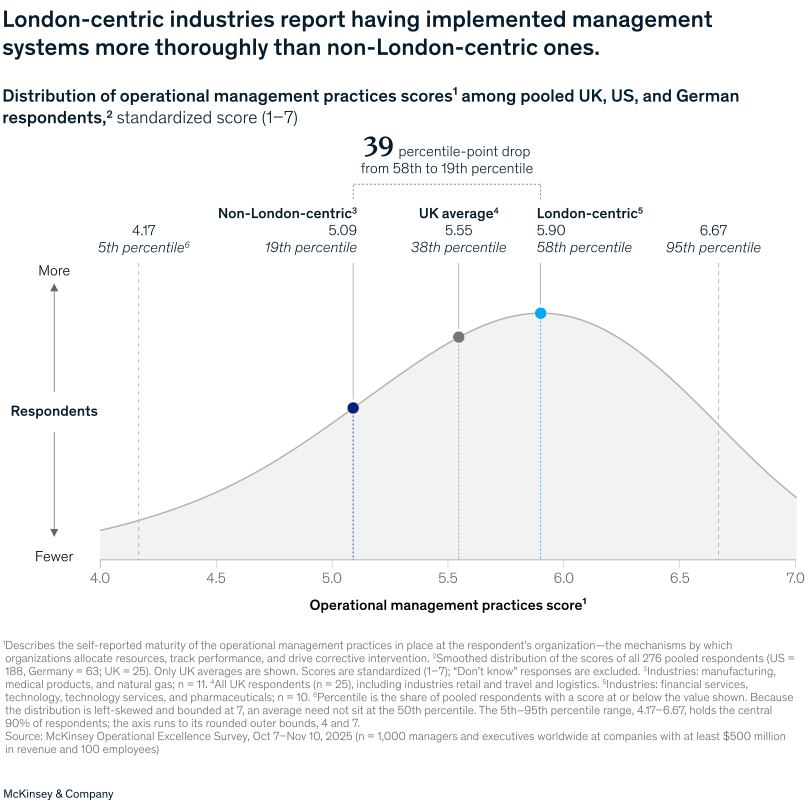
While granular empirical evidence is relatively sparse, these findings are consistent with, for example, the Office for National Statistics regional data on UK management practice scores. This indicates that firms in the same sectors but located in the South East, London, and Scotland are much more likely to have structured management practices than those in, for example, Yorkshire and the Humber, the North West, or West Midlands.8
These differences in the adoption of management systems between UK industries are echoed in the productivity and global competitiveness differences between London and non-London sectors. London is a top global financial centre,9 for example, with UK financial services contributing more than £200 billion to the economy in 2025.10 In contrast, UK manufacturing slipped from 11th to 15th in the UN Industrial Development Organization’s Competitive Industrial Performance Index during the first two decades of the 2000s.11 ONS data shows Germany to be approximately 16 percent more productive per hour worked in manufacturing, with UK output per hour roughly 10 percent below the G7 average.12
The Power of One study, cited earlier, asks which talent strategies “can nurture … managerial leaders who can make bold strategic moves”—the kinds of leaders who create standout firms. Our answer is that the United Kingdom already has such leaders, but the regional talent trap keeps them away from the operationally intensive businesses in the regions that could become the next standouts.
The regional talent trap
Our analysis shows that the structure of the UK economy is incentivizing its graduate talent (which originates from the whole nation) to gravitate to and then remain in London and the surrounding economic area. For organisations outside London, this removes one of the two routes to generate top talent, making it harder to form the critical mass of leadership needed to implement the management systems they need to become more productive, compete better on the world stage, and provide these regions with better-paying jobs.
Dissecting the regional talent trap
The regional talent trap can be broken down into five interrelated parts:
High-value roles in the United Kingdom are heavily concentrated in London. High-value roles, defined by the Economics Observatory as highly skilled, well-paid roles, are concentrated in London and the South East.13 ONS data shows that 40.8 percent of jobs in London are high-paying—nearly double the national average of 23.2 percent.14 And the gap is widening. Institute for Fiscal Studies analysis shows that employment in high-paying occupations grew 240 percent in Inner London between 1993 and 2022, versus 95 percent across the country as a whole.15
High-value roles are a magnet for high-performing graduates. The concentration of these roles in London and the South East exerts a strong pull on academic high performers at the point of graduation. At the start of a career, it is a rare individual in this group who can transform a business, but some can later become the top talent described earlier who can. Research by the Centre for Cities found that 22 percent of all graduates who moved to a new city after university chose London, and the likelihood of choosing London increased along with the prestige of the graduate’s university (Exhibit 2). Thirty-eight percent of graduates with a first-class or upper second-class degree from a Russell Group university who moved within six months of graduation chose London, alongside 52 percent of equivalent Oxbridge (Oxford or Cambridge) graduates.16
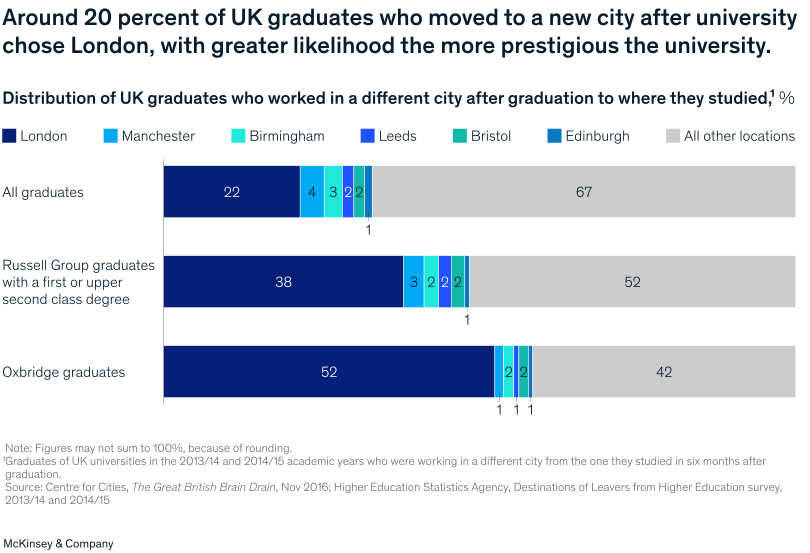
This is not a claim that selective universities make better leaders; it is a description of the natural graduate flow. Once graduates are in London, job concentration enables them to jump to different roles to develop professional experience early in their career with little personal disruption. Someone in London can have six different roles in the first decade of their career without having to move or undergo any geographic relocation. Outside London, this is much rarer, as fewer areas offer that density of transfer opportunities in a similar sector.
Assortative mating creates ‘power couples’ where both are in high-value roles. People build friendship groups and professional networks with others who have similar jobs, earning power, and educational backgrounds. Also, they often find long-term romantic partners within those same groups.17 As a result, many high-performing graduates (regardless of sexual orientation or gender) partner with other high-performing graduates, becoming a “power couple,” a term coined by American sociologists, and both of them work in London in high-value roles during the early years of their careers.
The United Kingdom’s economic structure makes it hard for such a couple to maintain their careers outside London and its surroundings. Once someone in this group has a similar partner, the two of them become “trapped” in the London economic zone. It is well documented that professional power couples gravitate to metropolitan areas economically large enough to support two high-value jobs.18
Many may want to live outside London but are unwilling to move due to the perceived career impact. Ipsos polling from July 2026 captures this precisely: Asked whether they would rather live in London or Manchester, Britons more often selected Manchester (26 percent, versus 21 percent for London), due to cost of living, friendliness, and community. However, London decisively wins on job opportunities and as the place where “more successful people” live and work.19
For this group, a career is more than a source of income. Professional identity is formed in one’s 20s and 30s. For some, a career is not just what they do but who they are.20 Someone working at a prestigious law firm does not view themselves as “someone who works at a law firm”; they are “a lawyer.” If they choose to leave London as a trailing partner, they are unlikely to find a high-value role in the same location as their partner and so would have to stop, pause, or move backward in their career. The effect on their sense of self can outweigh a net improvement in living standards for the couple. Put simply, a couple may have a better standard of living outside of London (the reduction in cost of living may be more than offsetting the reduction in income of the trailing partner), yet they still would choose not to move, due to the psychological impact of slowing their career.
A significant part of the nation’s graduate top talent, therefore, choose not to leave London, even if they might have a better standard of living elsewhere. Large numbers of people move out of London in the 25-to-35 age bracket, but most move to adjacent regions and are still economically active within London itself (referred to in this article as the London economic area). The pull of London and its stickiness act as a brake on the mobility of talent into other parts of the country. That in turn could prevent operationally intensive firms from accessing the talent they need to implement effective management systems and increase their productivity.
Firms outside of London can face a talent challenge
Industries outside of London feel this impact and often struggle to recruit top talent that can transform their business’s productivity. Half of manufacturers say they cannot source the talent their business needs locally, for example, and 97.5 percent say hiring and retaining skilled people poses a significant challenge to their business.21 Note that although this talent issue affects many different sectors outside London, manufacturing has some of the cleanest data on the issue. The risk is clear: Organisations outside London then do not see the benefits of productivity improvements and therefore do not see the investment case to acquire top talent at higher levels of remuneration. This perpetuates lower adoption of the management practices, which undermines their ability to compete on the world stage.
The pay and status of operational roles have fallen in relative terms over the last 50 years. In 1970, for example, the median production manager earned enough to sit at the 86th percentile of the national income distribution—a salary equivalent to around £68,000 a year in 2026. Today the median production manager has slipped to the 67th percentile, with an annual income of around £48,000.
The change is even starker at the top of the profession. In 1970, the best-paid 20 percent of production managers sat roughly at the 98th percentile of all earners, a position equivalent to about £133,000 a year in 2026. Today, the equivalent top-earning production managers sit at the 89th percentile, with an annual income of around £74,000. The equivalent pay commanded by the top of the profession has fallen by almost half.22
A decline of this kind is both a symptom and a cause of falling status. When a career’s pay ceiling drops away from the top of society’s income scale, the role loses its pull on people choosing a career, making it harder (but not impossible) for those roles to attract the ambitious future leaders who could drive the industry forward. Unlike in 1970, few people who command the highest salaries in the United Kingdom are in operational leadership roles.
Some firms break this pattern by offering prestigious formal operational leadership programs that capture talent at the point of graduation. However, these seem largely restricted to foreign-owned multinationals and a small number of global UK firms. This appears consistent with the World Management Survey finding that US-owned firms in the United Kingdom tend to import stronger operational management practices.
Within the United Kingdom, it seems that the London-centric industries are better at developing formal graduate schemes. Our informal review of UK leadership graduate schemes shows a ratio of approximately six to one in favour of London-centric industries over non-London-centric operational ones.
Why conditions in Germany and the United States seem more favourable
The structural forces described here appear less pronounced in Germany and the United States, the comparison economies we are using in this series. This is significantly influenced by differences in the geographic concentration of economic activity and by the relative pay and status of operational roles.
German and US economies are less concentrated
In Germany, economic activity is less geographically concentrated than in the United Kingdom. Berlin, the largest city, contributes only 5 percent of the country’s GDP,23 compared with London’s 23 percent share.24 With a distributed industrial base and thousands of hidden champion small and medium-size enterprises distributed across the country,25 a highly educated couple in Germany have more options to build dual careers outside the capital city. Although Germany’s industrial economy has challenges of its own today, the distribution of its talent is not one of them—and the productivity gap between the United Kingdom and Germany remains significant.
The United States has a genuine multi-hub economy. A dual-career household can build two high-value careers not only in the coastal centres of Boston, New York, San Francisco, and Washington, DC, but also in Atlanta, Austin, Chicago, Denver, Houston, Seattle, and beyond. Furthermore, the interior metros such as Columbus, Nashville, and St. Louis have all grown their shares of graduates and knowledge workers in recent years. Collectively, US cities offer ambitious graduates a range of viable options that the United Kingdom cannot match.26
Operational roles have higher status and pay
Operational roles in Germany and the United States often command higher pay and social status. In healthcare, for example, a UK healthcare general manager earns approximately £58,000,27 while a medical and health services manager in the United States earns a median $117,960 (£87,000).28 Pay is an imperfect proxy for status, but the gap is consistent with operational roles retaining a standing abroad that they have lost in the United Kingdom.
Production managers are paid a premium—the extra pay versus national median that a role commands for its responsibility and the scarcity of the skills needed to do it.29 Germany pays a premium of 65 percent, the United States 100 percent,30 and according to official statistics, the United Kingdom pays 50 percent. But the UK figure is inflated: The ONS category includes highly paid engineer and managing directors and other senior leaders whom the American and German statistics classify elsewhere. When we adjust the UK premium using advertised salaries for production managers, it falls to between 15 and 25 percent—less than half of Germany’s premium and a quarter of the US premium.31
The entry requirements for a production manager position tell a similar story. The ONS says of the UK role that “there are no pre-set entry standards” and that entry is possible “with either a degree or equivalent qualification, and/or relevant experience.” The US Bureau of Labor Statistics lists a bachelor’s degree and five or more years of related experience as the typical route in. Germany classifies the role at its highest skill level, which normally means a university degree, usually in engineering. Britain treats as an occupation what the United States and Germany treat as a profession.32
In Germany this premium may reflect the high cultural status of operations management and engineering.33 Germany’s leading engineering universities—TU Munich (TUM) and RWTH Aachen among them—have institutionalised relationships with the country’s most prestigious industrial employers. TUM’s formal Partners of Excellence include BMW, Bosch, Siemens, and Volkswagen, and RWTH Aachen alumni consistently fill some of Germany’s most senior DAX executive positions.34
A similar dynamic exists in the United States, where Boeing and the GE companies rank among the top dozen employers of Georgia Tech mechanical engineers. Caterpillar and John Deere recruit there, too.35
In the United Kingdom, by contrast, perceptions of operational roles lag those of other sectors. A Nestlé study of 2,000 young people found that just 4 percent would consider a career in manufacturing.36
Graduate schemes develop and attract potential future top talent at the point of graduation
Both countries also have more established graduate pathways into operational leadership and treat these pathways as a credible route to the very top. In Germany, the chief executives of all three major carmakers started on their companies’ graduate programs. Oliver Blume joined Audi’s trainee program in 1994 and has led Volkswagen Group since 2022.37 Ola Källenius joined Daimler-Benz as a trainee in 1993 and has led Mercedes-Benz Group since 2019.38 Oliver Zipse joined BMW as a trainee in 1991 and led the company from 2019 until May 2026, when he handed over to Milan Nedeljković, who joined BMW as a trainee in 1993.39
In the United States, Procter & Gamble hires at entry level and builds from within. The company reports that more than 99 percent of its senior leaders began their careers there. David Taylor, who served as the chairman, president, and CEO from 2015 to 2021, joined in 1980 as a production manager.40 GE Aerospace’s two-year leadership programs follow the same logic: more than 25 percent of its top leaders began their careers on one.41
What company leaders and policymakers could do
London is a high-performing economic region. Its industries compete across the world stage and generate tax revenue that funds public services across the whole country. London and the South East (broadly, the London economic area) are the only two regions that pay more into the Treasury than they receive in public spending.42 The answer is not to restrict London’s economic activity but to lift other areas up so they too can better compete on the world stage and return wealth to those regions.
Reversing the structural forces described in this article would entail deliberate actions by company leaders and policymakers.
Company leaders
- Revalue operational leadership. Raise the pay, profile, and prestige of operational leadership roles to shift their perceived status. A premium comparable to the 65 percent seen in Germany or the 100 percent in the United States could begin to change the career calculus for high-potential graduates.
- Build prestigious graduate pathways. Foster more industrial graduate programs—structured, high-status routes into operational leadership that are explicitly positioned as a pathway to senior corporate leadership.
- Formalise the route from the shop floor to the top. Make technical apprenticeships and progression from the front line into site and operations leadership an explicit pathway, so potential future leaders can gain a wide variety of experience early in their career. This can maximise the ability of operational businesses to generate top talent from within.
- Target critical leadership mass within organisations. Focus on building the collective operational capability of leadership teams, not just on individual hires, to create the conditions and momentum for management systems to take root.
Policymakers
Stimulate high-value economic activity. Growing high-value jobs in regional cities through sustained investment in those cities and their transport could increase the effective density of roles to encourage the top-talent couples to pursue careers away from London. The mechanism described in this article would indicate that the lack of implementation of strong management systems is caused by regional businesses’ restricted access to national talent, which is in turn caused by the regional talent trap. Therefore, improving UK productivity will depend on not just creating high-value jobs outside London but also ensuring that the talent needed to embed these systems is distributed more evenly across the economy.
To get access to this talent, regions outside London need to offer top jobs and attract top talent to fill them. Just moving the job will not fix the problem. These leaders are created over decades, building knowledge, skills, and expertise by working in a wide variety of roles within a specific industry. Transforming regions into attractive talent hubs will mean reversing a talent trap trend that has developed over 50 years and has been reinforced by economic, psychological, and social factors.
The implication is an uncomfortable one. London and the South East are remarkable economic assets, competing on the world stage and contributing hugely to the UK’s prosperity. But if leaders with the drive and capability to transform British industry come from two main routes—the shop floor and the graduate route—then one region is absorbing a very large share of the second group. Every year, graduates who are the possible leaders of tomorrow head to the capital and its surroundings. Then, for social and economic reasons, many never leave.
Rebalancing this even slightly would give more operationally intensive businesses of the Midlands, the North, South West, East, Wales, Scotland, and Northern Ireland the opportunity to reach the critical mass of leaders they need to install the management systems that would make them more productive, more globally competitive, and more profitable. If just some of the talent London attracts could be deployed to lead businesses elsewhere, the overall effect on the country could be significant—to the postcodes in which these businesses operate and to the United Kingdom as a whole.

