For decades, strategy for luxury brands has been oriented around destinations. The retail store was the primary front door; websites, social platforms, and wholesale partners expanded reach but remained downstream of brand control. Even e-commerce—operationally disruptive as it was—did not fundamentally change who shaped desire. The client still entered a world the brand designed.
Agentic commerce challenges that logic.
As AI systems increasingly interpret, compare, and curate products on behalf of consumers, decision-making is shifting upstream—from where a product is purchased to where intent is first expressed and desire is sparked. For luxury brands, this shift is not just about technology; it is about growth and productivity in a business where experience and service are essential components of the product. For ultra-high-value clients, AI creates the possibility of extending adviser-grade guidance beyond the boutique—making the shopping experience feel continuous, contextual, and available on demand. For the next generation of luxury clients, many of whom may never have a named client adviser, AI can provide a scalable digital proxy of that relationship, offering interpretation, curation, and reassurance at a level previously reserved for the top tier.
The strategic question, then, is not whether AI will mediate luxury journeys, but whether brands will use it to deepen and scale “clienteling” or allow others to define that layer on their behalf. The stakes are considerable. McKinsey’s broader research on agentic commerce suggests that AI agents could mediate $3 trillion to $5 trillion of global consumer commerce (goods only) by 2030, underscoring how quickly the “front door” of retail may need to be rebuilt, especially in the luxury space.1
Luxury, after all, is not a business in which demand simply arrives fully formed. It is a business where meaning is made. The “high-touch” layer—service, discretion, pacing, reassurance—is not a wrapping around the transaction; it is an essential part of it.
Yet that value proposition has been under strain. As highlighted in our State of Fashion 2026, the drivers of luxury purchases are shifting, and many brands are grappling with maintaining the consistency and distinctiveness of the luxury experience at scale. Service quality, clienteling depth, and perceived exclusivity have become harder to sustain in a context of rapid expansion and rising customer expectations. While ultra-high-net-worth clients remain resilient, a broader segment of “fluid” luxury consumers—those who historically traded up into the category—has become more selective, shifting spending toward experiences or postponing purchases.
For the highest-spend clients, AI can augment already meaningful human relationships—extending continuity and responsiveness beyond the boutique. For the next tier, AI creates something different: the ability to scale elements of concierge-level guidance to consumers who may never have had access to a named adviser. If adviser-grade interpretation can be replicated digitally, luxury brands have an opportunity to re-engage segments that have drifted—not by lowering prices, but by increasing perceived value through relevance, recognition, and reassurance.
It is for this reason that the emergence of agentic commerce poses a particular challenge for luxury brands. If a growing share of early shopping behavior takes place inside general-purpose AI assistants such as Gemini, ChatGPT, or other third-party shopping agents, long before a client reaches a boutique or brand site, the first interpretation of a consumer’s desire is occurring outside the brand’s universe. What is at stake is not only interpretation of demand, but brand identity, ownership of the customer relationship, control of data, and ultimately stewardship of the end-to-end experience—and, with it, the bottom line.
McKinsey recently surveyed 90 merchants and 300 consumers across the globe on their attitude toward, and adoption of, generative and agentic AI in shopping (see sidebar, “Methodology: About the research”). The results of our survey raise a number of difficult questions, which forward-looking executives already are grappling with, such as:
- How can AI extend and amplify our brand equity as it becomes embedded in shopping journeys?
- How do we ensure that automated recommendation and comparison engines do not flatten our positioning—eroding discretion, scarcity, and the high-touch service that underpins luxury value?
But the more consequential questions sit slightly upstream:
- How can AI deepen relationships with our highest-spend clients?
- How can we scale adviser-grade guidance to the next generation of consumers?
- And if AI mediates and frames demand before a client reaches us, who ultimately governs that interpretation?
The front door of desire is moving upstream—and consumers are already walking through it
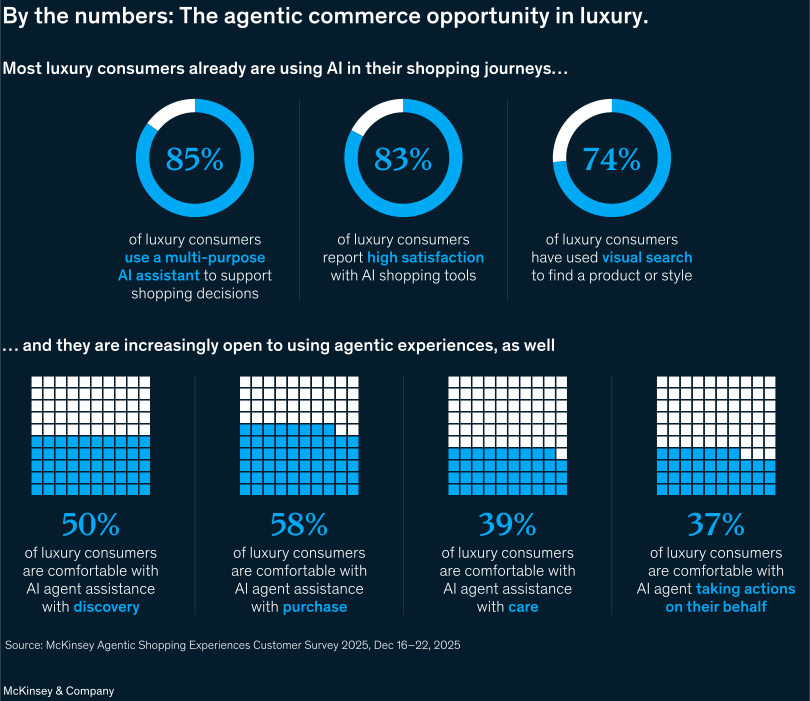
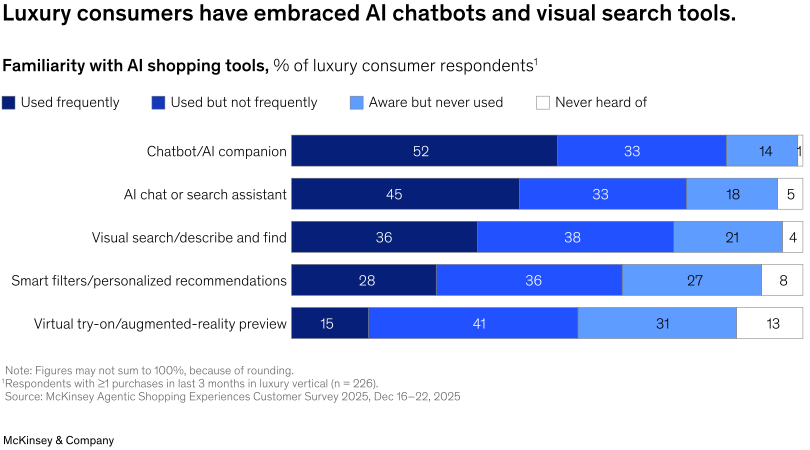
Those questions are not theoretical. Luxury consumers are already using AI in meaningful ways—and they are satisfied with what they’re getting (Exhibit 1). Our survey finds that 85 percent of luxury consumers use a multipurpose AI assistant such as Google’s AI Mode or Perplexity to support shopping decisions, with 52 percent reporting frequent usage. Seventy-four percent have used visual search (such as uploading a photo to find a product or emulate a style), with roughly half reporting frequent use; and 55 percent have used virtual try-on tools, with 15 percent using them frequently.
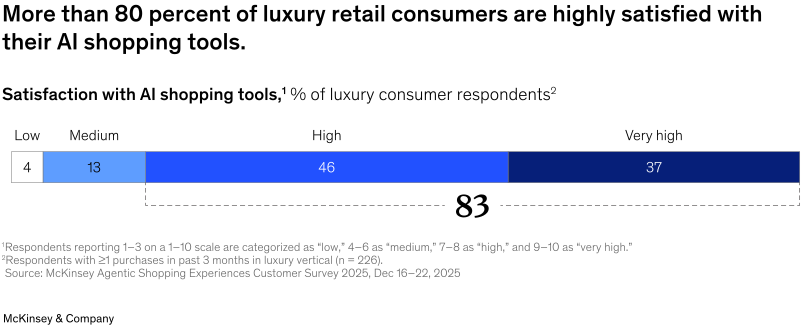
Clearly, this goes far beyond novelty or experimentation. Eighty-three percent of luxury consumers report either “high” or “very high” satisfaction with AI shopping tools and only 4 percent are dissatisfied (Exhibit 2).
This is where the “front door” of luxury begins to shift. In an AI-mediated world, the first moment of desire is increasingly expressed off-premises—inside multipurpose assistants such as Gemini or Perplexity, or via emerging category-specific AI agents that position themselves as stylists or personal shoppers. That doesn’t mean the brand is powerless. It does mean that the interface where intent is interpreted is becoming contested. It also means that brands need a view on what they want to own, what they want to influence, and what they are willing to delegate.
Luxury shoppers’ own preferences reflect that contested reality. When asked about preferred future AI “surfaces,” their top three choices were split almost evenly across traditional search engines, AI tools such as Gemini or ChatGPT, and brand apps and websites. Retailer apps and websites also received a meaningful though somewhat lower response. The dispersion here is the point: Rather than experiencing a single-channel shift, luxury brands are seeing a redistribution of where intent is captured and shaped.
Across retail more broadly, experimentation with agentic interfaces is moving quickly. In luxury, adoption has been more selective. Most maisons are not yet building fully agentic journeys; instead, they are piloting early interpretation and personalization layers—testing how AI can augment discovery, curation, and clienteling without relinquishing control of brand meaning.
Across the general AI disruption that is occurring, several early patterns are emerging.
First, intent capture is increasingly happening off premises. General-purpose AI assistants and shopping agents are becoming environments where comparison and framing occur before a client reaches a brand directly. Emerging applications such as Phia—an AI-powered shopping app that helps users identify the best available price across retailers—illustrate how younger, price-aware consumers are using agents to optimize decisions upstream. While these tools are not designed for high-spend VIP clients, they signal how AI is beginning to shape value perception outside the brand’s universe.
Second, some luxury brands are experimenting with brand-authored interpretation layers. Ralph Lauren’s “Ask Ralph,” for example, introduces a conversational stylist into the brand’s app, allowing clients to describe occasions or needs in natural language and receive curated looks in response. Brunello Cucinelli has launched a separate AI-driven environment that embeds house philosophy and narrative into a conversational interface. Other luxury players, including Moncler, are experimenting with AI-enhanced personalization and immersive product engagement, reflecting a broader pattern of selective testing rather than wholesale transformation.
AI also is appearing as adviser augmentation. Zegna’s ZEGNA X, for example, is a copilot and data ecosystem for sales associates that uses AI to enhance clienteling productivity—helping advisers personalize outreach and coordinate service across channels. In this configuration, AI augments rather than replaces human interaction.
For luxury leaders, the implication is structural rather than purely technological. Traditional levers such as marketing and sales-funnel optimization will continue to matter. But they will no longer be sufficient on their own. As the interface where demand is first structured and intent is expressed becomes a new battlefield, advantage will increasingly depend on who defines the rules of engagement—what is surfaced, what is filtered, and when human judgment and human touch enter the experience.
In the past, moving the buy button off-site meant losing control of the experience in ways that made luxury players uncomfortable and unready to adopt. Now we see a chance for brands and platforms to work together to create experiences and architectures that bring together data and a shared understanding of the customer. Architectures and standards like the Universal Commerce Protocol will enable bringing this data—that is, the intent expressed by the customer as well as the status and purchase history of the buyer—into context to deliver the best recommendations.
Given the pace of experimentation across sectors, waiting for full clarity is itself a strategic choice—one that risks lagging behind the pace of transformation that customers are experiencing in other parts of their digital lives. For luxury brands, early and deliberate experimentation—anchored in brand codes, governance, and clienteling logic—may be the only way to shape the interpretation layer rather than inherit it. In an agent-mediated environment, learning by doing becomes a competitive discipline.
Why luxury behaves differently in an agentic world
Agentic commerce is often framed as a linear march toward automation: assistants become action-taking agents, agents become autonomous, and soon shopping runs itself. But that framing is misleading—especially in luxury.
McKinsey’s recent research on the automation curve in agentic commerce suggests that delegation in the shopping process rises through distinct levels—from assistive research and curation to supervised execution and, in some contexts, fully autonomous transactions. But adoption is shaped by three forces that do not move in lockstep: time, trust, and category dynamics.
Time and trust are straightforward. As capabilities improve and consumers see reliable performance over repeated cycles, they become more comfortable delegating larger portions of the journey to AI tools. But category dynamics determine where delegation naturally plateaus. Where ticket size is high and the purchase is based less on price and convenience than on qualities like identity signaling, aspiration, and regret risk, consumers deliberately stop short—not because the technology is incapable, but because human involvement is intrinsic to value.
Luxury sits squarely in that dynamic. That’s because in luxury, demand is not merely revealed—it is constructed. Clients often cannot articulate what they want until a brand contextualizes it—and this happens through narrative, craft, restraint, and cultural codes.
This “delegation boundary” shows up clearly in our survey. When asked about comfort with agent involvement across stages, luxury shoppers report meaningful comfort in discovery and selection (50 percent), and even higher comfort in transaction execution (58 percent), but comfort drops sharply in care (39 percent)—the moments where reassurance, service, and relationship stewardship define the experience.
We see the same pattern when we ask how far shoppers would delegate overall. Only 9 percent prefer full “autonomized” behavior. Most prefer “assist” (32 percent), “assemble” (31 percent), or “authorize within guardrails” (28 percent). In other words, luxury consumers are not rejecting agents, but they are defining the terms under which they will use them.
Among luxury consumers who are hesitant to use AI shopping tools today, the dominant concerns are loss of control and perceived risk: 44 percent cite worry about privacy or data misuse in their top three concerns; 40 percent say they don’t want to rely too much on AI; and 34 percent doubt the accuracy of answers. Notably, only 18 percent cite lack of trust in the companies behind AI tools, suggesting what matters most is not “platform trust” in the abstract, but rather the use case, the stakes, and the safeguards that are in place.
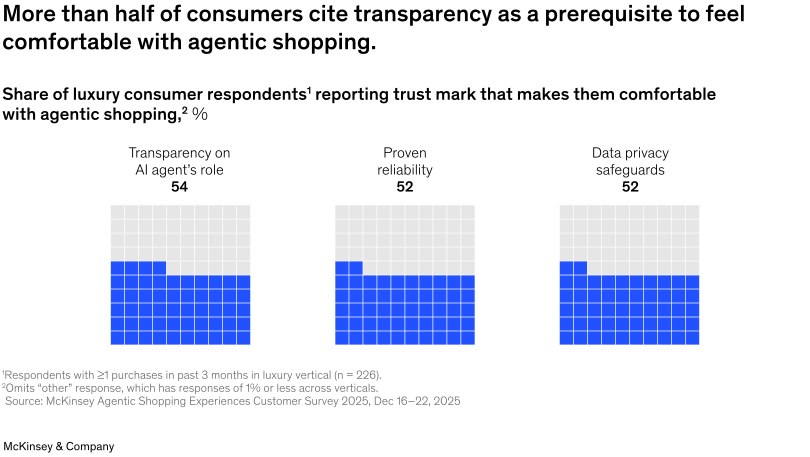
That leads to the most important luxury-specific implication: Trust is not a single attribute; it is a chain. When asked what must be true if they are to adopt and trust agents, luxury shoppers emphasize transparency about the agent’s role (54 percent), data privacy safeguards (52 percent), and proven reliability (52 percent). These are not nice-to-haves. They are prerequisites for letting an agent operate near the moments that define the luxury transaction (Exhibit 3). Any broken link breaks the entire chain. Crucially, if trust determines how far delegation extends, then the objective is not maximizing automation but governing how autonomy is deployed. That means defining the rules by which agents interpret, filter, and present the brand.
Consider a client selecting an outfit for a high-profile board dinner. An agent may be authorized to shortlist options that align with the brand’s codes—“elevated but not showy,” “formal but restrained”—and to assemble looks within a defined price range. But when the decision carries reputational or identity weight, the system escalates—the client reviews the selection, or a human adviser steps in to refine or validate the choice. The autonomy lies in reducing friction; the authority remains in preserving judgment.
This is why the strategic prize for luxury will never be maximizing automation. It is maximizing interpretive authority: defining the rules by which an agent should understand, filter, and present your brand. The automation curve makes the mandate explicit: The goal is not maximum autonomy, but the right support for the decision journey in the right moments—and a deliberate handoff to humans at the key moments where meaning is created and the power and ethos of a brand comes to life.
A luxury lens on delegation: The four ‘rooms’ where agents should, and should not, operate
A useful way to translate the automation curve into luxury terms is to conceptualize four “rooms.” These do not suggest linear stages. Instead, they are distinct contexts of value creation, each with its own opportunities for delegation. The automation curve describes degrees of delegation: assist, assemble, authorize, autonomize. The rooms describe where delegation creates value—and where delegation can erode it (Exhibit 4).
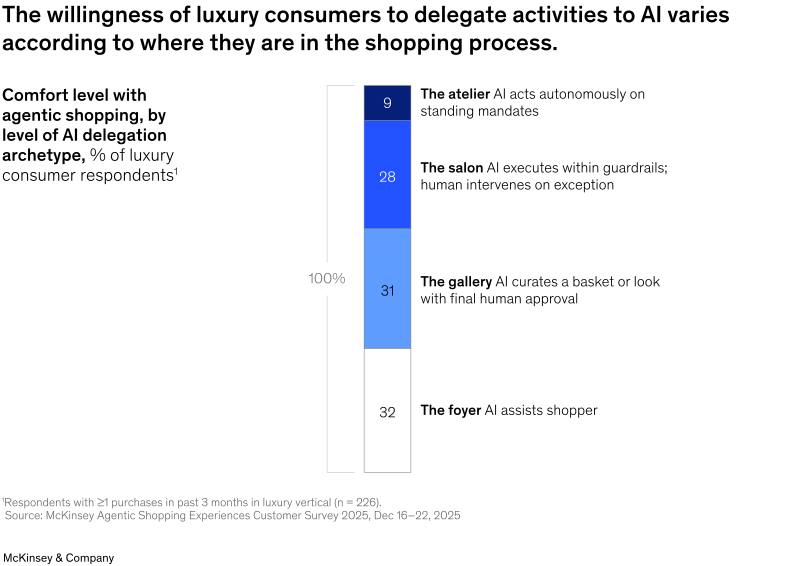
In the context of a luxury customer’s experience, think of the four rooms in this way:
- The Foyer (assist, selectively assemble). This is the moment that desire is first voiced in natural language—often as a situation, not a product: “I have a board dinner in London; the dress code is elevated but not showy” or “I’m going to a winter wedding; I want something formal but not stiff.” In this space, the core value is interpretation. The brand’s job is to make that first interpretation brand correct. If the first interpreter is a generic agent, the risk is not an incorrect SKU, it is an incorrect framing of what the brand is.
- The Gallery (assemble, with guardrails).This is the curation room. Agents can create real value by assembling looks, wardrobes, gift sets, travel capsules—doing the curatorial work that clients often want help with. But in an agentic-mediated world, curation only preserves luxury meaning if the brand supplies machine-readable signals that carry that meaning—craft and provenance cues, scarcity and eligibility logic, fit guidance, stylistic “dos and don’ts.” Without those signals, agents will default to what they can optimize: popularity, availability, and price. That is the mechanism by which luxury becomes flattened into dry attributes. Brands must therefore shape the experience in the Gallery to avoid this fate.
- The Salon (authorize, supervised). Automation intentionally slows down here. The “product” in this room is confidence—discretion, fit, judgment, reassurance. Agents can prefill, summarize, and prepare. But the authorization moment should remain supervised: Sometimes that means the client explicitly approves actions; in other cases, it means escalation to a human adviser (a brand client adviser or trusted stylist/concierge). This is also the room where “regret risk” is highest, and where the human layer is not merely a service feature but a key piece of the value proposition.
- The Atelier (selectively autonomize). Postpurchase stewardship lives in this room. This is where delegation can genuinely elevate the relationship—repairs, alterations, care instructions, appointment booking, delivery orchestration, service recovery—provided the brand governs tone, exceptions, and relationship rules so the experience remains unmistakably on-brand. In luxury, care is often where loyalty is built or lost. Done well, agents can make the brand feel more present, not less.
The practical implication of the four rooms means the journey is less about building an end-to-end agentic experience than about planning the pathways from one room to the next and making sure the handoffs work well even when customers linger in one room along their path—or when they invite a friend or client adviser to join them.
Merchants expect to own the relationship—yet the front door is contested
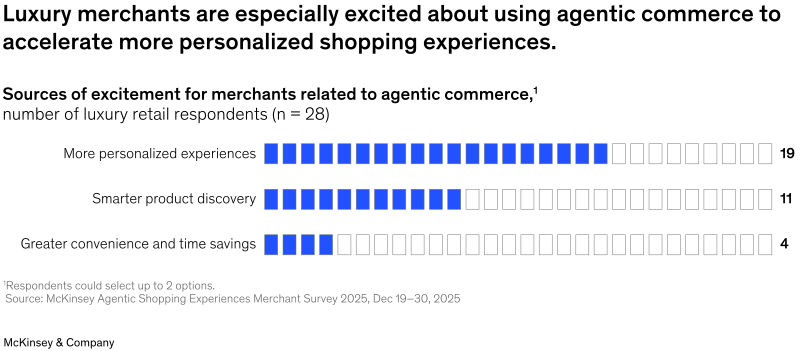
Luxury merchants broadly recognize the opportunity, even if they’re not yet aligned on how fast to move. In our merchant survey, 68 percent of luxury respondents (19 respondents) cite “more personalized experiences” as their primary source of excitement, alongside smarter product discovery (39 percent; 11 respondents) and omnichannel integration (32 percent; 9 respondents).
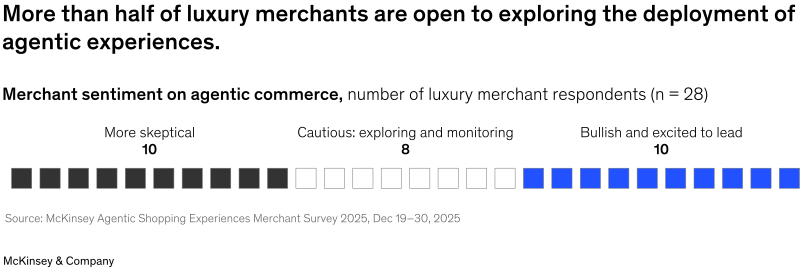
The posture, however, is fragmented. Thirty-six percent (11 respondents) place themselves near the “bullish and excited to lead” end of the scale; 29 percent (9 respondents) sit in the “cautious—exploring and monitoring” middle; and 36 percent remain at an earlier, or “more skeptical,” stage. Luxury’s posture is therefore mixed: enough leaders to move the category, but no uniform conviction across the sector (Exhibit 5).
It’s also instructive how luxury frames the moment relative to other verticals. In our survey, for example, only 4 percent of luxury merchants (1 respondent) describe agentic commerce as an existential threat to their business model, compared with 16 percent in specialty retail (5 respondents) and 13 percent in Food, Drug, and Mass (FDM) (4 respondents). And only 4 percent of luxury merchants cite a threat to consumer ownership and discoverability, versus 13 percent in specialty retail (4 respondents). Instead, luxury overwhelmingly reads the moment as an experience and service opportunity, with 82 percent of respondents (23 respondents) pointing to enhanced customer experience and efficiency.
Yet luxury merchants are also more likely to take a “monitored evolution” posture: 29 percent (8 respondents) say they are waiting for clearer signals, versus 19 percent in specialty retail (6 respondents) and 13 percent in FDM (4 respondents). The lag is not disbelief; it is selectivity—moving slower because the cost of getting interpretation wrong is disproportionately high.
This more cautious profile reinforces a crucial point: Luxury leans into what agents can interpret, not just what they can automate. Compared with specialty retail, luxury overindexes on personalization (68 percent versus 52 percent) and smarter discovery (39 percent, 19 respondents, versus 29 percent, 16 respondents), while underindexing on convenience and time savings (14 percent, 4 respondents, versus 29 percent, 9 respondents) (Exhibit 6). The strategic intent here is clear: Luxury expects the relationship to remain brand led.
Luxury shoppers, meanwhile, already spread their preferred future AI surfaces evenly across search engines, personal agents, and brand apps and websites. This is the definition of the contested front door: Brands may still own the product and the story, but they no longer automatically own the interface where intent is first interpreted. They must actively partner for access to it; those that do not risk outsourcing judgment to general-purpose agents whose incentives are optimization, not meaning.
The divergence is also visible in expectations about pace. Luxury consumers estimate that 39 percent of their luxury purchases will be mediated by AI agents by 2030. Luxury merchants expect an even higher share of customer interactions and transactions to be agent mediated (47 percent). Read together, this points to a category moving quickly—with a strategic twist: The winners will not be determined by how much of the journey becomes agent mediated, but by who governs the interpretation of intent as mediation scales.
Trust becomes a form of craftsmanship
If the front door of desire is moving upstream, trust is becoming as important as craftsmanship. What’s striking is the emerging alignment—along with a subtle luxury-specific divergence—between consumers and merchants on what creates trust.
Among luxury merchants, trust is anchored in two requirements: being safe and being consistently right. Data privacy and security remain a core pillar (more than half include it in their top three) alongside reliability (about a third). But the more actionable nuance emerges when we look at how luxury merchants believe trust is built across the journey:
- In agentic discovery, luxury merchants prioritize data privacy safeguards (61 percent; 17 respondents) and proven reliability (64 percent; 18 respondents), with transparency on the agent’s role (46 percent; 13 respondents) and human-in-the-loop control (39 percent; 12 respondents) as secondary reinforcers.
- In agentic commerce, execution risk rises: Reliability remains highest (64 percent; 18 respondents), but human-in-the-loop control rises to 54 percent (16 respondents), and transparency sits at 57 percent (17 respondents).
- In agentic care—the postpurchase stage—luxury merchants elevate human-in-the-loop control (54 percent; 18 respondents) alongside privacy safeguards (54 percent), with reliability and transparency still critical (both at 54 percent).
In other words, luxury’s trust requirement is calibrated according to stage: privacy and performance up front, oversight at checkout, with an accountable human backstop in the care phase (Exhibit 7).
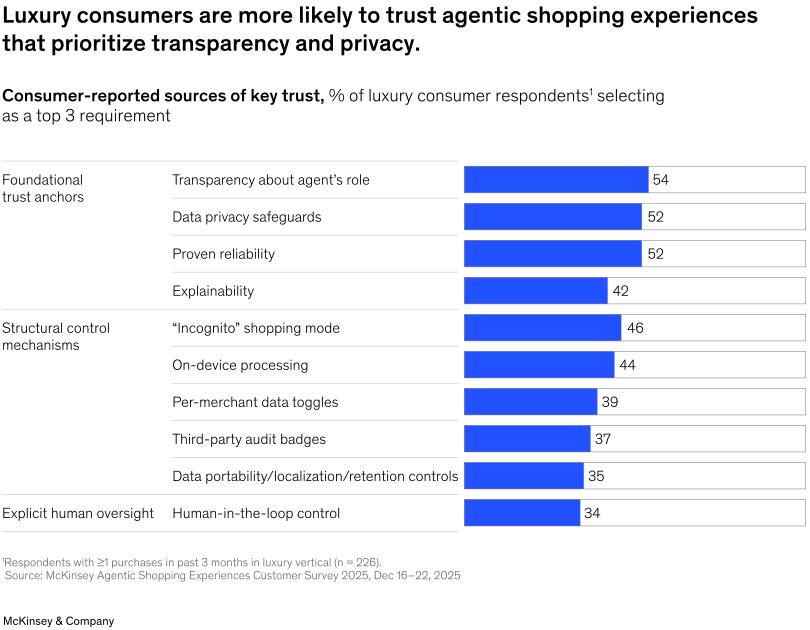
Merchants, in this regard, are largely aligned with consumers. When luxury consumers are asked what would make them comfortable when an AI agent deals directly with a store or business on their behalf, their top trust marks map closely: transparency about the agent’s role (54 percent), data privacy safeguards (52 percent), and proven reliability (52 percent), with explainability close behind (42 percent).
The divergence is where control is expressed. Human-in-the-loop control ranks lower than one might expect, with only 37 percent of consumers including it in their top three. Instead, consumers signal a preference for control by design: settings that preserve discretion without adding friction. Nearly half point to an “incognito” shopping mode (46 percent) and on-device processing (44 percent) as comfort builders; 39 percent want per-merchant data toggles; 37 percent want third-party audit badges; roughly 35 percent want practical control over data portability, localization, and retention.
For luxury leaders, this suggests an implication that is uncomfortable but unavoidable: In an agent-mediated environment, brand judgment can no longer remain implicit or embodied only in a human adviser. It must be codified, that is, translated into guidance about what can be recommended, to whom, under what conditions, and at what pace.
Consider the client asking an agent to assemble a look for a high-profile board dinner. A generic system might optimize for availability, popularity, or price. A brand-governed system, by contrast, would filter out pieces that conflict with the house aesthetic, limit exposure of scarce items to eligible clients, and escalate certain selections to a human adviser when the request crosses defined thresholds of price, status, or occasion. In this model, autonomy operates within boundaries defined by the brand rather than generic algorithmic optimization logic.
Put differently, the instincts of a great client adviser—discretion about what to show, restraint about what not to show, and reassurance at moments of uncertainty—must be translated into machine-readable policy and auditable behavior. Only then can autonomy scale without diluting what makes the brand the brand.
The strategic implication is that, in luxury, trust is not only a safeguard—it is a fundamental part of what the customer is buying. A luxury object carries quality and craft, but also identity and assurance. Trust, therefore, must be brand coded. What’s more, in luxury, trust ultimately resolves in the real world: in the hand, in the mirror, and in the presence of a human adviser accountable for the moment of commitment.
Stores are not becoming less valuable—they are becoming more intentional
It would be a mistake to assume that upstream digital mediation weakens physical retail. If anything, it raises the bar. As agents take on more of the filtering, comparison, and functional decision-making upstream, stores have the opportunity to lean further into what digital interfaces cannot replicate: immersion, emotion, surprise, and human connection. In this manifestation, the store becomes both a place of inspiration and a locus of confirmation—where fit, feel, proportion, authenticity, and the client’s confidence in the choice are established in ways digital systems cannot fully replicate. The associate remains central as the essential human layer providing judgment, reassurance, and discretion, while AI assists in making that layer more scalable and more personal.
Done well, these tools raise both the floor and the ceiling of clienteling. AI can surface client context and preferences in the moment, translate an upstream shortlist into brand-coded looks, check eligibility and scarcity rules seamlessly, and coordinate fulfillment, alterations, and aftercare. The adviser gains more time for the human moments that create emotional connection—and fewer minutes lost to operational friction.
At the same time, as delegation shifts upstream, the cost of error concentrates at the moment of commitment. That makes the human backstop and service recovery mechanisms more valuable, not less. The competitive threat is not that agents replace brands; it is that generic agents tarnish them, diminishing the luxury experience into attributes such as price, availability, popularity, or even resale value. If a brand does not author how it should be interpreted, someone else’s system will.
What this means for luxury leaders
Agentic commerce will not change what luxury is—but over time it will change how luxury shoppers make decisions and how they engage with brands across an increasingly broad range of occasions and categories.
Consumers already bring their desires to a range of preferred future AI surfaces—spanning evenly across search engines, personal agents, and brand apps and websites. So, the front door is no longer a simple single destination. Brands will need to meet their customers where they are and where they are going.
That implies a different capability agenda than many “AI in retail” discussions.
- First, build signature agentic experiences—not shinier chatbots, but as brand-authored interpretation layers that demonstrate how the brand thinks. Translate open-ended intent into curation and service that feels aligned with brand ethos. Ensure that ethos and style travel across owned and other surfaces so the brand remains coherent when the interface is not brand controlled.
- Second, move beyond product attributes. Luxury clients delegate not only to save time but for confidence and validation—and even for restraint. Make the brand’s point of view explicit: the occasions it serves, the boundaries it respects, and the situations it avoids. Agents should be able to understand not just what the brand sells, but also how it serves customers and what it stands for. In agentic shopping scenarios, that guidance must be structured and shared out, not assumed or inferred from clues.
- Third, engineer trust as a differentiating asset—not as a compliance task. Consumers want discretion by design: incognito modes, on-device processing, and clear data-use controls. In a category where much recent value creation has been price led, AI offers a different path to growth—one rooted in recognition, relevance, and relationship rather than escalating price ladders.
Finally, stores should evolve for a world in which more filtering and comparison happen upstream. Only 29 percent of luxury consumers say they prefer to use AI shopping tools in stores, underscoring the boutique’s differentiated role. In an agent-mediated environment, the store does not become less important, it becomes more specific: the place where fit, feel, proportion, and confidence are confirmed. In-store AI is most powerful when it augments advisers behind the scenes—surfacing context, anticipating needs, coordinating care—while preserving human judgment at the moment of commitment.
Luxury is not alone in facing this shift. Hospitality, travel, and technology players have long invested in anticipating needs before they are expressed and building trust through consistent, data-enabled service. The opportunity for luxury is not to copy those models, but to adapt that muscle to its own standards of discretion, experience quality, and brand expression.
Luxury remains a business of meaning not mechanics. What changes is not the importance of the human layer, but the threshold at which it engages. Increasingly, discovery, comparison, and early framing may occur before the client enters the brand’s universe. The winners will be the brands that design for that reality by making their codes legible to agents, building discretion and control into the system, and using technology to deepen rather than dilute the relationship. The question is not whether agents will influence luxury journeys. It is who shapes that influence—and whether the first interpretation of desire reinforces brand authority or reframes it.