As consumer expectations evolve, loyalty has become one of the most powerful ways for brands to remain present in consumers’ daily lives. For organisations and consumers alike, loyalty is no longer about points—it’s about presence. That presence is increasingly shaped by AI-enabled discovery and decisioning which are beginning to influence how consumers evaluate and select brands. Accordingly, brands that transform loyalty programmes into everyday-value ecosystems are set to outpace competitors in retention and in relevance.
Our latest Australian Consumer Loyalty Survey, the second in the series, surveyed more than 1,700 Australian consumers across 11 industries. Here we present its findings and offer perspectives on how persistent trends are reshaping the loyalty landscape and what organisations can do to stay ahead.
Drivers of change in the loyalty landscape
McKinsey’s December 2025 Asia–Pacific Consumer Sentiment Survey found Australian consumer sentiment to be stable. Net intent to spend was positive for essentials but negative for discretionary goods. It also found that 73 percent of Australian consumers were likely to try new shopping behaviours, a 3 percent increase since the previous quarter. While most weren’t experimenting with radical changes, they were likely to try different brands.
Our Australian Consumer Loyalty Survey shows a similar pattern of cost-of-living pressure and cautious optimism. In this environment, Australian consumers are redefining what value means to them and where they can find it. This is unfolding against a backdrop of ongoing global uncertainty which continues to influence how Australian consumers think about value. Some are trading down in certain categories to splurge in others, and are seeking immediacy, convenience, and recognition when they choose to do so. Splurge categories, such as dining and travel, often offer an emotional or experiential reward. A significant share of respondents intend to spend more in these areas.
At the same time, more than half of consumers now look for deals on every purchase, highlighting how value expectations have changed. The idea of consumer trust has also shifted; Australians now rely more on peer recommendations and community feedback than on traditional brand marketing.
These evolving expectations underpin rapid transformation in the loyalty landscape. We have identified four key drivers shaping this change—each revealing how loyalty is becoming more dynamic, data-driven, and demand-responsive.
Loyalty holds greater weight than ever before
Loyalty programmes continue to drive tangible changes in consumer behaviour. In fact, six in ten Australians say membership in at least one programme has changed how they shop, whether by increasing purchase frequency, choosing a brand more often, or recommending it to others.
The growing impact is evident across sectors: Grocery programmes now influence about 60 percent of members—up eight percentage points since 2022. Similarly, airline programmes affect the choices of roughly 70 percent of members—a significant 24-percentage-point increase over the same period.
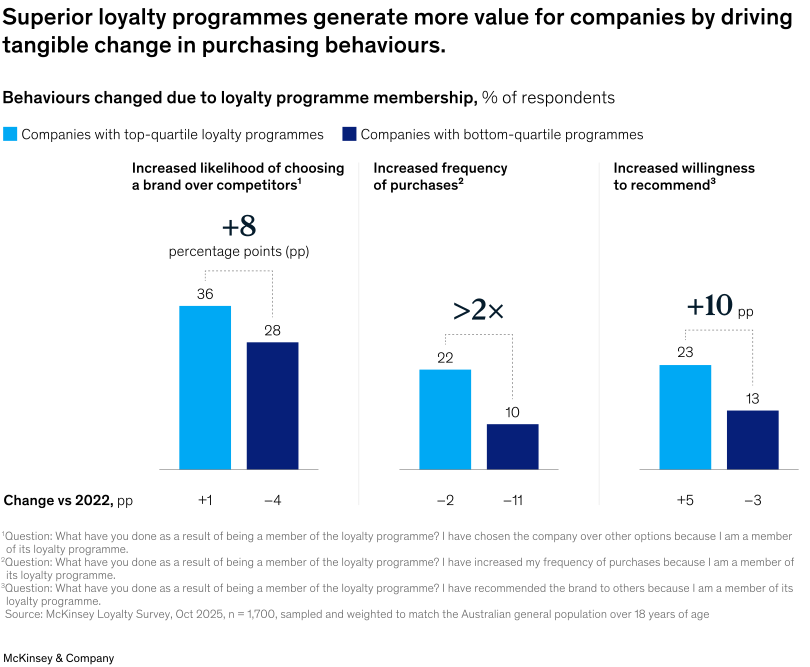
Concurrently, the benefits of getting loyalty right are intensifying. Top-quartile programmes now find members roughly twice as likely to increase purchase frequency, and 79 percent more likely to recommend a brand, compared to those in bottom-quartile programmes—a gap that has widened since 2022 (Exhibit 1).
However, consumers are becoming more selective. While awareness around loyalty programmes has risen, many remain sceptical about actual value. Simply put, members expect each programme to deliver tangible, easy-to-access benefits: accumulating points and redeeming them quickly are still the highest priorities. For brands, the challenge has shifted. Success no longer depends on enrolment alone, but on sustaining loyalty through consistent relevance, recognition, and daily engagement.
Value is shifting from delayed payoff to instant reinforcement
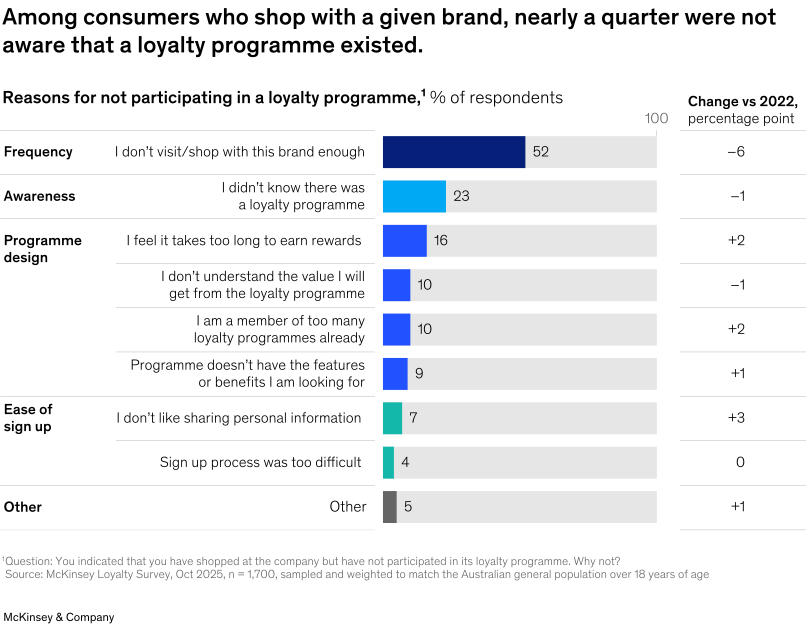
Increasingly, consumers are seeking more immediate rewards for their purchases. Long earning cycles and unclear redemption rules are weighing on consumers’ patience, highlighted by the 16 percent of nonparticipants who cite “it takes too long to earn rewards” as the reason they opt out, up two percentage points since 2022.
At the same time, engagement patterns reveal a widening gap. Grocery programmes still see 65 percent of members using them almost every shop, but that figure has slipped five percentage points since 2022, once again reflecting rising expectations for immediacy. Programmes that deliver near-term gratification, visible progress, micro-rewards, or frictionless redemption are outperforming in member satisfaction. Even so, nearly a quarter of customers are still unaware that loyalty programmes exist for specific brands (Exhibit 2).
The rise—and test—of subscriptions
Traditional loyalty programmes still dominate, with roughly twice as many members as subscription models. However, subscription-based loyalty is gaining momentum.
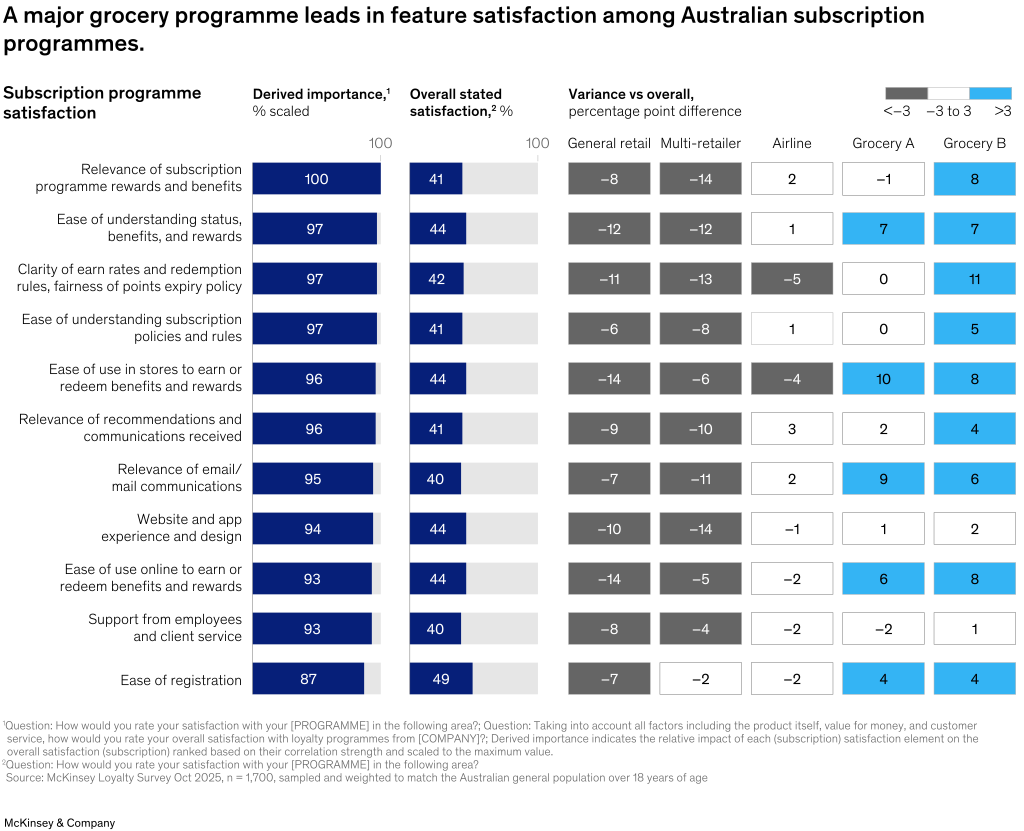
Australians are increasingly drawn to paid or hybrid models which tend to succeed when combining everyday utility with cross-brand access. As a result, subscription programmes lead in member satisfaction, scoring between 8 and 15 percentage points higher in customer satisfaction scores than their loyalty equivalents across major brands.
However, satisfaction levels vary amongst programmes. Consumers are quick to change when benefits seem too slow to materialise or difficult to see. Our survey finds that customers care most about relevance, ease of understanding, and clarity around rules (Exhibit 3).
The most successful programmes deliver immediate and clearly priced benefits, strong partner integration, and personalised engagement that sustains monthly activity. Continued success hinges on aligning programme delivery with consumers’ priorities—clarity, simplicity, and visible everyday value.
Ecosystems are expanding through partner integration
Australian consumers are showing a stronger preference for programmes that integrate across partners and sectors. And there is a growing appetite for flexibility and cross-category reach. In terms of feature importance, “spend points to redeem partner-company products” saw a five percentage-point increase since 2022—the highest change in the category.
Major grocery programmes lead national awareness (more than 90 percent of respondents claim to have heard of these programmes). They also show continued extensions into partner-based adjacent offers, such as financial services and travel. One grocery loyalty programme now connects with more than 20 partner brands across retail, travel, and financial services. Meanwhile, another has deepened its ecosystem through airline points conversion, health insurance, and fuel partnerships, allowing members to earn and redeem points across daily spend categories.
Traditional coalition models—where only a few brands collaborate on shared rewards—are giving way to fully integrated linked partnerships with multiprogramme tie-ins. The market is trending toward fewer but broader super-ecosystems that deliver everyday relevance and convenience.
Looking ahead: How organisations can keep up
The fundamentals of loyalty design still apply in today’s consumer landscape, but the levers are evolving. With the arrival of agentic commerce promising to radically remake the entire shopping experience, organisations are faced with rewiring their loyalty offerings in a world where the boundaries between platforms, services, and experiences are blurred. They increasingly need to understand and align with the data foundations and decision-making logic of AI agents while preserving the emotional, brand-driven experiences that build trust.
As organisations continue to test and scale AI-enabled capabilities, alongside broader changes in consumer expectations, they can draw inspiration from globally recognised loyalty initiatives. The following four courses of action represent transformative shifts that we believe hold potential to move loyalty from programmes to ecosystems that deepen customer engagement:
-
From data analytics to predictive intelligence
Organisations can consider a shift from static segmentation toward dynamic, AI-enabled insight engines that anticipate needs and personalise offers in real time. Programmes that are able to integrate behavioural, transactional, and contextual data across channels deliver relevance at every touchpoint, connecting app, web, and in-store interactions. These loyalty models not only react to customer behaviour, but shape it—identifying churn risks, forecasting intent, and triggering interventions before engagement drops.
Case example: Delta Air Lines introduced Delta Concierge, an AI-powered assistant built into the company’s Fly Delta app, which aims to provide select travellers with real-time, personalised assistance across journeys—from flight changes to baggage handling and tailored airport experiences.1 Similarly, Sephora uses AI and machine learning to conduct research and analytics to provide a more personalised experience, for example, by curating offers and surfacing products aligned with individual preferences.2
-
From static tracking to personalised experiences
Member satisfaction tends to be greater in programmes that create individualised experiences. These experiences can be seen as honouring a consumer’s value to the brand, rather than just their spending. Organisations can, therefore, look to move beyond static tracking toward rewards systems that recognise and reinforce value across the entire customer loyalty lifecycle. This can include enabling adaptive interfaces that respond to personal motivators such as savings, status, or recognition; providing context-aware reminders like geo-based alerts or timely prompts; and pairing simple visual progress cues with meaningful moments that connect to emotion or purpose.
Case example: Nike links loyalty to participation in sport as well as to purchase behaviour. Programme participants get access to member-exclusive products, events, experiences, and birthday rewards, alongside shopping benefits such as special offers and free shipping on eligible orders. Through its free Nike Run Club and Nike Training Club apps, members can track activity, take on challenges, and benefit from training content. In this way, loyalty is reinforced by more than product spend.3 Similarly, Peloton uses AI, machine learning, and an insights-generator engine to interpret riders’ habits and motivations and send them nudges, personalised fitness guidance, and actionable insights.4
-
From individualised to community-driven gamification
Gamification is no longer an individual pursuit—it’s becoming community-driven. Shared challenges, group streaks, and collective achievements turn engagement from a personal task into a social experience. Adaptive mechanics adjust rewards and goals based on group dynamics, while leaderboards, collaborations, and peer recognition build connection and friendly competition. Done well, community gamification transforms loyalty from isolated participation into collective momentum that strengthens with every interaction.
Case example: LEGO extends loyalty beyond transactions through platforms such as LEGO Ideas, where fans can submit and vote on designs from the LEGO community that can progress toward commercial review. This peer interaction is complemented by early access to products and experiential rewards via the LEGO Insiders programme.5 In another example, the McDonald’s MONOPOLY promotion integrates collect-and-win game mechanics with its digital app, allowing customers to gather physical or digital game pieces through purchases and to redeem instant prizes. The time-bound campaign drives broad participation, turning routine transactions into a shared promotional event across its customer base.6
-
From brand communities to connected ecosystems
An emerging best practice for organisations to take note of is the shift from closed brand communities toward connected ecosystems where loyalty extends across partners and categories. Partnerships that allow members to earn and redeem rewards in multiple contexts multiply relevance and also boost data richness. Organisations that open their platforms through application programming interfaces, shared analytics, or partner marketplaces can position themselves to capture a greater share of customer spend and attention.
Case example: Tesco’s Clubcard customers can redeem points at over 100 partners including Cineworld, PizzaExpress, and Uber.7 Lululemon has also embraced an integrated ecosystem, bridging apparel, fitness, and wellbeing across partnerships with AG1, Oura, and Peloton.8
What to remember
No single industry or organisation has the formula for lasting loyalty, but a shift is clear: Australians are more engaged in loyalty programmes than ever, even as they become less exclusively loyal to individual brands. As AI plays a greater role in shaping how choices are surfaced and executed, loyalty is likely to increasingly depend on how well organisations remain relevant within those decision environments. The brands set to lead the way are those that treat loyalty as a living system, powered by data, sustained by collaboration, and anchored in visible value for every member, every day.