Every day, US residents turn to state governments for services that affect some of the most important aspects of their lives—from healthcare and housing to childcare and economic support. States are under growing pressure to deliver amid accelerating technological change, tightening budgets, and changing federal policies.1
Amid these dynamics and in the wake of the November elections, this moment can serve as a critical inflection point for newly elected and returning administrations.
To help state leaders take stock of how well they are serving their residents, McKinsey’s 2026 State of the States Survey gathered perspectives from more than 50,000 residents across all 50 states and Washington, DC (see sidebar “About the research”). The survey assessed their experiences with 20 major state government services, and the findings reinforce an important insight from our 2022 benchmark: Improving government customer experience (CX) can create value for residents, employees, and governments themselves. This year’s results confirm that higher customer satisfaction is associated with greater trust: A five-percentage-point increase in satisfaction correlates with a three-percentage-point increase in resident trust.2 Satisfaction can be an important signal of service effectiveness and efficiency, as less friction and fewer repeat interactions can make services easier for residents to navigate and for governments to manage. Better CX can also go hand in hand with better experiences for the employees who deliver those services.
To improve CX and resident satisfaction, this year’s survey findings point to three opportunities for states and their leaders: setting a statewide agenda for CX, designing services around resident journeys, and using AI to build upon their digital progress. Doing all three can help states build lasting, holistic CX capabilities, so they can continuously improve residents’ satisfaction and trust—even as residents’ expectations keep rising.
Residents’ service experiences vary widely as new gaps emerge
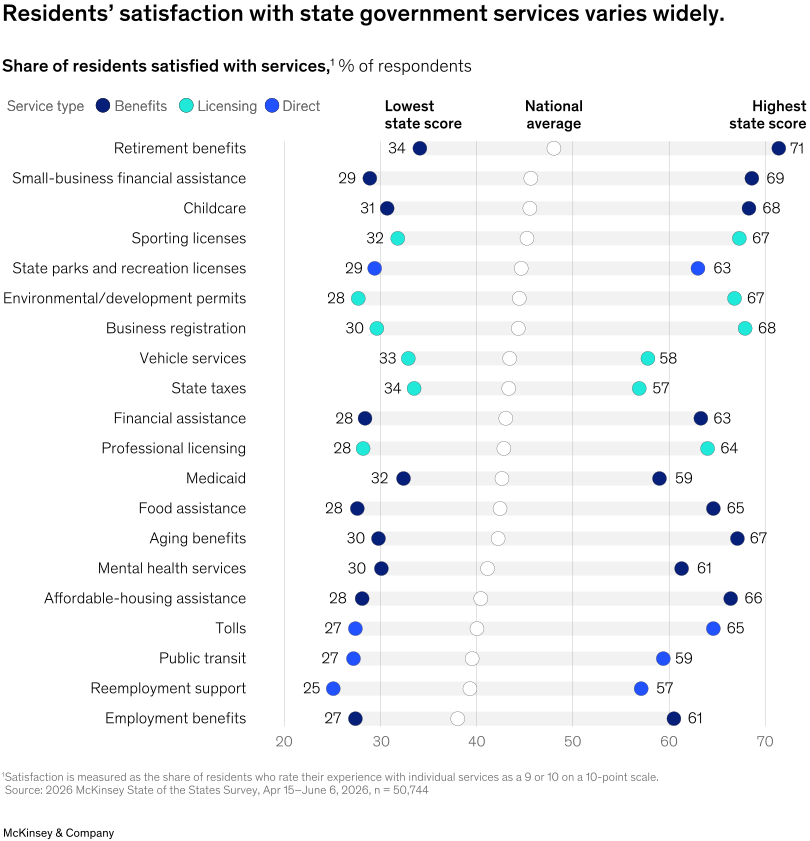
Across the 20 major state services tested in the 2026 survey, average satisfaction levels are relatively similar. But these averages mask considerable variation by state (Exhibit 1). Respondents’ satisfaction with retirement benefits, for example, ranges from 34 to 71 percent across states, while satisfaction with small-business financial assistance ranges from 29 to 69 percent. Such variation suggests that states can achieve higher satisfaction across a range of services and that there are opportunities for all states to improve the experiences they deliver.
Indeed, the broader trend since 2022 is one of improvement. The previous survey captured an unusual moment, as the United States was emerging from the acute disruptions of the COVID-19 pandemic. While that context may have shaped residents’ experiences and perceptions at the time, we found that overall customer experience with state governments has improved markedly since 2022.
Across the United States, average satisfaction scores rose 15 percentage points, with nearly every state improving. Since 2022, states have also closed much of the gap with the private sector (Exhibit 2). The satisfaction gap narrowed by more than 50 percent, and the highest-scoring states now outperform the private sector average.
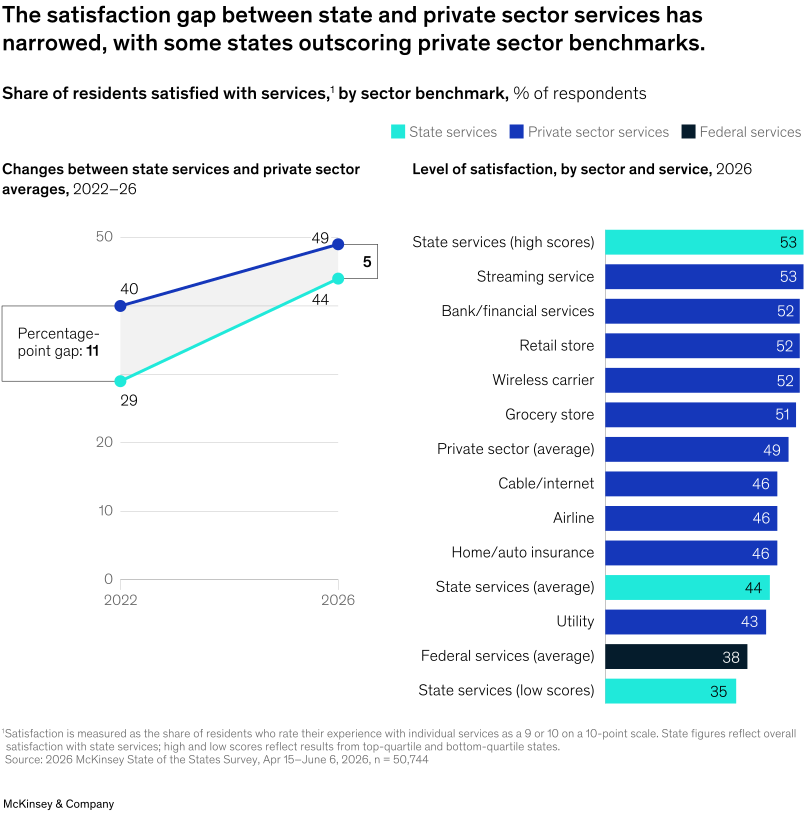
Broad-based improvement has also raised the bar for what good looks like. Today's highest-scoring states have improved nearly twice as much as today's lowest-scoring states since 2022, and states’ positions within the distribution have shifted meaningfully over the past four years,3 regardless of their socioeconomic and geographic characteristics. In fact, states with the highest and lowest satisfaction scores are broadly similar across measures such as household income, educational attainment, and share of rural population, while the highest-scoring states span all four US Census regions.4
These results suggest that CX performance can be continually improved if it is treated as an ongoing discipline. As customer satisfaction with state services rises across the country, sustaining yesterday’s performance may not be enough to keep pace with residents’ experiences in other states. Our research points to three opportunities that could help leaders develop CX as a true statewide capability:
- Set a statewide agenda for CX. Make customer experience a statewide priority with clear ownership, shared measures, and cross-agency accountability.
- Design services around resident journeys. Organize around the end-to-end steps residents take to achieve a specific outcome, with particular attention paid to the earliest steps in that journey (see sidebar “What is a resident journey?”).
- Use AI to build upon digital progress. Focus on how AI can improve the resident experience and, where residents interact directly with AI, design for trust, reassurance, and access to human support.
Set a statewide agenda for CX
Our research shows that in states with higher satisfaction scores, satisfaction is consistently high across the entire service portfolio. Even their weakest service satisfies about 45 percent of residents, which is higher than the typical service in any lower-performing group (Exhibit 3). The 12 states that climbed by at least one quartile since 2022 improved on nearly every comparable service.
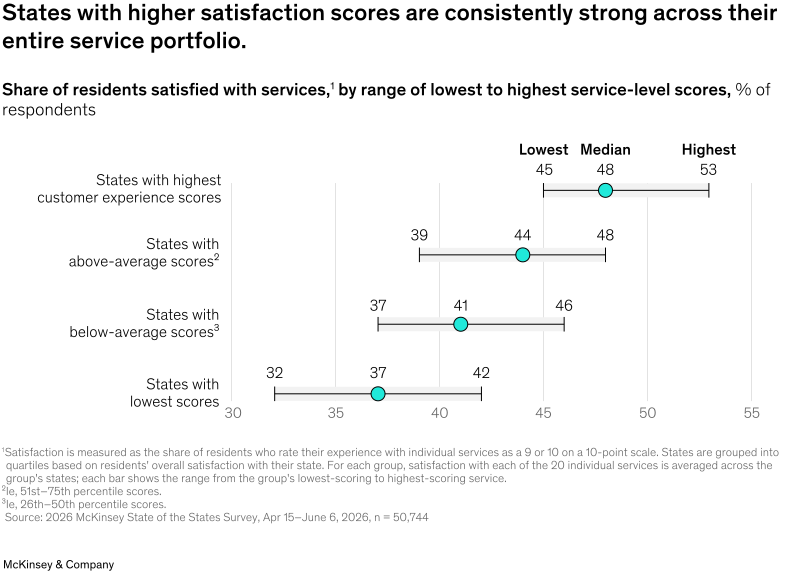
These results and our own experience working with state and local governments suggest that sustained gains in government CX do not come from optimizing service delivery at a single agency or from investing in one flagship initiative. They come from managing and improving the state’s services more holistically, with an “all of government” approach that includes clear ownership of customer experience.
Our analysis of other publicly available data points in the same direction. Of the eight states we identified with a dedicated statewide customer experience leader or office, seven have above- average customer satisfaction scores in our research. Both Utah and Washington illustrate the operating mechanisms that enable a holistic approach and the value that statewide ownership can create.
Utah is turning residents’ feedback into an enterprise management cycle. It places statewide responsibility for compiling agency-level customer feedback with the Governor’s Office of Planning and Budget (GOPB), which works with a dedicated statewide CX team to help agencies use that feedback to improve services. Residents can submit feedback through a common “Leave Feedback” button on state websites or QR codes at in-person locations, a system that creates a consistent cross-agency signal rather than a set of disconnected agency surveys. By July 1 of every year, the GOPB must provide state legislators with an annual summary of feedback collected during the previous calendar year and make the report publicly available. Its CX team then supports agencies with surveys, dashboards, web and app analytics, usability testing, and journey analysis—all of which are used to link transparency to a tool kit for practical improvements.5
And in Washington, state leaders combined an executive mandate with agency-level accountability. A 2025 executive order established “Your Washington,” a dedicated office within the governor’s office that is responsible for coordinating statewide CX strategy and holding agencies accountable for improvements. Your Washington requires cabinet agencies to appoint a CX liaison with decision-making authority, map the end-to-end experiences for the agency’s key services, submit CX data and feedback analyses, and develop a CX improvement plan that is embedded in each agency’s strategic plan. The order also establishes a reporting cadence— cabinet agencies must submit quarterly progress reports to Your Washington for the first two years of implementation, while Your Washington must publicly track and report statewide progress on a quarterly basis, including agencies’ customer-experience performance data—and directs the state toward a more unified resident experience through a centralized WA.gov portal, common service standards, and better cross-agency routing. 6
In both cases, Utah and Washington are coordinating across agency lines, using common measures of CX performance and creating a regular rhythm for enterprise improvements. But where can other states begin applying that same machinery?
With government CX, owning the portfolio also means knowing how each service contributes to both overall satisfaction and residents’ satisfaction with that specific service. Nationally, five services—affordable-housing assistance, tolls, vehicle services, taxes, and food assistance—disproportionately account for residents’ overall satisfaction with their own state’s services (Exhibit 4). But the mix of priority services is different in every state, making it important for leaders to understand which services have the most influence on their own residents’ experience.
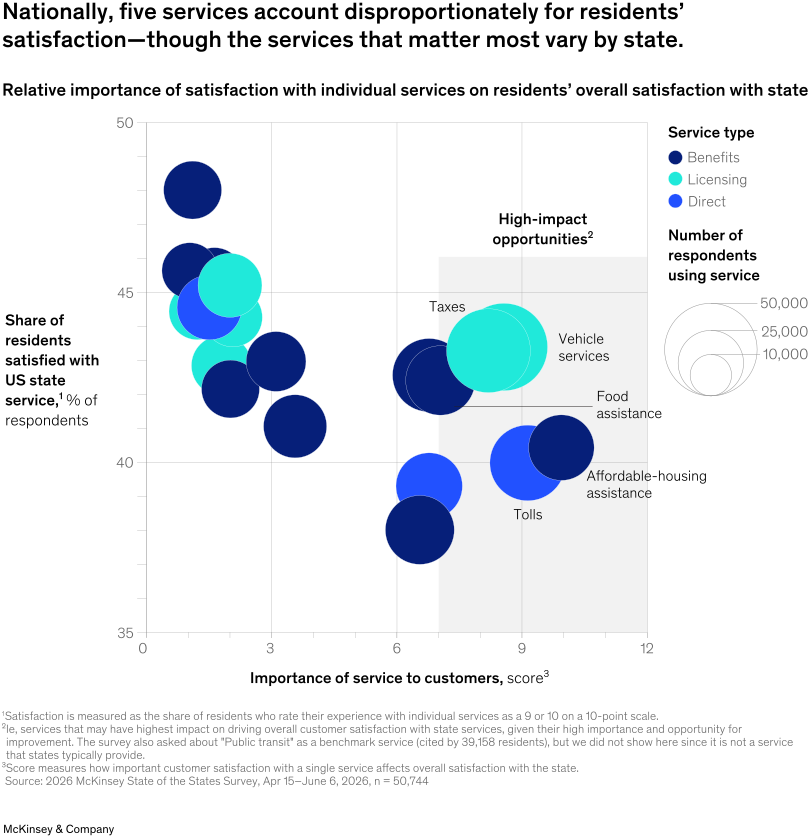
The experience of states with higher overall CX underscores why these priorities matter. In those states, the CX rating across each state’s own most important services averages 48 percent, compared with just 36 percent in states with lower CX scores. For individual states, the priority services can serve as an important starting point for addressing residents’ most pressing needs while continuing to raise performance across the broader portfolio.
Design services around resident journeys
Residents experience government through the specific goal they are trying to accomplish and not through the agencies responsible for delivering it. The process of starting a new business, replacing a driver’s license, or accessing unemployment benefits after a job loss may involve multiple agencies. But for a resident, they make up a single journey. Breaking that journey into the discrete steps that residents experience shows where states are delivering well and where the experience can be improved.
The research confirms that some steps have an outsize effect on satisfaction (Exhibit 5). The first step—learning about available services— is one of the most consequential, as “Learn” accounts for 15 percent of overall satisfaction.
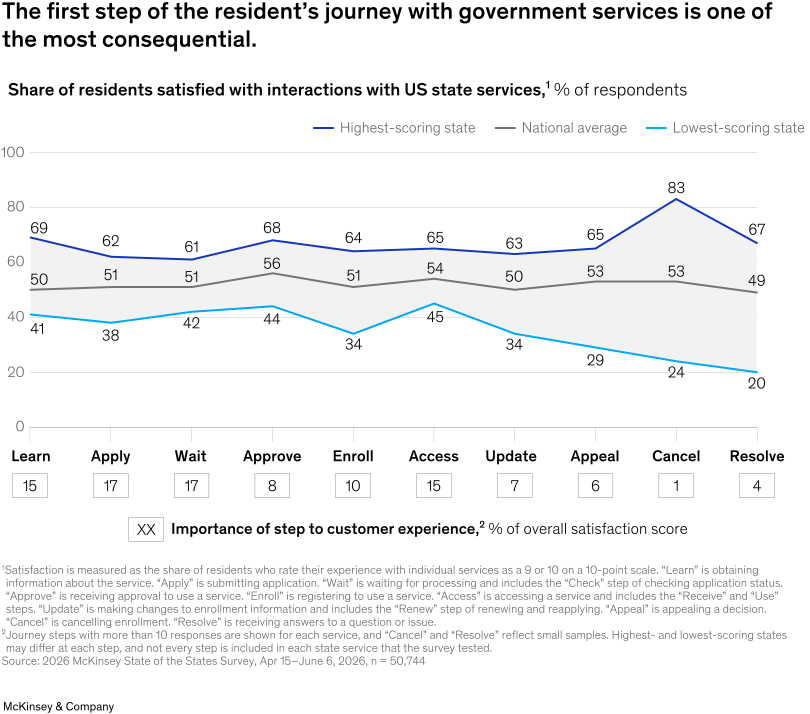
These findings point to the moments in the journey that matter most to residents, starting with the first one: learning which services are available and how to access them. Now, that first step can happen with AI assistants as well as government websites. Residents are asking ChatGPT, Claude, and Gemini how to start a business, renew a license, or apply for benefits. These tools build their answers in part from the information states publish online. When state websites are sprawling, outdated, or difficult for large language models to interpret, residents may receive incomplete or inaccurate answers—shortcomings they might attribute to the state rather than the AI tools.
That makes redesigning their website one of the simplest, most cost-effective steps states can take to improve CX. States can consolidate and simplify their content, organize information around residents’ needs and tasks, and structure it so that AI tools can read it reliably. Doing so can improve the accuracy of the information residents find, regardless of where their search begins.
Texas, for example, is rebuilding its digital front door with machine readability in mind. With legislative funding for a full website redesign focused on accessibility and customer service,7 the Secretary of State’s office is reducing the number of pages on its site from roughly 4,000 to nearly 400. The content on every page is also being written and structured so that AI tools can interpret it. This redesign will complement the state’s broader efficiency agenda, including the Texas Regulatory Efficiency Office’s AI-powered website (efficiency.texas.gov), which draws on Texas statutes and administrative code to help Texans find the rules, forms, and requirements that apply to their businesses or professions.
Maryland is enhancing its digital front door by bringing trusted government information to residents wherever they search for it. By adding a machine-readable guide (llms.txt) to Maryland.gov, the state helps the AI-powered tools residents already use to find and interpret authoritative government information. The guide also discourages the use of unsupported legal, policy, or eligibility determinations beyond what the state publishes.8 This approach acknowledges a changing reality: Residents may begin their search for government services through an AI assistant rather than a government website. Therefore, Maryland is working to deliver reliable information to residents across channels.
These examples suggest that the front door to government is no longer a single portal or homepage; it’s wherever residents ask questions. States don’t need to consolidate every service into one platform to improve service delivery. The more important design choices are organizing information around residents’ goals rather than agency boundaries and making it clear and readable for people and machines alike. By simplifying their existing sites and optimizing them for AI-driven discovery, states can help ensure that residents receive accurate information at the points of greatest friction.
Use AI to build upon digital progress
This year’s research suggests that states with higher satisfaction scores have a modest digital advantage. Residents in these states are somewhat more likely to prefer digital channels for service delivery (68 versus 62 percent) and report greater overall trust in government.9 Neither data point suggests that AI-enabled interactions—which we asked about for the first time in the 2026 survey—will improve resident CX. But together, they may provide a stronger foundation on which states can use the technology effectively.
For now, residents indicate a stronger preference for standard digital services than for AI-enabled alternatives.10 Across the service scenarios tested in the survey, residents selected AI-enabled options about one-quarter of the time, while standard digital options were the most popular overall (Exhibit 6).
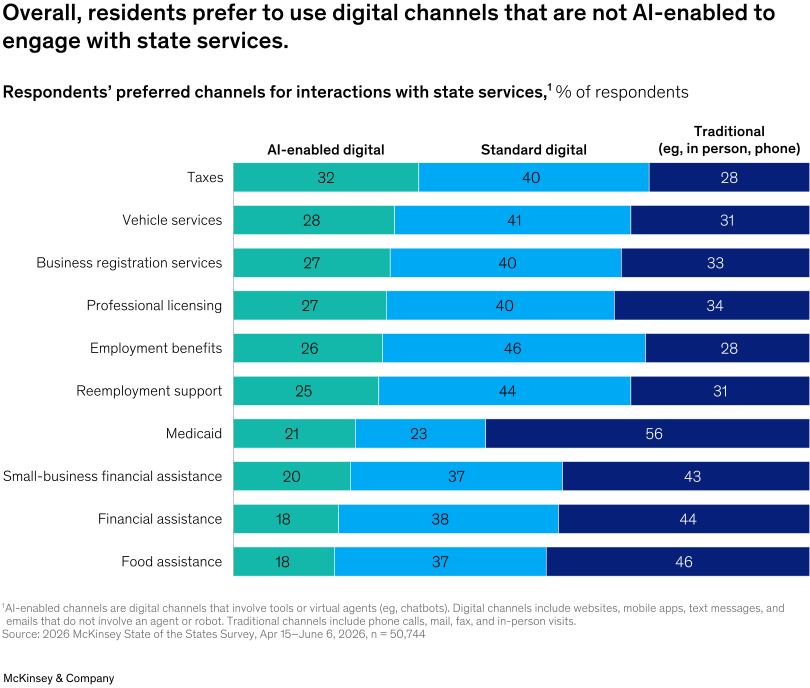
Residents’ preferences also vary across populations, though not always as expected. Our research suggests relatively little age-based differentiation—for instance, residents over age 75 are no more likely to prefer human interaction than those under 30. There are larger differences by income, geography, and race. Lower-income,11 rural, and Black residents are more likely than their peers to choose traditional in-person or phone options—and less likely to select AI-enabled ones.
The reasons behind residents’ preferences point to an important design principle. Nearly 80 percent of residents who avoid AI-enabled options either want a person to confirm that things were done correctly or believe their situation is too complex for self-service. Nearly one-half say they would be more comfortable if they could connect with a person in real time when a digital solution cannot resolve their issue quickly.
Residents’ comfort also depends on the task. According to our survey, they are more open to AI for relatively simple interactions (such as finding information, getting answers to routine questions, or checking the status of a request) and less so for interactions that are more consequential or require judgment, such as applying for benefits or resolving a complex case.
These findings suggest the near-term opportunity is not to replace digital or human interactions with AI, but to use AI to strengthen both. On the front end, AI can make routine interactions easier and more efficient for residents seeking information about specific services, understanding their eligibility, or checking their application status. Behind the scenes, AI can help employees summarize case information, classify documents, find relevant guidance, and resolve questions more quickly and consistently. This may be particularly valuable in complex, application-based journeys, where—according to our research—nearly 40 percent of residents who start a journey drop off before finishing it. Because the research suggests that only about one-third of resident contacts are resolved on the first attempt, using AI to improve staff’s ability to resolve questions could reduce both residents’ effort and repeated contacts.
This approach is consistent with McKinsey’s broader research on AI in government, which points to AI’s potential to improve resident-facing journeys while helping public sector employees work more effectively—reducing administrative burden, increasing consistency and capacity, and allowing staff to focus on more complex, judgment-intensive work.
Some state examples illustrate both types of benefits. Michigan is using AI to simplify the front end of the unemployment journey. Its Unemployment Insurance Agency launched a 24/7 chatbot that answers general questions through the agency website and links users to underlying source material. Customer feedback on its responses is helping the agency improve both the chatbot and the underlying website content.12
Ohio is applying the technology more broadly across the same journey, with AI-enabled assistance for residents and AI tools for its employees. Multilingual virtual assistants allow customers to file weekly claims and check claim status in 15 different languages, while intelligent document processing and an AI contact-center tool were developed to help staff classify information, find relevant records, and resolve questions faster.13
For government CX, the emerging AI advantage may belong to the states that are using it most deliberately, not necessarily those using AI the most across their agencies and processes. States can start by identifying steps and workflows where AI can have a meaningful, visible impact on customer outcomes while preserving live human support for complex, sensitive, or consequential interactions. In that model, AI can help build and extend a strong customer service experience rather than become a stand-alone destination for residents to navigate.
The opportunities ahead
The 2026 research offers governments reason for optimism. Nearly every state’s CX performance has improved, according to residents; the gap between public sector and private sector satisfaction has narrowed sharply; and states with higher customer satisfaction now deliver experiences that compare favorably with the companies residents interact with every day. US states have shown that meaningful improvements to service delivery are possible—and that they can happen quickly.
Still, the rising bar for customer satisfaction underscores the importance of continued improvement. The opportunity for state leaders is to turn CX from a collection of disparate service improvements into a holistic capability by setting a statewide agenda, designing services around the resident’s actual journey, and using AI to build upon digital progress. The states that build those disciplines now will be better equipped to meet today’s expectations and create systemic benefits for residents and employees alike. They will also be better positioned to get ahead of emerging challenges as residents’ needs and expectations for government services continue to rise.