An old axiom of dealmaking holds that “you make your money on the buy, not on the sell.” Yet that didn’t seem apparent in private equity (PE) for the 2010–2017 boom that followed the 2008 financial crisis. Powered by cheap financing and expanding deal multiples, PE buyout fund managers could count on industry momentum to roll right over elevated entry prices.
But time-proven principles of finance have a way of winning out. Consider how deal prices correspond to recent returns for PE buyout funds (Exhibit 1). We examined two distinct time periods of buyout fund vintages: 2010 to 2017 and 2018 to 2023. Specifically, within each period, we analyzed purchase prices, as captured by the purchase price multiple (PPM) of EBITDA, and broke PPMs down by quartile—the fourth quartile being the lowest price-to-EBITDA multiple paid, and the first quartile the highest multiple paid. During the post-financial-crisis boom (2010–2017), buyers in the cheapest quartile generated a 2.8-times multiple on invested capital (MOIC), while those in the most expensive quartile delivered 2.7 times MOIC. While buying at a good price mattered, tailwinds blew so strongly that price discipline was less evident in returns.
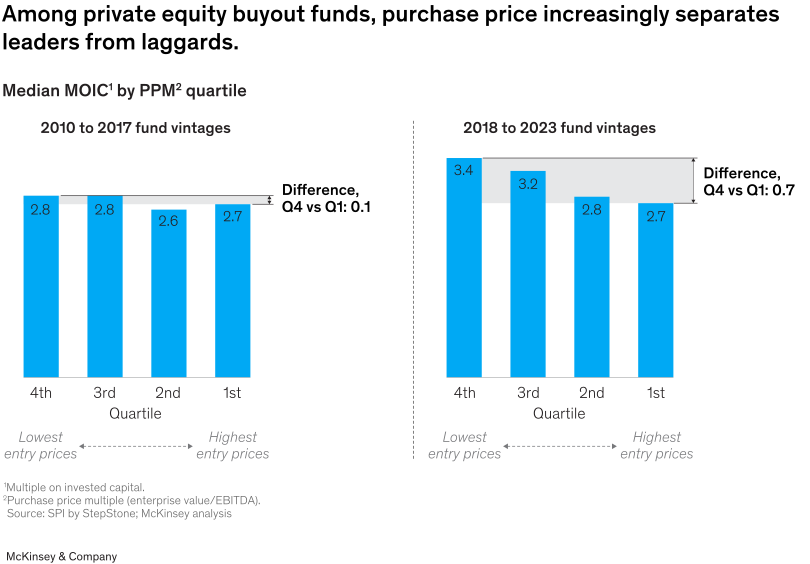
In the 2018 to 2023 vintage cluster, however, macro tailwinds died down, the road got more challenging, and a deeper divide opened between quartiles. Disciplined buyers—the ones in the lowest-price quartile—delivered 3.4 times MOIC, while those who had paid the highest PPMs remained stuck at 2.7 times. While one might suspect that the recent vintage could be skewed by funds taking quicker exits, that’s not the case; both categories capture a range of funds with longer and shorter holding periods.
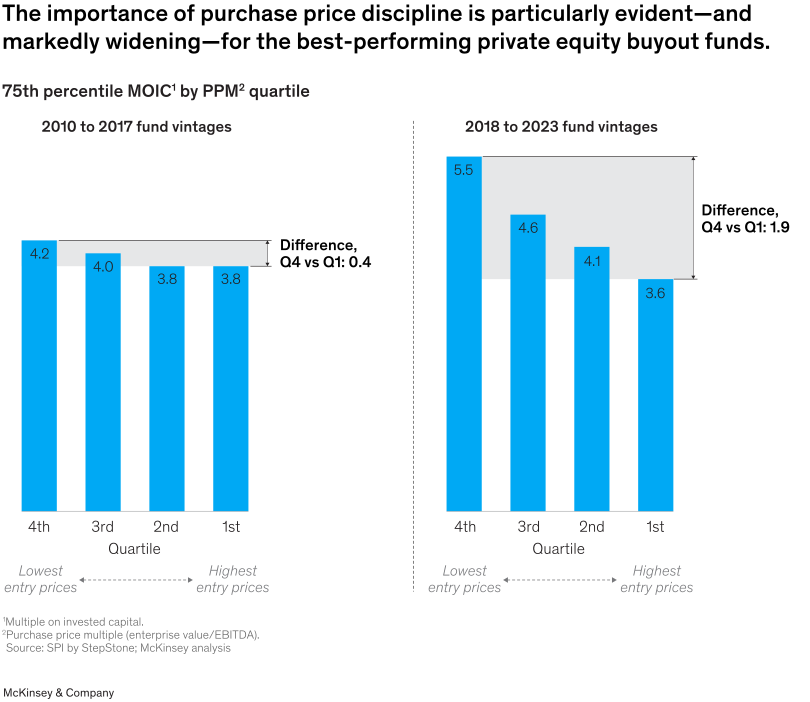
Simply put, the evidence of purchase price discipline is becoming more apparent. An even starker picture emerges when we isolate the top-performing investors—the 75th percentile per PPM quartile (that is, the ones who did exceptionally well on deal prices)—rather than just the median of the quartile, an analysis we performed to zero in on just how important price discipline can be. In recent vintages, managers who bought at the lowest multiples delivered an impressive 5.5 times MOIC. Meanwhile, even the best performers within the highest-paying PPM quartiles achieved only 3.6 times MOIC (Exhibit 2).
To an extent, the widening gap reflects the rise of equity markets. Globally, buyout entry multiples have risen since 2023, climbing to a record average of 11.8 times EBITDA last year. For larger transactions—specifically, buyouts greater than $500 million—multiples reached 18.1 times EBITDA.
Sponsors often justify these premiums by arguing that they are buying durable, “A-grade” businesses. But paying 11.8 times EBITDA—let alone, 18.1 times EBITDA, with far less leverage doing the work—shrinks the margin for error materially. The year 2025 featured headline acquisitions of A-grade companies, which naturally do command a premium. Yet several expected B-grade and C-grade companies did not come on the market, or were taken off the market, an indication that times are changing.
It’s understandable that general partners (GPs) would be willing to pay higher multiples for durability and downside protection, particularly in times of uncertainty. We recognize, as well, that uniquely in the PE sector, there are additional reasons for premiums, including the intense pressure to deploy capital. Still, whether it’s deployment pressures, competition for quality assets, underwriting AI, or the level of GP confidence, purchase price matters. It has distinguished M&A leaders across industries for decades. In recent years, a good purchase price has clearly marked winners in PE buyout funds as well.