Consumers returned nearly $1 trillion in merchandise in the United States in 2024—more than double the total from just four years prior. That surge has forced retailers to spend an estimated $200 billion annually to recover value from returned goods, making reverse logistics a major cost center for consumer companies. For many retailers, the most crucial returns-related question is whether a returned item is still sellable and, if so, where it should move next in the network to maximize value recovery.
Addressing this challenge is complex. The same practices that fueled e-commerce growth—free returns, instant refunds, and minimal friction—have cemented consumer expectations for how returns should work. At the same time, supply chain leaders tell us they are still managing reverse logistics the same way they did during the COVID-19 pandemic, with one-size-fits-all return policies and decisions for where to send returned goods (see sidebar “About the research”). Those measures worked when the goal was simply to keep goods moving, but they can’t keep pace with today’s constant flow of returns or the need for faster, smarter decisions about where each item should go next.
Retailers must apply the same rigor, investment, and cross-functional coordination to reverse logistics as they do to forward logistics, treating returns not as a back-end process but as a core stage of the product life cycle. In this article, we explain how retailers can use AI and automation to modernize return-policy design and disposition decisions, two persistent pain points along the returns journey. We then discuss how retailers can design products and processes with resale, retention, and recovery in mind from the start and outline six levers that can shape the reverse-logistics model of the future. Done right, reverse logistics can shift from a growing cost center to a source of resilience and competitive advantage.
Return policies don’t have to be consistent across consumer groups
When designing return policies, retailers face a “returns paradox”: How can they offer a customer-friendly return policy that drives sales and improves customer satisfaction without increasing costs? Consumers, meanwhile, are clear about what they expect: They want free, unlimited returns that require no labels or boxes and the ability to drop items off anywhere, anytime after purchase.
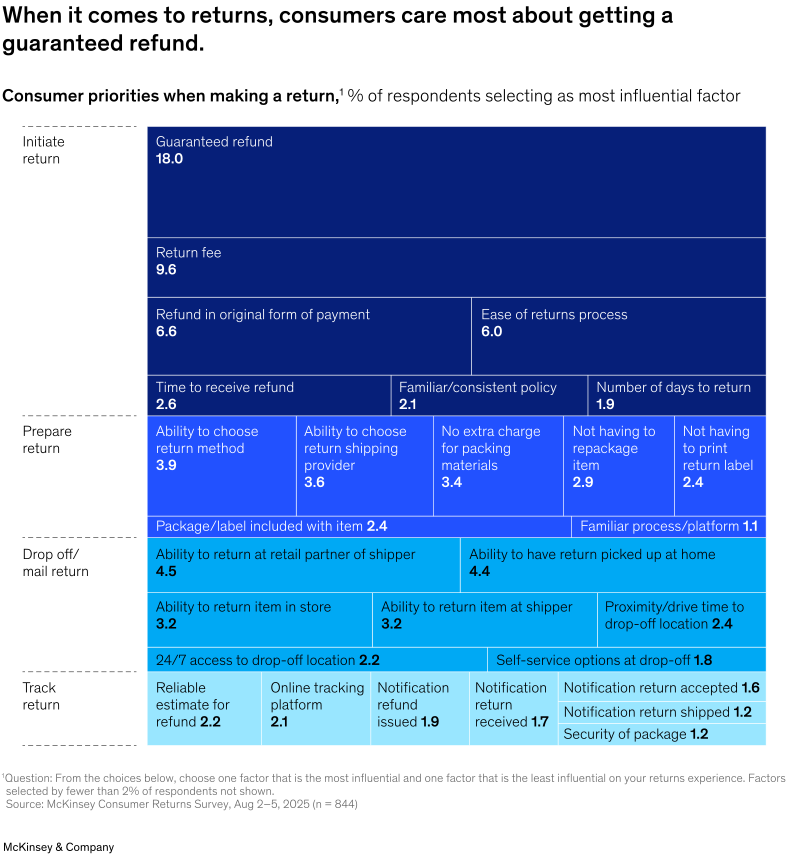
But consumers don’t weigh each of these features equally. When asked to rank their preferences, consumers say they care most about receiving a guaranteed refund, the cost of the return, and the form of repayment; they care less about the number of days they have to return an item, visibility into the process, or consistent processes or platforms (Exhibit 1). They also value ease and convenience and access to convenient drop-off or pickup options, often enabled through partnerships with third parties (see sidebar “Improving retailers’ collaboration with parcel carriers and third-party logistics providers”).
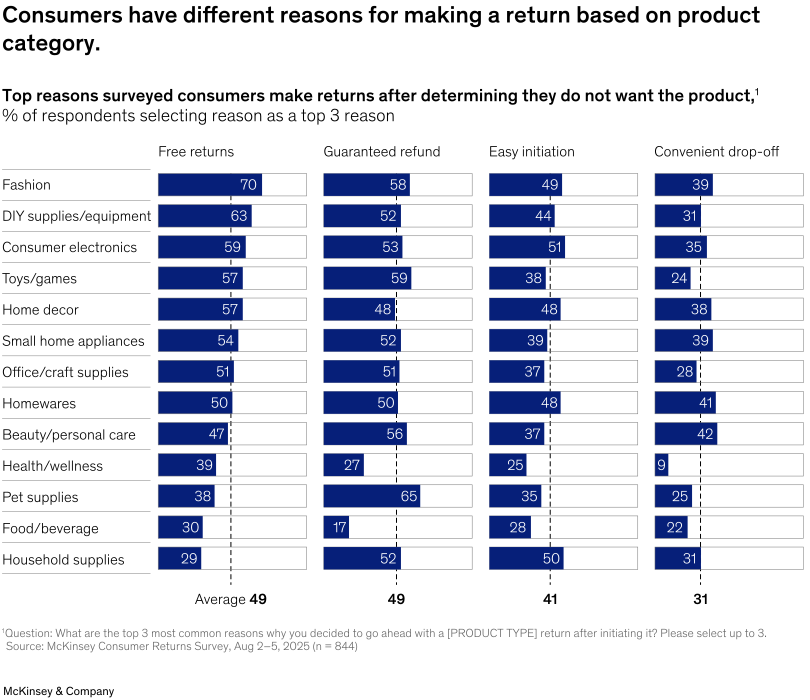
Often, what customers value in a return policy varies based on the product category. For example, in our survey, fashion shoppers are most likely to go through with a return if it is free, but pet supply shoppers are most likely to go through with a return if offered a guaranteed refund (Exhibit 2). This type of differentiation opens the door for retailers to design smarter return policies while selectively introducing friction into the process (which can help discourage returns fraud and “exploitative behavior” that retailers frequently encounter1).
The good news is that most consumers (71 percent) say a dynamic, product- and customer-specific return policy would not make them less likely to shop with a retailer again. This gives retailers room to create returns policies that segment customers based on projected customer lifetime value (CLTV) and previous returns behavior.
Consider a handful of typical customer segments: A customer with an average CLTV and return frequency might be offered free returns with instant refunds in the form of store credit within a 14-day return window. Loyal customers with historically high order values and low return rates could be rewarded with more generous terms, such as free returns and instant refunds to a credit card. Customers who return items they didn’t buy or exploit “keep-the-item” policies could be placed under stricter conditions: $10 return fees, store credit only, and a seven-day return limit.
By establishing the data architecture needed to integrate customer, product, and transaction information—which a robust governance structure within the retail organization supports—companies can run controlled experiments to measure how different policy levers, such as fees, refund methods, or return windows, affect CLTV and return frequency.
As evidence accumulates, AI models can be trained on these outcomes to predict the optimal policy mix for each customer segment—and eventually, individual customers—balancing retention, profitability, and fairness. These models should include clear guardrails, such as caps on refunds, fees, or return windows, to prevent inadvertent margin erosion or misalignment with a retailer’s objectives. It is also important that all model testing complies with applicable consumer protection, payments, and data privacy regulations, which can vary significantly by region. Taken together, these capabilities allow retailers to move from static rules to dynamic systems that continuously learn and adapt.
AI can help returned products reach their next destination faster
Once a customer initiates a return, the seller must decide what to do with the product, a process known as dispositioning. Among 30 supply chain executives in our survey, more than half say dispositioning is their greatest challenge in managing returns, as most of the total cost of a return is concentrated at this stage.
In that same survey, all but five supply chain leaders say their companies still rely on basic data, or no data, to make dispositioning decisions. Historically, dispositioning has been manual and tedious, requiring costly inspection before deciding whether to recycle, repair, or restock—often through a slow, linear process.
Companies can instead adopt a dynamic disposition model that integrates what they already know about the customer, product, supply chain, and operations to optimize the return pathway from the moment the return is initiated. Many retailers already have the data to make smarter dispositioning decisions. Besides knowing a great deal about their customers, they also know about a product’s margin profile, seasonality, shelf life, and resale potential; the supply chain costs and timelines associated with shipping, inspection, and redistribution; and the operational setup of their retail network, including store locations and inventory capacity.
The best results come when companies combine these diverse data sources into a single, AI-driven decision engine that routes each returned item to its highest-value outcome in real time. By integrating product data with demand forecasts, retailers can ensure restocking occurs when demand still exists, while analyzing historical defect patterns against customer-reported issues can inform condition checks that fast-track refurbishing or recycling. Together, these insights enable risk-adjusted, situation-specific decisions that avoid unnecessary shipping to default intermediary locations and return products to market faster, maximizing value recapture.
For example, when an unknown customer returns a $100 holiday sweater in early December, the item follows a default path: It is routed to a central facility, queued for standard inspection and repackaging, and eventually shipped to a discount partner in January. That slow, static process erodes value, as retailers recover only about 50 percent of the product’s worth.
In contrast, when a trusted customer—a buyer with a reasonable return history and accurate claims—returns the same sweater, a retailer’s digital returns portal predicts that no refurbishing or redistribution steps will be needed. And, as in-season merchandise, the return should be routed directly to a nearby store for resale within days, not a month or longer. This allows the item to reenter the market while demand is still high, boosting recovery to around 75 percent.
A growing set of technology providers already helps retailers make smarter dispositioning decisions, and some retailers are using these tools effectively today. The bigger issue is not the absence of solutions but limited and uneven adoption. Many retailers still rely on manual approaches to dispositioning or use dispositioning software in isolation, rather than as part of an end-to-end returns process. Capturing the upside requires more than adopting a tool. Retailers must first connect customer, product, and supply chain data; define clear rules that balance speed, margin, and capacity; and redesign returns workflows so dispositioning decisions are made automatically and early—ideally at the moment a return is initiated, not after items enter the network. (To be sure, retailers do not have to use off-the-shelf dispositioning platforms; they may choose to acquire and customize these platforms or build their own entirely, depending on scale requirements, internal tech capabilities, and data maturity.)
Retaining value from returned items begins before the product is sold
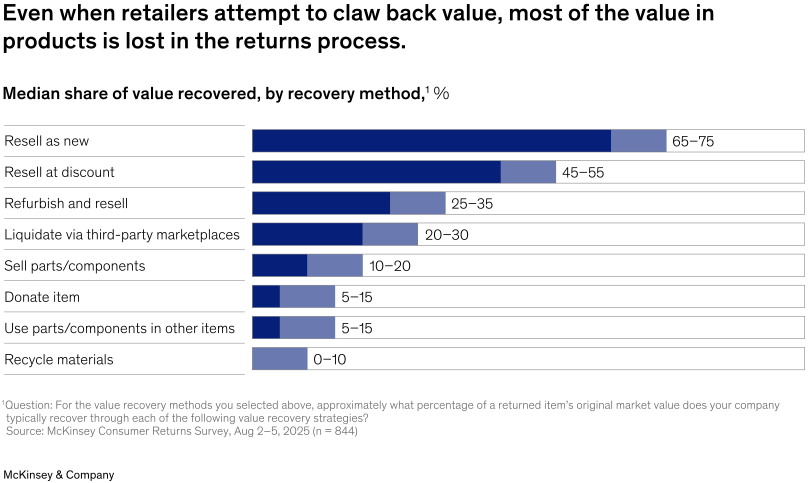
During dispositioning, companies consider the value they can recover from each item. For items that aren’t recycled or donated, companies typically have three re-commerce (or reverse commerce) options to recover value: reselling the product in stores, liquidating it via a third-party marketplace, or selling for parts. Unfortunately, most sellers recover only about half of a product’s value with these strategies (Exhibit 3).
Factoring expected value recovery into the earlier stages of the product life cycle, including design and pricing, can help. When insights from returns feed back into product and operations decisions, retailers can reduce returns, recover more value from each item, and improve margins.
Consider product design: Products are often optimized for their first sale, with less thought given to what happens if they’re returned. By factoring return and resale insights into design, companies can reduce return risk and increase resale potential. Some footwear brands are now designing shoes with interchangeable parts—like replaceable soles or detachable uppers—so they can be easily cleaned, refurbished, or resold through certified second-life channels, building circularity into the product itself. An electronics maker could embed smart sensors or digital IDs that track usage and condition data, allowing automatic assessment and relisting of returned devices. In both cases, upstream design choices unlock downstream value recovery, turning returns from a cost center into a planned stage of the product life cycle.
Or consider pricing: A home furnishings retailer might use predictive analytics to identify high-return product segments and adjust pricing, bundling, or incentives accordingly to better align with customer preferences—such as offering tailored bundles or “keep-it” credits—helping reduce unnecessary returns. It could also time promotions around refurbished or open-box restocks, protecting margins and minimizing markdowns. Together, these strategies shift focus from first-sale revenue to full life cycle value.
High-quality customer reviews are also valuable to retailers. Most online shoppers consult reviews before making a purchase, and detailed feedback on fit, fabrication, and quality helps customers make better purchase choices up front. A shopper choosing between sizes may select the correct fit after reading that an item runs large, or they may choose a different product through “others also bought” recommendations. Retailers can increase high-quality reviews by prompting customers shortly after delivery—once items have been worn or used—and by making the process effortless through one-click ratings from email or app, mobile-first flows, and short, structured prompts focused on fit, quality, and use. When retailers encourage their customers to leave reviews, they reduce avoidable returns while still supporting conversion.
To capture this value, retailers need an end-to-end re-commerce strategy that clearly defines ownership and accountability and treats returns as a core business capability rather than a secondary process. Third-party partners can support retailers’ returns execution, but primary responsibility should sit with a designated internal leader who connects returns insights across design, merchandising, and operations.
To build a future-ready reverse logistics model, address six core levers
As returns grow, companies can use the following six levers to address key reverse-logistics pain points: demand, data and insights, decisioning, operations, re-commerce, and feedback (table).
By optimizing six levers across reverse logistics, retailers can reposition returns as a source of growth and competitive advantage.
| Key returns levers | Description |
| Demand | Minimizing return rates by enhancing purchase precision and optimizing friction along the returns experience |
| Data and insights | Leveraging deep data integration to unlock richer insights into customers, products, and market dynamics |
| Decisioning | Harnessing data-driven intelligence to optimize returns strategies, operational efficiency, and value recovery |
| Operations | Optimizing returns logistics to minimize resource use and streamline reverse supply chain efficiency |
| Re-commerce | Maximizing value recovery from returned products through smart resale, refurbishment, and reintegration strategies |
| Feedback | Building integrated feedback loops to drive alignment across the end-to-end returns value chain |
Below, we’ve highlighted three of these—data and insights, decisioning, and feedback—since they underpin the end-to-end cycle from insight generation to decision-making to sustained execution.
Data and insights
Combine data from across functions to unlock richer insights about customers, products, and market dynamics:
- Design scalable cloud or hybrid architecture for returns data, and establish real-time ingestion pipelines that connect structured and unstructured sources (such as returns portals, point of sale, resale platforms, and shipping records). This enables a single, continuously updated view of return activity.
- Create a unified returns data product, or a single source of truth with clear ownership and governance. Ensure it includes key variables such as CLTV and returns history, SKU information, time and mode of return, seasonality, expected demand, reason code, product value, expected recovery, and processing cost.
- Link product metadata (like margin profile, defect history, and life cycle status) to returns information. Use machine learning models to predict recovery value and automate routing decisions, such as whether to refurbish, liquidate, or restock an item. Account for the full cost and value potential of returns at every stage—from shipping and inspection to resale or recycling—to surface the true margin opportunity of each decision.
Decisioning
Harness data-driven intelligence to optimize returns strategies, operational efficiency, and value recovery:
- Use predictive analytics and AI to flag and prevent high-risk return behaviors.
- Personalize returns options based on customer data, including a shopper’s return history, and product data (such as seasonality).
- Route returns dynamically to the most cost-efficient re-commerce end points—such as restock, resale, and recycle—by integrating data on demand forecasts, product condition, and logistics cost into automated decision flows.
Feedback
Build connected feedback loops to align teams and decisions across the returns process:
- Assign clear executive accountability for reverse-logistics performance. Designate a senior leader with visibility across design, operations, and re-commerce as accountable for the returns P&L. This leader should act as a central integrator to align supply chain, store operations, and customer experience teams on shared goals.
- Conduct regular cross-functional reviews of returns data to identify and act on systemic issues.
- Test new products, tools, and processes—such as digital IDs or modular design—and measure their impact on reducing dispositioning costs and increasing resale potential.
Amid rising e-commerce volumes and consumer expectations, solving the reverse-logistics problem is more urgent than ever. Companies that act now to modernize returns policies, dispositioning, and value retention can protect margins while strengthening customer loyalty. By treating reverse logistics as a core capability, leaders can turn one of retail’s biggest cost burdens into a powerful driver of resilience and value creation.