Amid persistent inflation, rolling commodity deflation, tariffs, and geopolitical disruption, pricing has moved to the center of how distributors protect margins and outperform despite volatility. Pricing has always been distribution’s most significant value creation lever, but its strategic relevance has increased sharply as cost structures, competitive dynamics, and customer expectations shift faster than traditional pricing processes can keep up with.
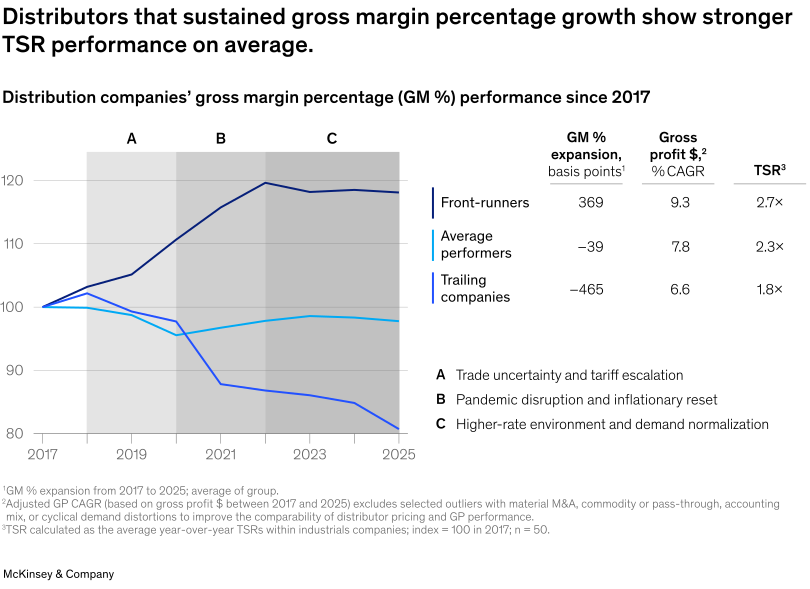
The upside of getting pricing right is material. A 1 percent price increase can drive a more than 22 percent boost in EBITDA margin and a 25 percent increase in share price, since those 100 basis points flow directly to the bottom line and disproportionately affect overall profitability.1 That far outstrips similar gains in volume, procurement, or SG&A, and pricing’s crucial role is underscored by the fact markets clearly reward companies able to maintain performance in periods of instability (Exhibit 1).
But capturing that value today requires a different approach. Traditional levers such as annual price increases, broad cost pass-throughs, long-tail markups, and spreadsheet-based pricing matrices are no longer sufficient. B2B buyers now have unprecedented transparency into alternatives, price benchmarks, and market movements. With AI tools increasingly available to both sellers and customers, blunt pricing moves can quickly erode trust, trigger overrides, or accelerate churn.
That makes the next frontier not simply about optimizing price but about building a pricing capability that continuously senses market changes, refreshes guidance quickly, personalizes offers, and protects margins across contracts and channels. Done well, this transforms pricing into a source of organizational agility with faster test-and-learn cycles, fewer manual overrides, stronger customer experiences, and greater resilience in volatile markets.
Importantly, distributors do not need perfect data or a modernized technology stack to begin. New AI tools can help work through fragmented data, inconsistent product hierarchies, and legacy systems, provided companies follow a pragmatic recipe for sequencing use cases, governance, and targeted infrastructure investments.
Here, we show how leading distributors are embracing AI-enabled pricing across four capabilities: building a stronger product and data foundation, deploying dynamic and self-learning pricing, personalizing offers at scale, and using contract intelligence to protect margins. Together, these capabilities are redefining pricing from a periodic sales or finance exercise into a strategic engine for profitable growth.
Four essential capabilities anchoring new ways of pricing
Driving a class-leading pricing strategy requires four essential capabilities:
Capability 1: A product and data foundation for pricing
Distributors today manage extraordinarily complex product assortments measuring millions of SKUs across thousands of product categories, creating vast volumes of product data. Often, this product data is incomplete and inconsistent, and because it is a key input into price-setting processes, it undermines pricing accuracy, drives margin leakage through overrides, and complicates both customer experience and inventory management.
Traditional data-cleansing and enrichment approaches are slow and labor-intensive, sometimes taking months to years to complete, making them unsustainable at scale. Advancements in gen AI have helped significantly improve the ability to address these traditional data challenges. In our experience, here’s what good looks like:
- a standardized product taxonomy across categories
- robust attribute coverage enabling substitute identification and price sensitivity and elasticity modeling
- automated gen AI–driven enrichment workflows for new SKUs
- clear governance over product data ownership
- override rate threshold enforced based on execution data
Example: Transforming data accuracy and pricing discipline. A leading building materials distributor was grappling with slower market growth and a sales team and customers losing confidence in its pricing. Sales teams were overriding system-generated prices in more than half of all transactions, citing unreliable product information and inconsistent pricing logic. The underlying issue lay in fragmented and incomplete product data, ranging from inconsistent descriptions to poor product-category mapping, which made it difficult to identify related SKUs or generate logical pricing guidance.
Recognizing that accurate pricing depends on a trusted data foundation, the company leveraged gen AI to systematically enrich and standardize its product catalog. The solution delivered a sixfold improvement in processing speed through automated creation of structured product data and the ability to rapidly and accurately price new SKUs. The effort involved extraction and structuring of key product attributes across more than one million items, a task that would have been unmanageable for human category managers at scale.
With a robust and reliable product data set in place, the distributor was able to design and deploy a market-based optimal pricing architecture that strengthened pricing discipline, reducing manual overrides by 80 percent, and expanded margins by more than 200 basis points. The transformation not only improved commercial performance but also rebuilt organizational trust in data-driven decision-making, demonstrating the power of gen AI to enhance both operational efficiency and strategic agility.
Capability 2: Dynamic, self-learning pricing
Modern price-setting is no longer static. Smart algorithms continuously learn from transaction data, market fluctuation, and demand shifts, adapting prices to maximize both win rates and margin. High-velocity products, such as janitorial supplies and maintenance, repair, and operations equipment, benefit from regression-driven elasticity modeling, while field-based SKUs rely on bid-response analytics. For commodities, local market intelligence still rules, but everywhere else, prices should move as the market moves. Deploying this level of self-adapting pricing requires strong guardrails and exceptions governance, including price floors and ceilings, competitive position roles for key value items (KVIs), and escalation for strategic accounts. Here’s what good looks like:
- Eighty to 90 percent of transactional prices are auto-generated.
- Price refresh cycles are measured in hours or days, not weeks.
- Elasticity models are recalibrated weekly or monthly.
- There are clear KVI positioning rules.
Example: Developing an agile, intelligent pricing framework. An auto-parts distributor operating in a highly competitive aftermarket landscape was facing shrinking margins and pricing inconsistency across its extensive catalogue of SKUs. Static pricing rules could not keep pace with rapid market shifts. Competitor prices changed daily across online marketplaces, yet internal price updates often lagged behind by weeks. This lack of responsiveness eroded both competitiveness and profitability.
To address the challenge, the organization deployed AI-enabled web-scraping capabilities to gather real-time competitive intelligence and feed a dynamic, self-learning pricing engine. The system continuously captured market data and refreshed price elasticity to automatically refine pricing decisions over time. By establishing category-level pricing strategies within defined competitive guardrails, the model balanced aggressiveness with profitability, ensuring channel-specific optimization at scale. Over time, the self-learning algorithms improved predictive accuracy and reduced manual intervention, creating a closed feedback loop that made the pricing engine smarter with every transaction.
The result was a highly agile and intelligent pricing framework that transformed how the company managed its commercial performance, driving about 100 basis points of margin expansion, reducing pricing cycle times from days to minutes, and reinforcing competitiveness across digital and traditional sales channels.
Capability 3: Designing and delivering personalized offers
Today’s B2B buyers demand bespoke experiences. Leading distributors use customer and market data to design individualized offers that deliver the right price, terms, and incentives to each account. AI-powered segmentation and predictive analytics enable hyper-relevant cross-sell, upsell, and promotional strategies. In practice, here’s what good looks like:
- clear customer micro-segmentation logic tied to willingness to pay
- price points specific to customer items, refreshed weekly or biweekly
- behavioral discounting based on volume and mix
- embedded personalization in digital channels
- transparent rules reducing discretionary discounting
Example: Transitioning to an e-commerce pricing platform. A leading food service distributor sought to transition from a traditional, seller-driven sales model to a scalable, e-commerce–led commercial engine. With hundreds of thousands of SKUs and diverse customer segments, the distributor struggled to deliver consistent, competitive, and personalized pricing through manual sales interactions.
The company developed a granular, data-driven pricing and discounting program powered by AI and digital integration. Millions of tailored price points were dynamically generated and refreshed weekly, reflecting customer-specific behaviors such as purchase volume, product mix, and cross-category breadth. Standard and behavioral discounts were embedded directly into the e-commerce platform, mirroring the personalization and transparency of leading B2C experiences. Customers logging in could see individualized pricing, behavioral volume discounts, and AI-driven product recommendations.
The shift to personalized, self-service digital pricing improved competitiveness and customer engagement while delivering a 2 percent return on sales.
Capability 4: Protecting margins by optimizing contract structures
As contracts and deals grow more complex, protecting profit requires proactive oversight. Contract structures can become silent drags on profitability when terms vary widely and visibility is fragmented. Guarding margins requires combining AI-driven analytics with end-to-end contract visibility: optimizing rebates, adjusting payment terms, and surfacing profit leakage risks (such as returns, credits, and contract compliance) before they erode the bottom line. Additionally, such measures can retroactively help address contract compliance and recover lost margins as allowed within the existing contract structures. Here’s what good looks like:
- a centralized, structured contract database
- automated extraction of key commercial terms
- reconciliation of transactions to contract provisions
- visibility into rebate, credit, and compliance leakage—and as a result, contribution margin
- standardized renewal playbooks with quantified impact
Example: Analyzing contracts to empower sales negotiation. A leading national industrial provider serving construction labor and rental needs faced challenges in managing large account profitability where the central team had limited line of sight into the commercial terms shaping each customer relationship. By pairing a targeted value diagnostic with gen AI–enabled contract intelligence, the organization rapidly uncovered where margin was being left on the table.
The team began with a top-down value sizing to isolate the dozen contract terms most influential to unit economics and overall margin performance. From there, a gen AI–powered workflow parsed more than 500 contracts, extracting and analyzing clause-level language to quickly assess term favorability and risk across the portfolio. Armed with these insights, the team built a practical negotiation playbook, complete with scripts, quantified impact, and levers, that equipped sales teams to navigate renewals and in-cycle negotiations with greater precision.
The result was a clear line of sight to roughly 5 percent margin uplift through contract term optimization. Client teams, actively coached through live negotiations, are now positioned to systematically capture this opportunity as contracts come up for renewal.
The path forward: A margin imperative for distributors
For distributors, the margin race will not be won through incremental tweaks to annual price increases or reactive cost pass-through. It will be won by building pricing as a scaled, AI-enabled capability that continuously senses the market, adapts in real time, and embeds pricing discipline across the commercial organization.
The performance gap is already visible. Top-quartile distributors have expanded margins and delivered materially higher shareholder returns, even in volatile environments. Their advantage is not access to better markets but superior pricing infrastructure. Four capabilities define this next-generation model:
- A clean, governed product and data backbone enabling accurate price guidance and reduced manual overrides. Without trusted data, even the most sophisticated algorithms fail.
- Dynamic, self-learning pricing engines that automate price setting with clear quantification of price sensitivity and operate within clear strategic guardrails. Pricing cycles measured in hours, not weeks, are becoming the standard.
- Personalized pricing at scale, embedding customer-specific price points, behavioral incentives, and cross-sell logic directly into digital channels. This shifts pricing from negotiation-driven to insight-driven.
- Systematic margin protection, using AI-enabled contract intelligence to surface leakage, optimize terms, and arm sales teams with quantified renewal playbooks.
The implication is organizational as much as technical: Pricing must move from a reactive sales-support tool to a strategic growth engine, backed by analytics talent, governance, and executive sponsorship. Distributors that institutionalize these capabilities will not simply withstand volatility but will convert it into structural margin advantage and reinvest ahead of the market.
Perhaps most important, these capabilities are no longer reserved for distributors with pristine data or best-in-class technology stacks. Advances in AI, particularly gen AI, now allow companies to unlock value from fragmented data, inconsistent product structures, and legacy systems that may have previously stalled pricing transformations. Leading distributors are not waiting for perfect data or multiyear modernization efforts but are taking a pragmatic, use-case-led approach that delivers measurable impact quickly while building the foundation for more-advanced pricing capabilities over time.