


Health insurers in the United States have long viewed care management as a necessary function but not as a strategic part of their core business. Traditional care management, which comprises elements such as wellness programs and longitudinal case management services via telephone engagement, has not been treated as an engine for value creation. As a result, payers struggle to effectively respond to the growing external pressures driving up medical costs. Cost of care has become a burning platform for payers, who need to support high-value medical decisions that improve member health and reduce total cost of care.
The stakes are high for US insurers. Revenue alone can no longer guarantee continued performance: Payers’ EBITDAs declined 11 percent after 2019, hitting a low of $29 billion in 2024.1 Medical costs rose 6.5 to 8 percent in 2023 compared with 5.5 percent the year before.2 This trend continued in 2024, with 7.5 to 8.5 percent increases, and medical costs are expected to stay at that rate through 2026.
In this environment, the path to better value requires that payers adopt reimagined care models, which prioritize engaging the member with the right care provider through the right channel and with the right information to make high-value clinical decisions. This would align improved patient outcomes with financial resilience. Insurers that can demonstrate improvements in member experience, health outcomes, and costs will be best positioned to differentiate and grow. Insurers that fail to transform their clinical strategies risk losing their position in the healthcare value chain, while those that proactively refine their approach can build a competitive moat and become individuals’ go-to choice for personalized, coordinated care.
What isn’t working today
While high-performing payers can achieve 2 to 5 percent savings from care management approaches that have a clear clinical approach,3 most payers lack a clinical strategy that improves their members’ health and ensures sustainable financial performance. In its absence, many default to a compliance-driven patchwork approach characterized by tactics that often focus on metering care or meeting process measures rather than optimizing health outcomes. These stand-alone levers, when not operating in concert, don’t improve outcomes and can result in member and provider dissatisfaction. For example, insurers lean too heavily on care management through telephone engagement that’s often focused on closing process gaps to improve performance on quality measures and does not move the needle on cost of care. To address cost of care, many insurers rely solely on utilization management approaches rather than designing better care models or pathways for members that help spur higher-value, lower-cost medical decisions in partnership with providers.
And although some insurers attempt to tailor tactics to specific member groups, this segmentation often fails to target clearly defined populations and align them with the clinical interventions most likely to improve outcomes and reduce costs. For example, targeting the top 10 percent of spend, members with rising risk, and those with known health-related social needs with telephonic outreach, isn’t sufficient to change medical decision-making and often fails to reduce preventable spend.4 Delivering real impact requires patient-specific interventions focused on addressable sources of value at the right point in time in a member’s journey (see sidebar “Sources of value”).
Moreover, payers’ clinical teams are often composed predominantly of registered nurses, who may be tasked with addressing social-care needs that could be addressed by other professionals, such as community health workers, at a lower cost. Finally, payers’ lack of integrated clinical functions and overreliance on external vendors can exacerbate these issues, creating fragmented solutions that lead to poor experiences for members and providers alike.
A blueprint for payer-led care model innovation
Given the cost-of-care crisis and threat to overall financial performance, payers must move beyond their traditional role as insurers. They should take the lead in building high-functioning, interdisciplinary care models that enhance member experience, deliver better outcomes, reduce administrative burdens, and align incentives across the healthcare value chain.
Care models are targeted, multimodal, and action oriented. They have the potential to reduce the total cost of care by 3 to 6 percent, according to our research. They succeed where other approaches fail because they consider the following questions:
- Whom is the model serving? What are the specific outcomes to improve, and what are the clinical sources of value? Member segmentation tied to individual members’ clinical needs and addressable spend helps ensure that care models improve health and spur an ROI.
- What interventions will the member receive, at what moment in their care journey, by which care team, and in what setting? Interdisciplinary care teams that are resourced according to member needs deliver integrated, targeted interventions tied to clinically addressable spend at the right time for the member.
- What technology platforms will deliver an integrated experience that enables the care team and member to make a high-value decision? Hardwired workflows and fully integrated, real-time clinical and social data set up the care team for success with the right information to understand how to support a member’s decision.
- What’s the underlying business model to deliver clear ROI? The care model helps create a flywheel of savings that enables investment in member experience and delivers better health, which can support member retention, growth, and investment.
Creating successful care models, however, is expensive. As a result, insurers must zero in on areas with true clinically addressable spend. For example, clinically appropriate site-of-care shifts alone could spark approximately $114 billion in savings across the entire US healthcare system.5 To figure out where to deploy resources that will have a real impact, we propose taking the following steps:
- Conduct ROI analysis to scale clinical programs that are working and sunset those that aren’t. If there isn’t evidence that a program is working, assume it isn’t. Resources from programs that aren’t producing results can be channeled toward care models.
- Prioritize specific members at the right time, informed by member segmentation, clinically addressable spend, the clinical context (for example, after a planned procedure), and the ability to invest by line of business (LOB). Insurers can use social determinants of health, behavioral-health metrics, and real-time clinical analytics to understand the variation in utilization and spend. They can then map member segments to sources of clinical value to assess savings potential by market and LOB (Exhibit 1).
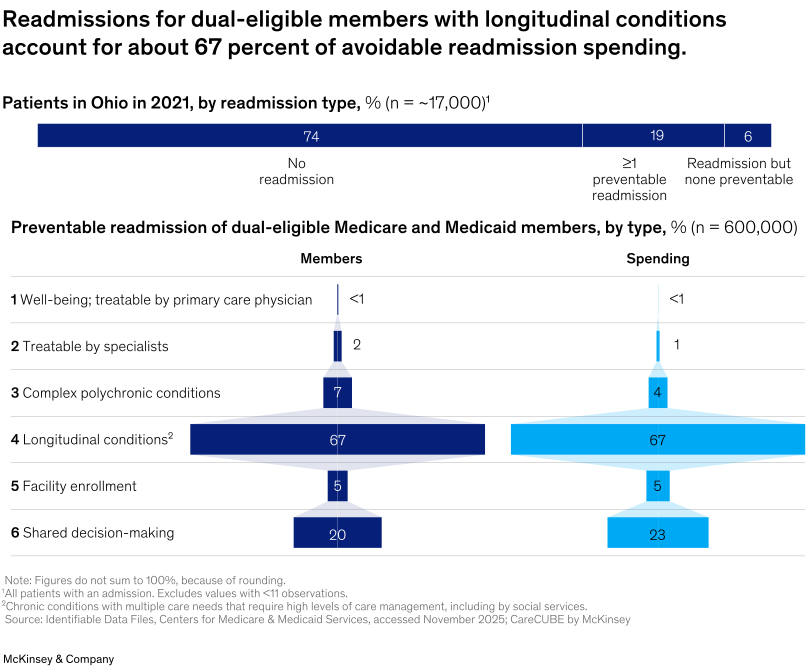
- Design the care model by focusing on the clinical needs of the prioritized member segment and the segment’s largest areas of avoidable costs. Each segment will require a distinct care model (image), with different interventions depending on who is leading delivery. Interventions could be delivered by payers, payer and provider partnership, integrated payer and provider, or providers (see sidebar “Payer and provider partnership types for care delivery”). Interventions can range from traditional telephone engagement by nurse care management teams to comprehensive wraparound services and care management teams delegated to providers. For example, a payer that has substantial opportunity for medical cost avoidance in the complex polychronic segment might combine virtual urgent care with community paramedicine and a mobile integrated health program to enable members to receive appropriate care in their homes instead of the emergency department (ED).
- Assess capabilities and gaps relative to the aspiration, with a focus on care team composition, operating model, and technology enablement. The aim is to be able to launch segment-specific, interdisciplinary care teams that use technology to scale personalized interventions and seamlessly collaborate both internally and with members’ providers, social supports, and caregivers.
- Create a strategy that balances both building and vending capabilities using the organization’s bandwidth for change, execution strengths, and areas where it may make more sense to partner with external experts.

Transformative-care models demand a fundamental shift in how populations are understood, how care teams are structured, and how interventions are deployed. Payers that adopt care models can expect a meaningful difference in value creation. For example, Alignment Healthcare USA reported medical-loss-ratio reductions that it attributes directly to an integrated clinical strategy that uses clinical risk stratification technology to trigger clinical engagement approaches for each member’s needs, enabling lower cost of care and medical-loss-ratio savings that can be reinvested into richer product offerings and spurs growth.6 Early results suggest that the hospitalization rate for its members is 39 percent lower than Medicare’s rate in its markets.
Another example is Commonwealth Care Alliance (recently acquired by CareSource). Its model for clinical and social care, delivered in partnership with owned primary care practices, reduced total cost of care by $23,000 per member per year, and adoption of similar models at other payers demonstrated decreased inpatient admissions and ED visits by up to 11 percent among those enrolled in dual-eligible special needs plans.7
Health insurers are facing mounting pressure from all sides. Employers are pushing back on rising costs, government LOBs are being squeezed, and payers are grappling with rising utilization costs across the board. Meanwhile, consumers are growing increasingly dissatisfied.
The status quo is unsustainable. The time for incremental change has passed. Payers that continue to rely on legacy care management tactics will struggle to enhance member experiences and outcomes and to control costs. They must instead reimagine their role in the healthcare ecosystem, moving beyond the use of one-dimensional member segmentation and table stakes care management to the use of integrated strategies that result in clinically precise and operationally excellent care models. Those that act decisively will lead the transformation of healthcare delivery in the years to come.
Anne Koffel is an alumna of McKinsey’s Boston office; Cara Repasky is a partner in the Pittsburgh office; Jordan VanLare, MD, is a senior partner in the New Jersey office; Caroline Morgan Berchuck, MD, is an associate partner in the Atlanta office; Emily Schlichting Demres is an associate partner in the Austin office; and Omar Kattan, MD, is a senior asset leader in the Southern California office.
This article was edited by Querida Anderson, a senior editor in the New York office.
1. McKinsey analysis of Payer Financial Database.
2. “Behind the numbers 2026: No let up in sight. Medical cost trend set to grow at 8.5%. Is your playbook ready?” PwC, July 16, 2025.
3. Oleg Bestsennyy, Michelle Chmielewski, Anne Koffel, and Amit Shah, “The untapped potential of payer care management,” McKinsey, January 25, 2021.
4. Nancy D. Berkman et al., “Management of high-need, high-cost patients: A “best fit” framework synthesis, realist review, and systematic review,” Comparative Effectiveness Review, 2021, Number 246.
5. Nikhil R. Sahni et al., “Potential US health care savings based on clinician views of feasible site-of-care shifts,” JAMA Network Open, 2024, Volume 7, Number 8.
6. Tim Casey, “After ‘really good’ year, insurtechs look to continue growth in 2025,” Health Plan Weekly, March 7, 2025; Alignment Healthcare’s 10-K for fiscal year ended December 31, 2024.
7. Jack S. Rowe et al., “Intensive care management of a complex Medicaid population: A randomized evaluation,” American Journal of Managed Care, 2022, Volume 28, Number 9; Kaylyn E. Swankoski et al., “Senior-focused primary care organizations increase access for Medicare Advantage members, especially underserved groups,” Health Affairs, 2024, Volume 43, Number 9.