For decades, the securities services industry has served as the indispensable backbone of financial markets. Custodians, fund administrators, and central securities depositories (CSDs) keep tabs on the world’s holdings, generating about $76 billion in annual revenue, or roughly 30 percent of total financial market infrastructure revenue of $245 billion. Reliable, stable, and heavily regulated, the industry has been slower to modernize, on average, than other sectors in financial services; more than 80 percent of leading firms we surveyed in 2025 and again in 2026 say keeping pace with tech advancements is one of their biggest challenges.1
Yet as the industry’s dynamics shift, change is now an imperative. Today, five disruptive forces are lowering historical barriers and opening the door for new competitors. The race to real-time settlement is accelerating, agentic AI is opening up new ways to provide services, and digital assets, private markets, and investors’ geographic ambitions are placing new demands on providers. Slow-moving modernization is giving way to rapid, transformative change.
For incumbents, the strategic question is how to move fast enough to overcome legacy architecture challenges and maintain their edge. Some providers have already modernized their architecture and are building nimble and adaptive firms. But to take advantage of the opportunities these changes bring, firms will need to do more than just adapt; they will have to fundamentally rewire their organizations across strategy, talent, operations, and technology.
This article examines the changing industry dynamics and suggests some priorities for securities services leaders as their industry transforms.
Growth rates are diverging as the industry rebalances
Our proprietary analysis of the securities services industry forecasts growth of about 5 percent annually through 2030. This top-line figure masks a significant rebalancing.2 Growth is concentrating at large-scale platforms: global custodians and major CSDs. Fund services CSD divisions are growing at an annual average rate of between 10 and 15 percent, driven by the expansion of alternative assets and passive investment vehicles. Smaller, nonspecialized players without clear scale or specialization advantages are falling behind.
Geographically, North America has been the primary engine of revenue growth (averaging about 8 percent annually), while Europe and the Asia–Pacific region are growing more slowly, at about 1 to 2 percent.
The disruptive forces shaping the future of securities services
Beneath the surface-level stability, foundational pressures are building. After decades of gradual change, five interconnected forces have emerged and are reshaping the industry at an accelerated pace. These pressures are reflected in evolving customer demands—institutional investors increasingly expect always-on, data-rich interaction models that are a hybrid of digital and physical delivery—and firms that cannot deliver will likely lose mandates to those that can. Customer demands include delivery-versus-delivery (DVD) settlement alongside traditional delivery-versus-payment (DVP) settlement, 24/7 servicing windows, one-stop portals with real-time connectivity, and flexibility to access new asset-class wrappers.3 These notably include active ETFs, which have grown at an average annual rate of about 60 percent over the past three years.4
The race to real-time settlement is on
The industry is nearing the end of a multidecade acceleration of settlement times. The shift to trade execution and settlement in a single day, known in the industry as T+1, is a significant stepping stone toward the ultimate goal of T+0—that is, real-time, “atomic” settlement. The European Union, Switzerland, and the United Kingdom all plan to adopt T+1 by October 2027. Moving to real-time settlement is more than a technological upgrade; it would fundamentally rewrite the liquidity logic underpinning financial markets.
Compressed settlement windows would require entirely new prefunding models, reshape collateral management, and oblige all market participants to rethink how they source, allocate, and recycle liquidity across the settlement chain. The operational implications include end-to-end straight-through processing, new “follow the sun” operating models to manage cross-border frictions, faster net-asset-value calculations and intraday reconciliation for fund administrators, and expanded real-time settlement offerings from CSDs.
Several pilots are already underway. For example, in 2023, SIX Digital Exchange and the Swiss National Bank (SNB) began a pilot to settle digital securities with wholesale central bank digital currency—issued by the SNB in real time on a distributed ledger—and facilitate atomic DVP settlement.5 In India, the market regulator launched a T+0 settlement pilot in March 2024 for select equities in the cash market.6 Some pilots are already producing results. In the United States, Broadridge launched a platform in 2021 to execute and settle repurchase transactions (repos) using smart contracts on blockchain infrastructure.7 Since launch, adoption has increased significantly: The platform processed about $365 billion in repo transactions daily in July 2026, up from $65 billion in 2024.8
Agentic AI emerges as a leading industry priority
AI agents are a critical ingredient in the race to real-time settlement and can help firms structurally reduce their costs. Unlike previous technologies, agentic AI has the potential to automate complex, end-to-end workflows, offering a path to a real-time, always-on servicing model that was previously unattainable. For example, it can minimize settlement failures by autonomously triaging trade mismatches, predicting “at risk” trades before market close, and drafting real-time resolutions. Agents can also help bridge the funding gaps inherent in shorter cycles by continuously monitoring intraday cash balances and executing preapproved collateral movements.
Priority domains for rethinking operations using agentic AI include client onboarding, IT development, and the middle office (Exhibit 1). For the middle office, agents can tackle end-to-end processes such as detecting and investigating instruction breaks, automatically applying repairs, and informing counterparties accordingly. We estimate based on experience with clients that agents have the potential to automate up to 60 percent of select middle-office activities. As clients become increasingly willing to switch providers for lower processing costs, these productivity improvements become all the more inevitable.
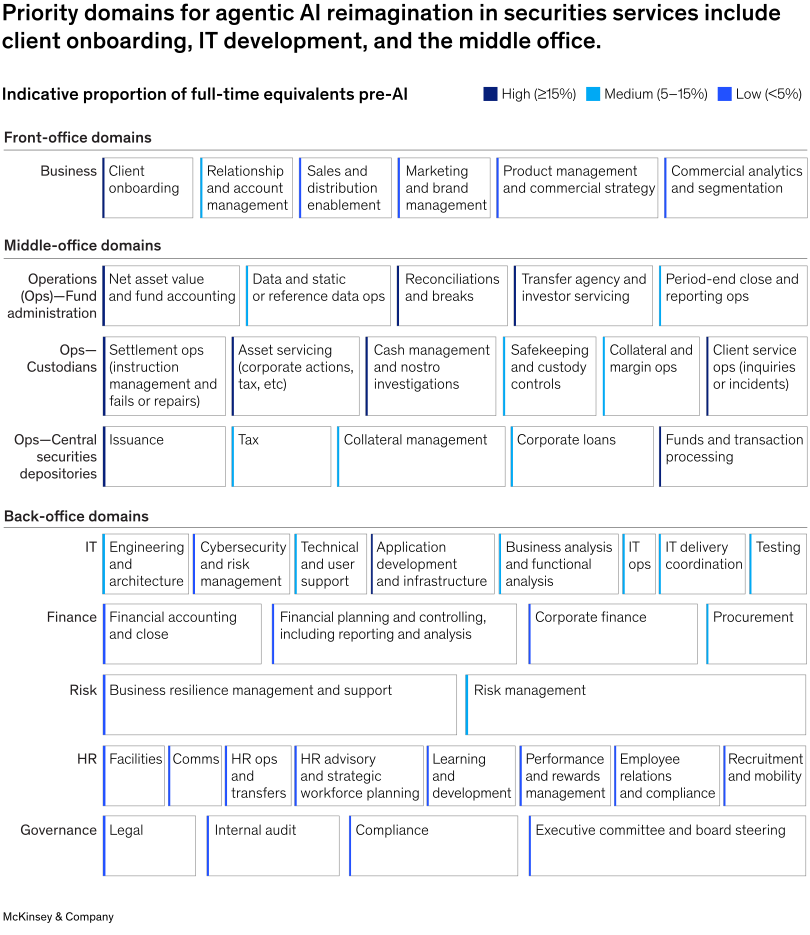
Surveyed firms tell us that agentic AI and the “zero ops” models they power are a high-focus priority, second only to the shift to T+1. Yet adoption lags behind ambition: The majority of firms we surveyed remain at the proof-of-concept or single-use-case stage, with only about 20 percent reporting at-scale transformation, primarily in IT and platform modernization. While the middle office is cited as the highest-priority operational domain, none of the surveyed institutions have implemented a full middle-office transformation.9 Human supervisors of AI remain an important element in any transformation.
The rise of tokenization and digital assets may redefine post-trade infrastructure
After years of experimentation, digital assets and distributed ledger technology (DLT) have reached institutional scale. With an annual growth rate of more than 75 percent in tokenized assets, McKinsey research has estimated a base-case market of nearly $2 trillion by 2030.10 Most asset classes are expected to be tokenized, with differing scenarios for stepwise adoption.
For the securities services industry, a shift to more tokenized assets may redefine post-trade infrastructure by enabling atomic settlement and creating new, efficient value pools across custody and servicing. Asset tokenization introduces fundamentally new operating models, such as new issuance rails, redesigned asset servicing models, DVD settlement replacing traditional DVP, and smart contract automation that collapses multiday processes into near-instant execution. However, no global standard has yet emerged. Instead, multiple parallel protocols and chains are developing simultaneously. This fragmentation requires securities servicers to build hybrid operations capable of supporting both on-chain and off-chain environments, as well as interoperating across different on-chain ecosystems.
Incumbents have stepped up their digital operations. For example, in 2020 JPMorgan Chase launched a blockchain and digital assets business unit named Onyx, which has since been expanded and rebranded as Kinexys by J.P. Morgan.11 Goldman Sachs operates GS DAP, a blockchain-based platform that includes end-to-end workflows to digitize and manage assets in real time across their life cycle.12 In Europe, BNP Paribas Securities Services is working with Fireblocks as its “hot wallet” connectivity infrastructure layer for its settlement and custody of regulated security tokens.13
These and other moves toward increasingly automated operations and digital-asset infrastructure raise the bar for cyber resilience. As firms shift from human-executed to system-executed workflows, the dependence on systems’ accuracy, uptime, and cyber defense increases materially because of the broader attack surfaces the technology brings, lower tolerance for downtime, and new threat vectors introduced by DLT connectivity and autonomous AI agents operating across the settlement chain.
The expansion of private markets
Private capital has made major inroads in financial markets in recent years; we expect private assets to nearly double from about $16 trillion to about $27 trillion by 2029, primarily in private credit and infrastructure.14
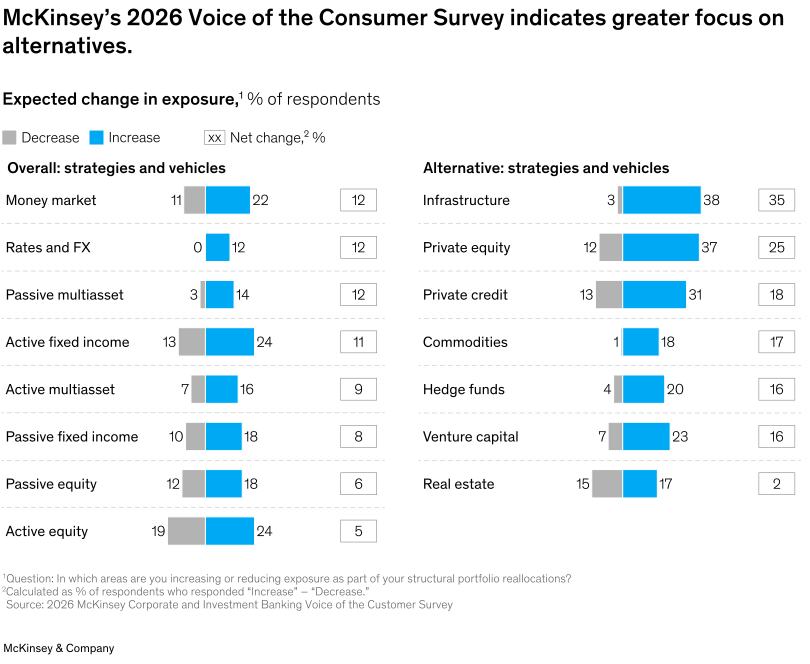
While fundraising has slowed as interest cools in some segments, notably real estate and venture capital, the structural trend toward alternatives continues: A significant share of institutional investors in McKinsey’s 2026 Corporate and Investment Banking Voice of the Customer Survey15 plan to increase allocations, with infrastructure (+35 percent net), private equity (+26 percent net), and private credit (+18 percent net) leading planned increases (Exhibit 2). Access to private markets is also expected to increase, although unevenly: For now, about 20 percent of private market assets under management (AUM) is raised from individuals, up from 4 percent in 2020.16 However, barriers relating to minimum thresholds, liquidity, and investor experience remain significant.
For securities services, the infrastructure opportunity lies in smoothing these points of friction. The lack of standardized settlement services—such as distribution, manual ledger tracking and tax handling, and poor data transparency—creates operational challenges that securities services providers can address to unlock new value. Multiple market participants are actively expanding their presence in private markets through organic growth initiatives and strategic platform launches with partners. Examples include BNY’s September 2024 launch of its Alts Bridge platform, which enables wealth managers and intermediaries to access third-party alternative and private market funds,17 and LSEG’s February 2026 launch of a private funds platform, which integrates Apex Group’s fund administration and servicing infrastructure.18
Geographic diversification to cater to regional growth needs
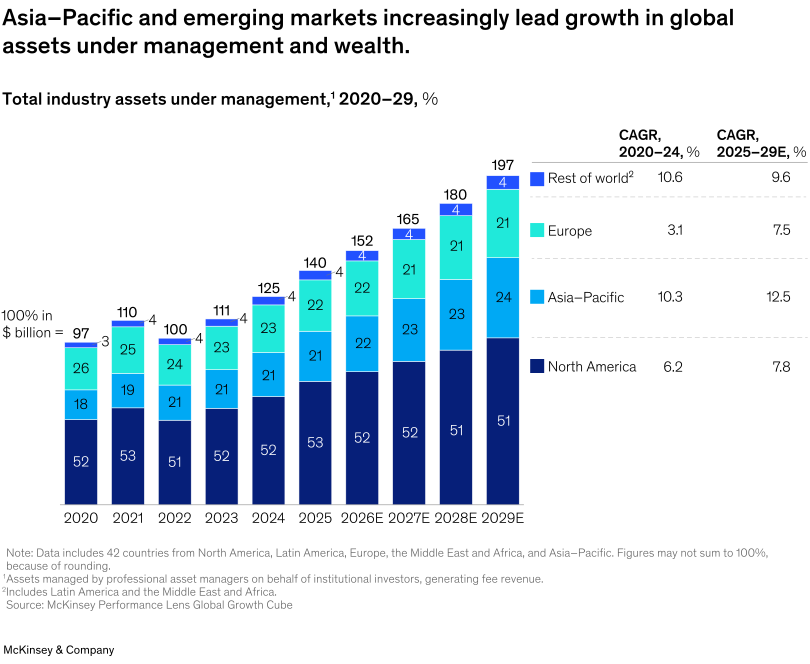
Institutional investors are actively diversifying their geographic exposure, driven by geopolitical volatility, tariff regimes, and the search for uncorrelated growth. Global AUM is projected to reach about $197 trillion by 2029, but the composition is shifting. Asia–Pacific and emerging markets are outgrowing developed markets; we expect Asia–Pacific AUM to grow at 12.5 percent annually through 2029, compared with 7.8 percent for North America and 7.5 percent for Europe (Exhibit 3). McKinsey’s Voice of Customer Survey confirms this rebalancing: Net allocation intentions over the next one to two years favor Asia (excluding China, +45 percent net) and Europe (including the United Kingdom, +43 percent net), while North America sees a net outflow (–16 percent). The Middle East and Africa are attracting more incremental capital than Greater China (+19 percent versus +8 percent net), partly driven by US tariff exposure.
For securities servicers, demand for multi-jurisdictional coverage, regional connectivity, and localized servicing capabilities is intensifying. Firms need to be able to follow their clients’ capital wherever it flows.19 This geographic rebalancing is already visible in provider positioning. For example, from 2024 to 2025, HSBC grew its Asia assets under custody by 23 percent, from $5.5 trillion to $6.8 trillion.20 Citi obtained a domestic fund custody license in China in 2020 (with final China Securities Regulatory Commission approval to launch in 2021) and launched Custody+ in 2026, a real-time and near-real-time custody suite supporting a business that serves more than 100 markets.21 Clearstream appointed Bank of China (Hong Kong) as common depository for international securities from August 2025, extending Eurobond infrastructure into Asia–Pacific.22 And DLT is emerging as a geographic bridge: Project mBridge—backed by the Hong Kong Monetary Authority and the People’s Bank of China, among others—launched a pilot in mid-2024 for atomic cross-border foreign-exchange settlement, and the Canton Network is being tested for Japanese government bond repo settlement (MUFG) and Japan–Korea payment networks (SBI).23 These are not isolated moves. They make up the early infrastructure of a multipolar settlement landscape.
Rewiring securities services firms for the new era
To navigate these disruptions, protect margins, and capture new growth, securities services firms may need to embark on a holistic transformation. Our analysis based on McKinsey’s Rewired framework suggests that leaders could consider rewiring their organizations across five key dimensions.24 Applied to securities services, this framework may provide a structured road map for firms navigating the simultaneous shifts in settlement infrastructure, asset classes, and operating models described above. The Rewired framework is not a sequential checklist: The organizations that break through move on all five dimensions in parallel, starting with two to three lighthouse domains where value is concentrated.
Strategic road map. One approach for leaders would be to build an interoperable multisettlement infrastructure, enabled by AI, that would operate across traditional venues and DLT-based networks simultaneously. To do so, they could define two or three lighthouse AI use cases delivering validated effort reductions of 50 to 90 percent, build tokenization and crypto custody as a parallel revenue line, and position for the eastward shift in institutional capital and the rapid projected expansion of private markets.
In such a scenario, leaders would need to prioritize: Trying to be present on every chain and every asset class from day one is unlikely to work. In our experience, organizations that stall tend to be those that are spread thin across many proofs of concept. The ones that break through often pick domains where client demand is already crystallizing—such as standard-settlement-instructions processing, reconciliation, and net-asset-value calculation—and build depth before breadth.
Talent. Firms will likely need to recruit critical AI capabilities, including agentic AI architects, platform engineers, AI product managers, and governance specialists. Equally important, operations staff may need to be upskilled as AI supervisors rather than replaced. That would require reframing roles from processors to trainers and overseers of autonomous agents. This demands dedicated upskilling academies and strategic workforce planning for the shift toward digital assets and agentic AI.
One pitfall here could be underinvesting in the “middle layer”—the people who translate between data scientists and domain experts. Without AI product managers and process redesign leads who speak both languages, use cases can stall at handover. The organizations that scale fastest tend to invest in upskilling early, before scarcity of talent causes cost increases.
Operating-model agility. Hybrid infrastructure that spans on-chain and off-chain DVP and DVD may require new organizational forms. Firms would need to organize cross-functional squads around AI use cases, combining machine learning engineers, operational experts, and product managers with clear ownership of profit and loss. A 24/7 “follow the sun” servicing model may become inevitable. Leaders would need to implement decision rights frameworks to set guardrails on agentic autonomy and auditability.
Rigorous governance will be an essential success factor. Agentic AI operating within ambiguous decision boundaries creates risk faster than it creates efficiency. Our analysis suggests that the leaders who succeed define escalation paths and audit trails before the first agent goes live, not as an afterthought.
Hybrid-by-design technology, data, and AI. Firms will need technology that can connect to multiple DLT networks—such as Canton, SDX, and Ethereum-based networks—while securely managing digital assets and maintaining connections to traditional financial infrastructure through standards such as Swift and the FIX Protocol. Platforms should be flexible enough to work with different AI models and cloud environments while providing full visibility into how AI agents operate as well as a traceable record of their actions and decisions. One approach is to make agentic enablement a first-order design principle: platforms built to host autonomous AI agents across operations. Critically, technology and cyber resilience would need to scale in proportion to this growing dependency. Autonomous AI systems and digital-asset rails demand a structurally higher bar for accuracy, continuity, and defense than legacy processes, making operational resilience an architectural requirement rather than a compliance overlay.
Industry leaders will need to take care not to build the platform in isolation from the use cases. The organizations that move fastest tend to use agentic AI in the software development life cycle itself. In other words, they use AI to help build the platforms that will run AI. This can compress replatforming timelines from 18 months to six. Those that build “enterprise AI platforms” without a live use case typically end up with elegant infrastructure and little adoption, according to our analysis.
Adoption, scaling, and ecosystem positioning. Our analysis suggests that firms need to go beyond proofs of concept and through rapid test-and-learn cycles, demonstrating value before scaling across the organization. The key challenge is more operational than technical: Leaders need to invest in business readiness and top-down commitment to change. Client adoption matters just as much because customers must be able to access new capabilities as service expectations shift. Finally, firms need to maintain proximity to DLT protocol developers, standard-setters, and disruptive entrants to shape emerging standards rather than react to them.
Patience is a virtue here. A use case that works for 500 transactions does not necessarily work for 50,000. Our analysis suggests that the organizations that break through force the uncomfortable question: “What breaks at 100 times the volume?” They invest in operational readiness—including monitoring, failover, and human-in-the-loop triggers—before scaling, rather than waiting until after the first production incident.
The securities services industry is on the brink of its most significant transformation in a generation. The forces of change are no longer ripples on the horizon; they are waves gathering force. Incremental adjustments will not be enough to navigate the coming shifts. The winners will be the organizations that act decisively now, embracing a holistic, top-to-bottom rewiring of their business.