A group treasurer sits down to decide how to split her company’s business among its banks for the year ahead. Her options are familiar: the house bank that runs the cash-pooling structure, a handful of other banks on the panel, and the nonbank lenders and platforms now competing for the same business.
This quiet, annual reallocation is both a calculus and a contest. The stickiest balances stay put; the operating cash-pooling structure that took years to set up is not worth moving. But everything else—the next financing mandate, foreign exchange (FX) cash, and the hedging flow—is contestable, even at her house banks. This contestable flow is the most likely to drift. The group treasurer determines which provider gets the business based on how they answer one question: What have you done for me lately?
The 2026 McKinsey Corporate and Investment Banking (CIB) Voice of the Customer Survey measures this drift precisely using perspectives from more than 300 global corporations, institutional investors, and financial sponsors (including private equity firms, venture capital firms, and infrastructure, real estate, and natural resource financers), as well as C-suite-level interviews. Five findings offer banks guidance on how to best capture wallet share across clients.
Treat loyalty as if it’s earned every year, not owned
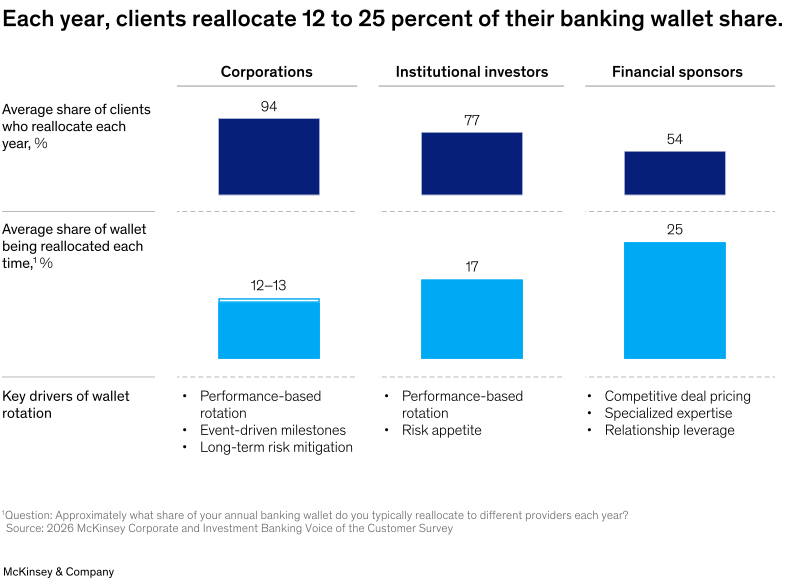
Banking relationships are no longer evergreen. Across segments, clients continuously optimize their provider ecosystems, and even house banks can be displaced—but the pace differs sharply by segment. Nearly 95 percent of surveyed corporates reassess their allocations annually, yet relationships are typically sticky. Respondents said 12 to 13 percent of their wallet share rotates per cycle, which is a modest but meaningful opening for challengers.
Surveyed institutional investors and financial sponsors were far more volatile: Though fewer reassess each year (about 80 percent and 55 percent, respectively), when they move, they move hard. Surveyed institutional investors said they move 17 percent of their wallet share per cycle, and surveyed financial sponsors said they move up to 25 percent. In these segments, a lead position one year can erode to an also-ran status the next.
The drivers of that rotation differ sharply by segment:
- For corporates, wallet rotation usually happens in one of three ways: performance-based rotation (routing flow products based on the best available price and execution); event-driven rotation (large-scale shifts triggered by M&A, capital restructuring, new investments, or greenfield projects); or strategic rebalancing (to prevent single-provider dependency). Not all wallet shares move at the same speed. For instance, operational cash management is highly sticky, flow products (such as FX, hedging, and trade finance) constantly retender to whoever is most competitive that quarter, and M&A and event-driven financing drive the occasional structural shifts.
- Institutional investors shift wallet share based on performance (flow is routed to the best available pricing and the most novel ideas) and risk appetite.
- Financial sponsors view wallet allocation as a fluid tool to maximize transaction value. They dynamically shift mandates to capture the most favorable economics and structural terms on a deal-by-deal basis. They direct allocations toward banks with highly targeted, niche capabilities or expertise. Ongoing adjustments are also used to enforce high service quality and reward banks that provide proactive, actionable outreach.
Main takeaway: Don’t assume client relationships are guaranteed. Re-earn the 12 to 25 percent of wallet that is contestable every year. Taking steps such as targeting the flow and event products that move rather than the sticky operational core and prioritizing service and delivery could help to maintain clients each cycle.
Aspire to be the house bank—it’s worth up to three times the wallet share
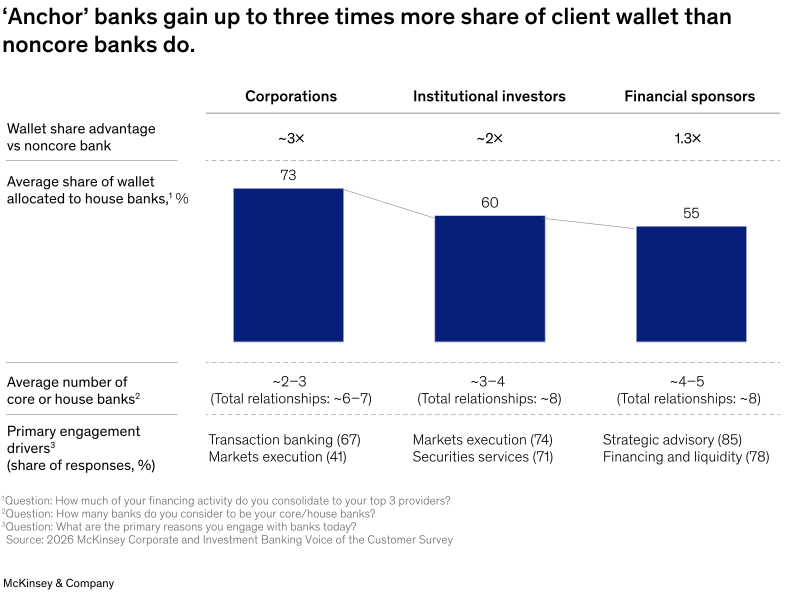
Although wallet allocations remain fluid, cementing a house bank, or “anchor” bank, relationship drives disproportionately higher wallet share. Corporates consolidate about 73 percent of their wallet with primary banks, and institutional investors and financial sponsors consolidate 60 percent and 55 percent, respectively, to preserve negotiating power on pricing, terms, and access to proactive advisory.
- Corporates employ a bifurcated model. House banks are rewarded with high-yield, complex mandates, such as global liquidity, FX, M&A, and capital markets. Others are strictly relegated to participation in revolving credit facilities or operational utility roles (such as in-country cash management and payroll) to plug geographic gaps. Corporates actively rationalize their banking ecosystems, often prioritizing operational efficiency over complex multibank systems.
- Institutional investors balance scale and specialization. They rely heavily on global investment banks for their comprehensive capabilities in global markets and top-tier securities services while using specialist providers for niche mandates, such as prime services or FX.
- Financial sponsors use an approach based on suitability: Provider selection is determined by deal size and product. Traditional banks secure standard facilities (sublines, for example) and increasingly compete with alternative lenders on complex structures (such as net asset value [NAV] credit facilities).
Main takeaway: Achieving anchor status can result in a massive upside, tripling the share of wallet and offering opportunities to sponsor portfolios (about 92 percent of sponsors drive portfolio company banking decisions). To become an anchor bank and avoid being relegated to utility status, consider strategically choosing where to compete and deploying optimized coverage models and differentiated products to target high-potential clients.
Relationships, certainty, and breadth are as important as price
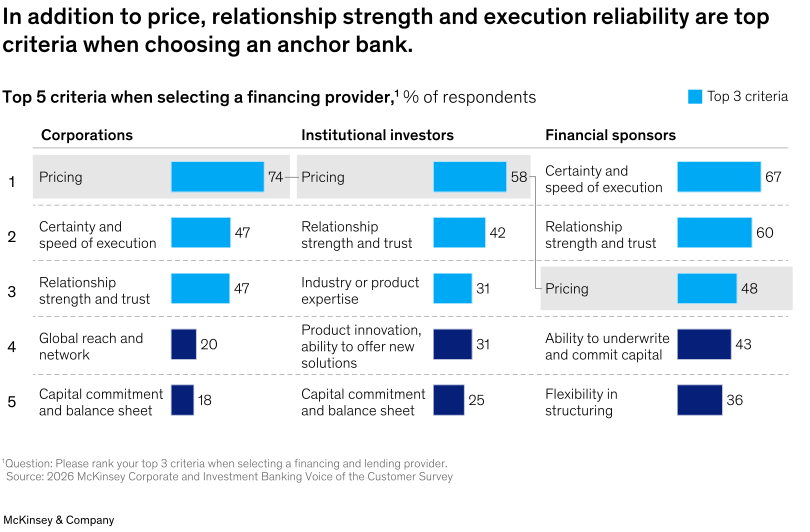
When it comes to selecting a financing and lending provider, price is a leading factor, but it is rarely the sole differentiator. Execution certainty and the historical strength of the banking relationship are also valuable factors in clients’ decision-making.
- Although pricing is a primary driver, corporate clients place a significant premium on execution and relationship strength. Corporates prefer operational reliability to seamlessly execute major milestones (such as mergers) and reliably conduct highly efficient, streamlined operational processes, including know your customer. Corporates also value banking partners that demonstrate their commitment early, using this support as a foundation to build enduring relationships.
- In addition to price, institutional investors consider sector or industry expertise and the ability to contribute innovative solutions as top criteria when selecting a bank. Surveyed respondents noted that the share of their assets under management allocated to alternatives (including private capital) exceeded 40 percent. As such, banks need to be able to demonstrate a track record of strong performance and experience in offering private-capital services, such as capital-call financing, secondary market solutions, syndication, and co-investment facilitation.
- For sponsors, banks that can provide certainty when closing a deal and have a strong track record in execution consistently secure mandates. Relationship strength also helps drive repeat mandates and wallet share. One sponsor said, “We rarely seek new lenders but seek to get the best from those we know and trust.”
Main takeaway: Exceptional delivery and trust-based relationships offer a stronger competitive advantage than product features or price alone. Price is important, but anchor status is achieved with stronger relationships, faster execution, and the assurance to close deals.
Address nonbank competition and avoid wallet leakage
Nonbank financial institutions are becoming more prominent considerations for clients.
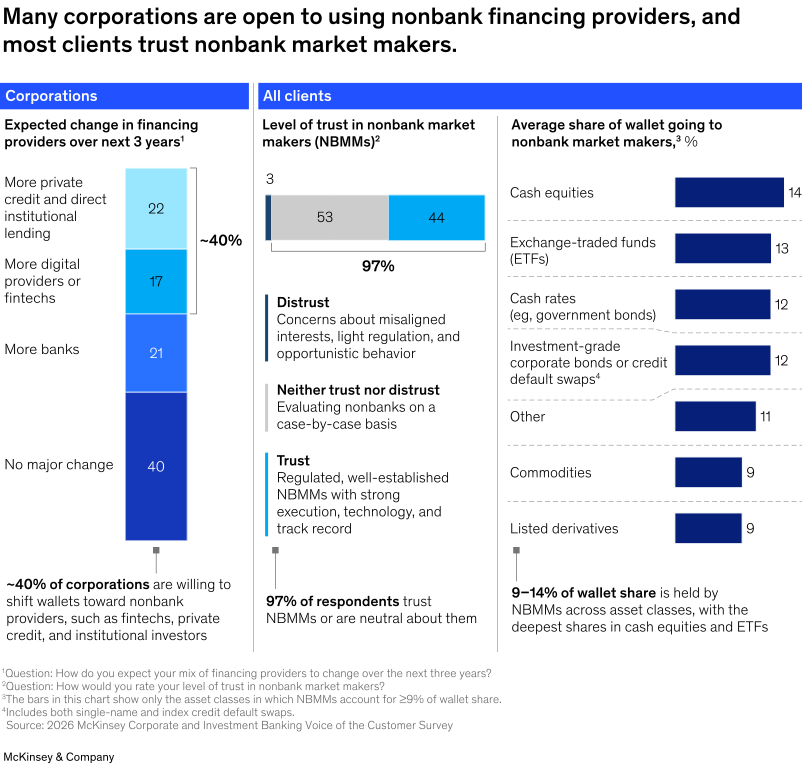
- About 40 percent of corporates are open to using nonbank financing over the next three years, and they expect to rely more heavily on fintechs (17 percent) and private credit and direct institutional lending (22 percent).
- About 67 percent of financial sponsors are already using direct lenders and private credit firms, particularly for NAV facilities.
- On the trading side, nonbank market makers (NBMMs) already capture 9 to 14 percent of the wallet share by asset class. The role of NBMMs is narrower than banks’ and purely market-facing. They act as liquidity providers for mostly electronic and commoditized flow products (such as cash equities and exchange-traded funds), where speed and low-cost execution matter more than a balance sheet. Only 3 percent of clients said they distrusted NBMMs.
Each nonbank challenger has a different advantage. Private credit firms offer structured flexibility, speed of execution, and a willingness to provide leverage. Meanwhile, fintechs offer faster, seamless digital experiences and innovative features that outpace traditional banks’ offerings. And NBMMs’ advantage comes from their technological sophistication, superior liquidity provision, and proven risk management.
Still, incumbents have defensible ground. Fintechs fall short for many clients on breadth of product, enterprise-scale delivery, regulatory robustness, and relationship continuity. Private credit’s challenges relate to pricing, covenant strictness, liquidity and maturity terms, and valuation opacity.
Main takeaway: Reclaim the contestable wallet share before nonbanks can take it. Banks can aim to match fintechs on digital experience, private credit on speed and flexibility, and NBMMs on execution, then use their incumbent edge where challengers fall short.
Make the relationship manager faster, better informed, and AI-enabled
Clients’ preferred engagement model is decisively centered on the relationship manager (RM); corporates and institutional investors want the RM to be an orchestrator, and sponsors want a hybrid coverage model with access to direct specialists. The two attributes that define a great RM for corporates are speed and responsiveness (76 percent) and a deep understanding of the client’s needs (49 percent).
Coverage must be reengineered by segment:
- Corporates need coverage bankers who orchestrate rapid, tailored solutions and ensure central-treasury proximity. At the same time, they want the RM to facilitate seamless, orchestrated execution across the client’s local geographic footprint.
- Institutional investors expect service to be high-quality and institutionalized (in terms of continuity and senior coverage). They expect it to be delivered by a hands-on relationship team and to be seamlessly coordinated across front and back office.
- Financial sponsors need a hybrid coverage setup that aligns multiple stakeholders—nearly 40 percent of sponsors report siloed decision-making. They also require cross-franchise execution to help capture portfolio company wallet shares while managing the general partner or fund relationship.
Building the bank around client-centric capabilities—from value-based tiering to an AI-enabled front office—offers a distinct competitive advantage. Incentives can then be explicitly tied to client outcomes and share-of-wallet growth, not product silos.
Main takeaway: Place a faster, AI-enabled RM at the center of relationships. Banks can move to equip coverage with real-time AI tools, institutionalized with senior sponsorship to ensure team continuity. Finally, institutions can empower coverage bankers to orchestrate capabilities to proactively work toward client outcomes.
Banks that rethink coverage and technology to meet evolving client expectations will not just hold the anchor but will redefine what a house bank is worth. For most clients, a few anchor bank relationships carry the bulk of spending. Targeting these relationships first—to defend a core corporate wallet, deepen an institutional mandate, or capture the wallet of a sponsor’s portfolio company—will help banks secure each year’s contestable 12 to 25 percent of wallet share.
AI and technology are reshaping the banker’s role, taking on routine tasks, documenting and disseminating client knowledge across the organization, and helping to deliver a consistent experience. These tools are important to gain an advantage, but as more banks adopt them, they could become commoditized. True differentiation will be the added human touch: the RM’s judgment, industry and sector expertise, and ability to orchestrate the full breadth of the bank to secure and deepen client relationships.