



The data points in this blog post are based on research by McKinsey Panorama.
Can scale be offset? Can smaller banks win? It depends on the bank.
Our analysis finds that about 25 percent (143 of roughly 600) of midsize banks worldwide clear a 4 percent economic profit threshold.[1] These leaders share a common characteristic: They follow one of two distinct, asymmetric paths for creating value (exhibit). For the average bank below the economic profit cutoff, closing the gap to large-cap performance could lift ROE by about five percentage points, translating to roughly $100 million a year in added profit.[2]
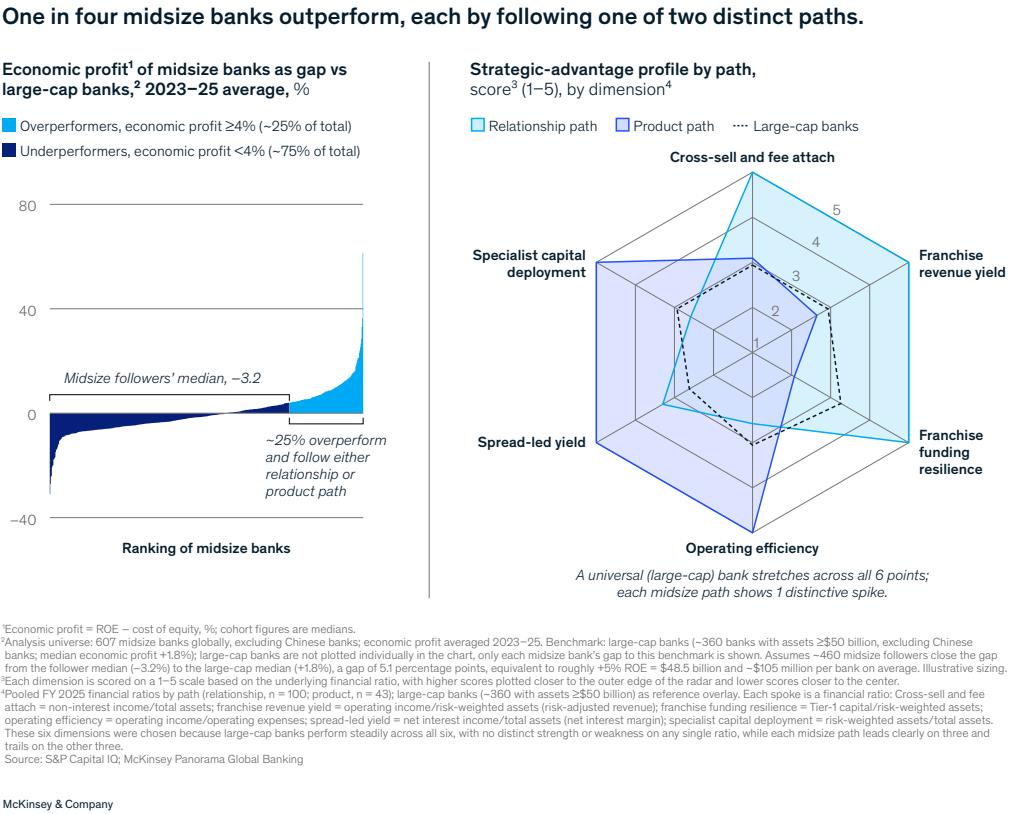
Leading midsize banks make a clear choice
On the relationship path, advantage starts with the customer. The focus is on everyday retail access, public sector flow, customer primacy, and ecosystem orchestration—that is, bringing together a broader set of banking and adjacent services. These elements build trust, along with deposits, which help deepen relationships. The result is a durable funding and revenue advantage. This model requires a bank to have superior capabilities in customer engagement, deposits, distribution, and cross-selling. This dynamic is borne out in the data: Mid-cap banks with retail-deposit-heavy franchises have posted materially stronger net interest margins and faster asset growth than peers reliant on commercial or wholesale funding. Of the 143 value-creating banks in our sample, 100 are on this path, with a median ROE of roughly 18 percent.
On the product path, advantage starts with superior economics in a specialized product, such as underwriting, pricing, and funding capabilities that support trade and transaction flow or asset-based lending. Customer access helps originate volume, but the product capability, not the relationship, is the source of value. Forty-three of our 143 value creators are on this path, with a median ROE of about 20 percent.
Some banks blend the two paths, but every outperformer focuses on one dominant source of advantage, resulting in higher economic profit. They also consistently make strategic exits from low-return segments and products.
The next 12 to 18 months will be critical for midsize banks seeking to bridge the gap with the leaders. AI, digital assets, and new partnership models are reshaping banking economics, exerting margin pressure on generic banking products, and opening up fresh ways to deepen relationships and product specialization. Midsize banks that double down on an asymmetric approach now can offset disadvantages from lack of economies of scale; those that defer risk falling further behind large-cap banks and the midsize leaders.
The takeaway
Midsize banks can offset their scale disadvantage with a focus on building either very strong customer ownership or superior product capabilities. Across the markets we analyzed, these banks typically do not just match the returns of their larger counterparts but exceed them, with median ROEs of about 18 to 20 percent. Small size and agility can be an advantage, but only if paired with a clear, distinct strategy.
[1] Economic profit = return on equity − cost of equity (as a percentage); cohort figures are medians.
[2] The gap is measured as the difference between the median economic profit of midsize banks below the 4 percent threshold (−3.2 percent) and the median of large-cap banks (+1.8 percent), about 5.1 percentage points, equivalent to roughly five percentage points of ROE at a constant cost of equity. Applied to the roughly 460 midsize banks below the threshold, this equals about $48.5 billion a year—or about $105 million per bank. Economic profit is averaged over 2023 to 2025; sizing is illustrative.