The new Global Energy Perspective 2026 scenarios, explained


The global energy system is becoming increasingly diverse and complex, and—as the events of 2026 have highlighted—vulnerable to shocks in a geopolitically fragmented world.
The closing of the Strait of Hormuz in early 2026, and the onset of the Russia-Ukraine war in 2022, have had profound effects on global energy flows, raising concerns about supply security and affordability. Decision-makers are now tasked with balancing these considerations alongside decarbonization as global demand for energy continues to rise.
These shifting priorities have led us to reassess the Global Energy Perspective and take a broader view of the global energy system in this year’s report. Today’s system complexity and uncertainty are captured in four new plausible scenarios, with the Continued Momentum scenario from previous editions continuing to function as the baseline.1
For executives, the most important strategic capability at this time of uncertainty is not to pick a correct single forecast, but to build portfolios that can perform across a range of plausible futures, and to understand the market signals that may warrant a strategic course correction.
Executives can use this year’s Global Energy Perspective to test whether their organization is tracking the right set of market signals, has a firm-wide view of its posture in a geopolitically fragmented world, and is adequately adapting its short-term shock responses into long-term resilience.
The four new scenarios
This Global Energy Perspective 2026 reflects the disruptive forces of geopolitics and AI, the structural challenges in the energy system, concerns about affordability, and the need to secure sufficient energy to support ongoing socioeconomic development.
These forces are explored in four new scenarios that describe plausible directional outcomes to 2050 (Exhibit 1):
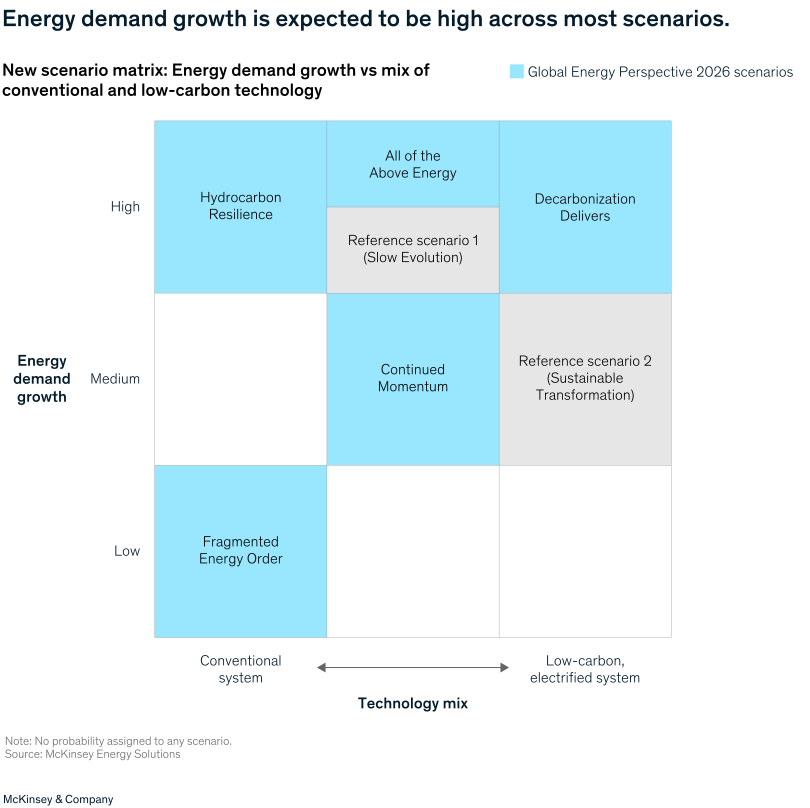
Hydrocarbon Resilience. This is the scenario in which the “addition rather than substitution” dynamic for energy sources becomes most pronounced. Low-carbon technology continues to be developed, but it adds to the existing hydrocarbon base rather than replacing it. The world remains heavily reliant on fossil fuels and established infrastructure and value chains to meet growing demand for energy. Energy demand accelerates above the current trajectory, fueled by access to lower costs, locally sourced energy, and a higher assumed global GDP. Continued fossil fuel use pushes global greenhouse gas emissions higher, with an associated temperature increase of 3 to 4°C.
Fragmented Energy Order. This scenario envisions a world where geopolitical developments move the world even further toward a more “tripolar energy system” centered around China and its trading partners, the United States and aligned markets, and Europe and its partners. Countries increasingly aim to meet energy demand within their own “bloc” through domestic resources, preferred suppliers, local-content requirements, tariffs, and strategic industrial policies. Global energy demand growth therefore slows as trade becomes less efficient and the world’s GDP growth decelerates, reducing the pace of low-carbon technology development or expansion.
All of the Above Energy. This scenario reflects a world that develops and utilizes every available energy resource to meet growing demand, ensure grid reliability, and keep energy costs affordable. The net effect is that all energy sources grow simultaneously as countries harness hydrocarbon resources—oil, natural gas, and coal—alongside renewable sources such as wind, solar, geothermal, hydropower, and biofuels, as well as nuclear power. The scenario underscores that no single technology is cheapest everywhere once system reliability costs are factored in and the lowest-cost path to firm, affordable energy becomes increasingly geography-dependent.
Decarbonization Delivers. This scenario shows an energy system that achieves affordability, security, and decarbonization almost simultaneously. The mechanism driving this outcome is primarily economic rather than policy based, with low-carbon technology costs falling fast enough to make clean energy—including firming costs—the cheapest option across most applications. This would see markets driving deployment without sustained policy support. The accelerated adoption of rooftop solar in Pakistan in recent years is a prime example of this dynamic.2 High energy prices, an unreliable grid, and plummeting costs for solar photovoltaic (PV) panels have spurred a significant increase in solar PV installations in the country.3
What the scenarios could mean for reliability, affordability, and decarbonization
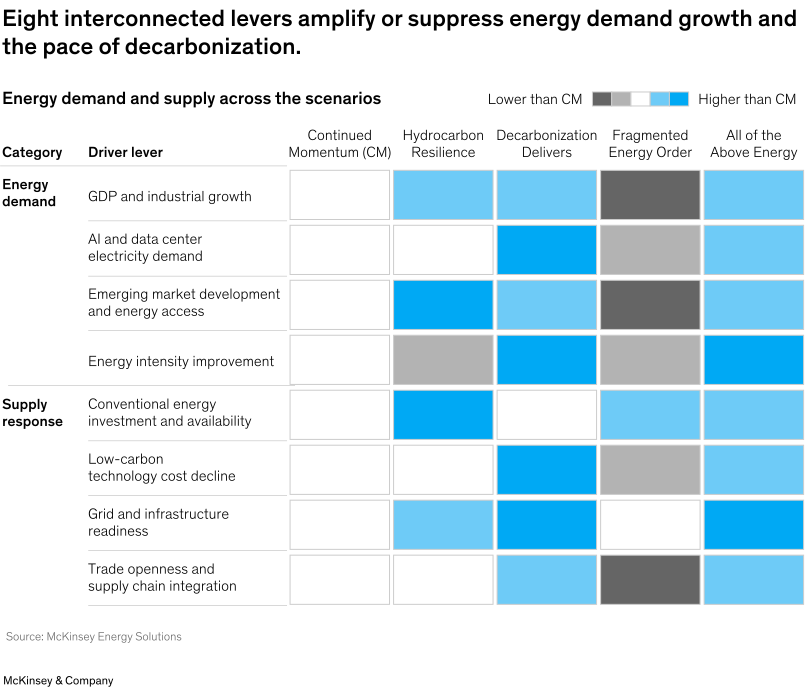
Each scenario adjusts a set of eight structural levers that influence energy demand or the pace of decarbonization, amplifying or suppressing energy demand growth and accelerating or curbing the energy transition (Exhibit 2).
Six system-level KPIs describe the various tradeoffs between the scenarios, quantifying how much energy the system needs to provide, how reliability is maintained, the system’s dependence on hydrocarbon fuels, and the associated cost burden for each scenario (Exhibit 3).
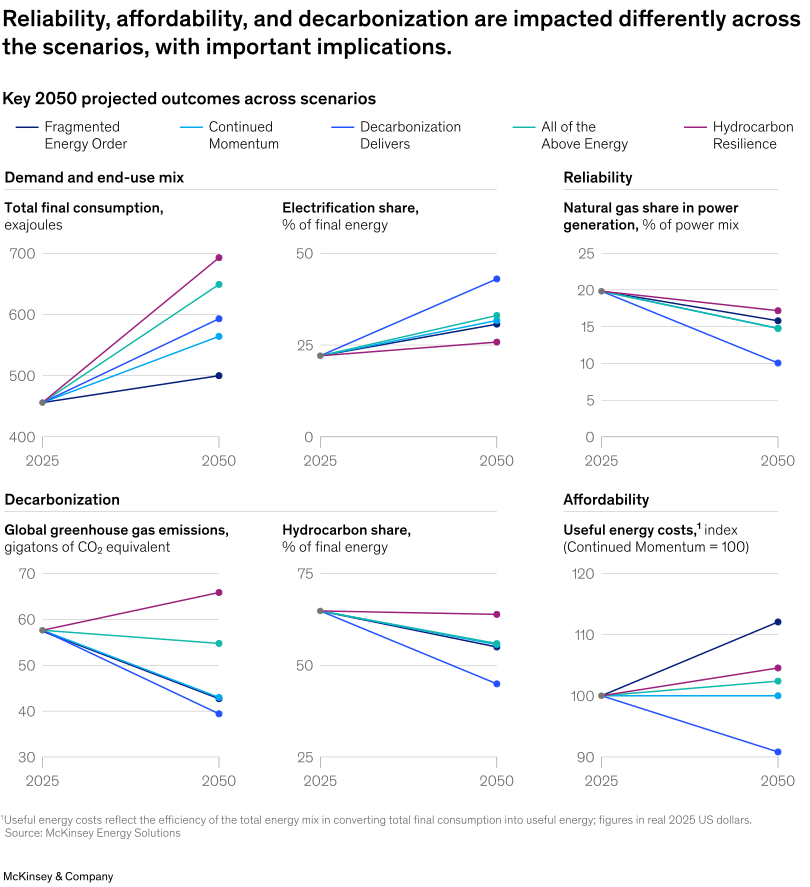
The scenarios explore a range of distinct possible outcomes for how the energy system may evolve to 2050, based on current observable trends. Unknown future shocks, such as a major cyberattack on energy infrastructure or accelerated global warming and climate-related disasters, could shift energy system priorities once again. AI-related data center buildout—the largest projected source of new energy demand growth—remains highly uncertain beyond 2030 and breakthroughs in technology, such as small modular reactors, could also alter the energy mix in unexpected ways.
If previous editions of the Global Energy Perspective have taught us anything, it is that the global energy system is unpredictable and highly context dependent. For leaders, the decisions on what to do next are likely to be highly context dependent, too, influenced by their organization’s exposure to energy system dynamics, geographic location and customer base, and value chain constraints and opportunities.
This year’s report aims to help executives better understand the risks and opportunities they face as the global energy system evolves to meet the growing need for abundant affordable and sustainable power.
Read the full report here.
1 Full data sets for the Slow Evolution and Sustainable Transformation scenarios from previous editions of the Global Energy Perspective are available on request and are only briefly covered as “reference scenarios” in this year’s report.
2 Nabiya Imran et al., The solarisation of Pakistan’s energy economy, Ember Energy, June 25, 2026.
3 Faraz Hayat and Numair Liaqat, “Navigating Pakistan’s power sector crisis: Challenges, IMF recommendations, and the path to sustainable reform,” Consortium for Development Policy Research, April 27, 2023.