
Amidst growing recognition that plastics will continue to play a vital role in many applications long into the future, plastic recycling represents a $50-75 billion economic opportunity by 2035. Rising consumer demand, regulations and bold sustainability commitments from consumer-packaged-goods brands have seen recycled resin premiums increasing up to 150% for some resins and driven accelerating investment in new technologies. The buoyant opportunity in chemicals circularity may be comparable to the previous investment boom in petrochemicals, when falling ethane prices drove a surge of investments in gas crackers in the early 2010’s.
Yet maintaining this momentum will depend on whether brands can keep ambitious sustainability commitments amidst global inflation and uncertain consumer demand. Closer cross-sector partnerships and collaborations will also be needed to derisk further investments. Similarly, pooling resources and collectively scaling production capacity will help reduce the high cost of advanced recycling.
Why plastics are difficult to displace

The recycling market is growing as it becomes clear that demand for plastics will likely endure across a variety of applications. Different packaging materials offer different trade-offs on performance and sustainability, and currently there are few optimal alternatives in applications such as flexible packaging for frozen and refrigerated goods.
Plastic remains the most common packaging material in new product launches across food and drinks, representing ~50% of total launches. Flexible packaging is projected to grow around 5% per year, more quickly than fiber (4%), rigid plastic (3%), metal and glass.
With plastic likely to remain a staple ingredient of many future products, advanced recycling, new bio-based feedstocks, and improved end-of life management are becoming increasingly important.
The drivers behind a burgeoning market in advanced recycling
Bold big-ticket commitments from major brands buttressed by stringent regulations are driving burgeoning demand for circular polymers. There has been a three to fourfold increase in the weighted average of recycled content across 12 leading brands in just five years between 2018 and 2022. Similarly, brands have set ambitious targets to reduce supply chain emissions with the food and personal care industries committed to abating 20-30% of their Scope 3 CO2 emissions by 2030.
Market demand is also being driven by recent regulations. EU laws now mandate that up to 35% of some plastics must be made from recycled content by 2030 and restrict compostable plastics to products with clear benefits, while uniform recycling is also being introduced across member states.
Cumulatively, this is creating a significant investment and growth opportunity. Investment in advanced recycling is being scaled up accordingly over the next decade, with over 9 MTA of announced pyrolysis capacity under development, mostly in Europe and North America.
The potential pitfalls ahead
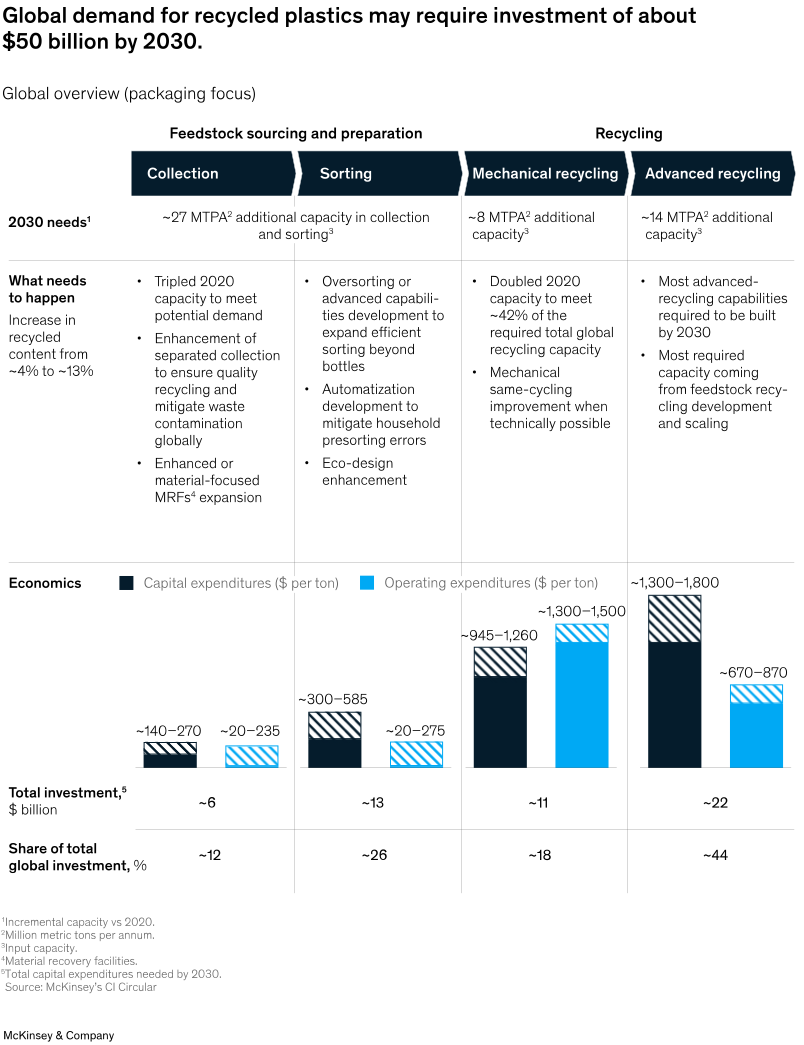
Yet unlocking this economic opportunity and delivering on brand-owner commitments will involve a major transformation of the chemicals industry (Exhibit 2). The market opportunity could also be at risk if recent economic headwinds, such as rising inflation, reduce consumer packaged goods company demand for sustainable packaging and cause brands to scale back their commitments.
In addition to sustaining demand, there is a parallel need to scale up supply. Few companies currently have commercial-scale plants for advanced recycling and many are at an early stage with production of less than 20,000 metric tons. The small scale of current production results in higher costs, and industry will need to significantly ramp up production capacity to lower these costs through economies of scale.
The capital and time needed to commercialize advanced circularity technologies also lies beyond traditional venture investors’ timelines. McKinsey research indicates the opportunity for up to $50 billion investment (Exhibit 2) across the value chain to add up to 20-25 MT advanced and high-quality mechanical recycling, along with supporting feedstock supply by 2030. Uniting CPG’s, resin producers, waste-management players, technology providers and others will therefore be key to derisking this investment.
Derisking advanced circularity
We are already seeing promising signs of cross-sector collaboration and vertical integration in advanced recycling, and this is derisking investment and scaling up production. Over 20 technology developers have now announced advanced-recycling projects often in partnership with petrochemical players and some have committed to produce 10 million metric tons a year by 2030. For example, two multinational petrochemical companies and a feedstock provider recently partnered on a pioneering plastic waste processing facility in Texas that could derisk access to feedstock. Others are vertically integrating in the waste management value chain, building end-to-end supply chains from initial setup and collection to processing and recycling.
Towards a virtuous circle of advanced recycling
Further coordination across the value chain between technology providers, resin producers, waste-management companies, and CPGs could de-risk demand, expand feedstock supply chains and boost investment.
Collaborative new business models across the value chain may include material recovery facilities (MRF) offtake agreements and pyrolysis oil offtake agreements to further accelerate investments. Partnerships could take the form of buy-sell agreements for intermediates such as pyrolysis oil, partnerships to develop plastics recovery facilities, and upstream investments by waste management companies.
Closer cooperation among industry incumbents, startups and investors could also help bridge the gap between innovation and commercialization. For example, investors could broker third-party deals uniting investor capital with start-up technology and industry leader resources. We are already seeing such collaborations in the fields of chemical process innovation and AI-assisted discovery, and this model could be extended across the industry.
Ultimately, this could create a virtuous circle of advanced recycling where collaboration fuels investments that further reduces costs, scales up supply and accelerates speed to market.
The glittering economic prize
There is now a major economic prize in advanced recycling if brand-owner commitments can be sustained and industry-wide partnerships and production scaled up.
There was up to a 30 MT market size in recycled plastics in 2023 compared with just 2 MT in bio-based or bio-degradable materials. Global demand for high quality recycled content in packaging could reach 20-25 MTPA by 2030 and premiums for recycled plastics such as Natural rHDPE make investment attractive.
Closing the loop
Further investment in advanced recycling can be unlocked through sustaining green premiums on recycled content, doubling down on value chain partnerships and scaling production. Industry incumbents could directly invest in or acquire disruptive startups to help scale new innovations while investors could act as credible, independent advisors to facilitate cooperation between startups and incumbents. Digital innovations could further boost collaboration and innovation such as digital twins providing shared visibility of materials across suppliers and partners, or digital solutions improving feedstock management to ensure consistent input and output quality.
Addressing global waste leakage
Yet recycling alone will be insufficient to fully address the global waste leakage challenge. We will also need complementary investments in end-of-life management, particularly in emerging markets where 95% of environmental leakage is concentrated. Addressing this will require investments in infrastructure from collection to transport to landfill. The scale of investment is daunting (we estimate $500-700 Bn infrastructure across emerging markets over at least a decade) and will require government investment in both waste management and supporting infrastructure. Public-private partnerships could provide one platform for more creative collaboration models as well as additional sources of funding. There are also operational challenges to address including complex and informal waste collection systems, multiple layers of government, ambiguous land-use rights and challenges to foreign investment.
Ultimately, we will need accelerated investment in both advanced recycling across developed economies and end-of-life management across emerging markets to close the loop and address the plastic waste leakage challenge.
This article originally appeared in S&P Global Chemical Week special publication.