



European farmers are feeling the squeeze of tightening margins. EU input prices remain about 18 percent above 2021 levels, disruption in the Strait of Hormuz has pushed up fertilizer and energy prices, and the onset of El Niño is a major concern.
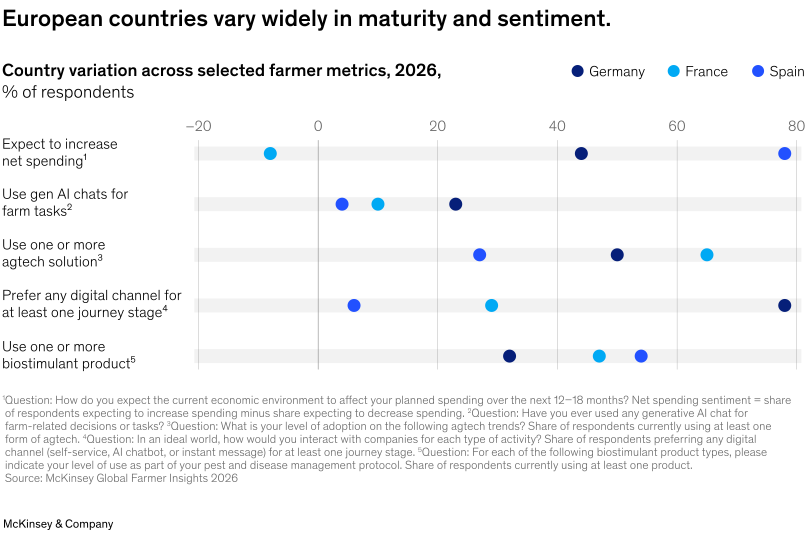
These factors are commonly felt, but farmers are not responding in the same way. In this blog, we analyze a subset of the 2026 Global Farmer Insights survey, focusing on about 700 farmers in France, Germany, and Spain. The survey, conducted between April and July 2026, reveals sharp differences in spending sentiment, technology adoption, and product preferences across these three markets (Exhibit 1). This blog explores these findings and what they could mean for the agricultural companies that serve the farmers (see sidebar, “About the research”).
Margin pressure is reshaping spending and purchasing choices
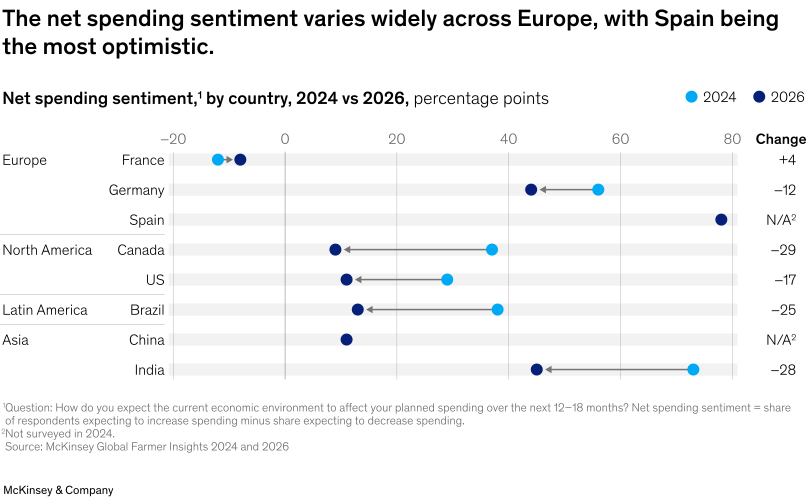
European farmers’ spending outlooks vary sharply by market (Exhibit 2). Net spending sentiment—the share of farmers expecting to increase spending over the next 12 to 18 months minus the share expecting to decrease it—is 78 percent in Spain and 44 percent in Germany, but is –8 percent in France. German sentiment has fallen by 12 percentage points since 2024, whereas French sentiment has improved slightly but is still negative. Across these three countries, there is little variation between row-crop and specialty-crop farmers, with a net spending sentiment of 33 percent and 37 percent, respectively.
Across the three markets, rising input prices are now the top risk to farmers’ profits, cited by 58 percent of respondents—up 12 percentage points from 2024 and broadly in line with the global average. Extreme weather, the leading concern in 2024, now ranks third.1 As one corn and rye farmer in Germany told us, “We have a total spending freeze: no new machinery or new technology. We are doing minimal tillage to cut costs. Our diesel costs about €2.20 per liter, but colleagues in neighboring EU countries are paying somewhere between €1.00 and €1.20 after refunds. We cannot compete with that.”
Farmers are responding to these pressures by reassessing where and how they spend. Fertilizer is the most common target for savings, with 31 percent of respondents saying they are cutting fertilizer spending, compared with 19 percent who are reducing spending on equipment. Row-crop farmers are cutting back the hardest, with 37 percent reducing fertilizer use, compared with 21 percent of specialty-crop farmers.
As another cost-cutting strategy, farmers are buying fewer new machines. New equipment made up about 69 percent of equipment purchases in the past two years, but farmers expect it to account for only 50 percent in the next two years. The drop is steepest in Germany, from 63 percent to 42 percent. When farmers do buy, price is the leading consideration, cited by 42 percent, followed by reliability, at 35 percent, and proximity to a dealer, at 26 percent.
However, these cuts may be temporary. When profits recover, farmers say they will spend first on equipment (37 percent) and fertilizer (31 percent). German farmers lean toward equipment, Spanish farmers toward fertilizer, and French farmers toward precision-agriculture hardware.
Farmers are also adjusting product choices for crop protection. About 30 percent of European row-crop farmers expect to increase the share of generics over the next two years, compared with 19 percent of specialty-crop farmers. German farmers are most likely to make this shift, with 34 percent intending to do so. Among farmers expecting to switch, 53 percent cite comparable performance at a lower price as the main reason. The pattern is not uniform, however: In Spain, 19 percent of respondents expect to increase the share of branded products in their crop-protection mix.
Biologicals look to be more resilient with roughly 80 to 90 percent of farmers expecting to maintain or increase their spending on biologicals regardless of changes in input prices, suggesting the category may be more resilient than fertilizer, equipment, or conventional crop protection.
Digital tools are spreading, but gen AI adoption remains limited so far
Agricultural technology (agtech) adoption—the use of at least one technology, such as farm management software or precision hardware—is increasing in France and Germany. Adoption is highest in France, at 65 percent, followed by Germany, at 50 percent. Spain is at an earlier stage, with 27 percent of farmers reporting agtech use.
Cost is the biggest barrier to agtech adoption, cited by 43 percent of farmers surveyed. The time required to set up or use the technology and uncertainty about the return on investment also hold farmers back.
Digital channels are becoming more important in the agricultural purchasing journey, particularly before a purchase decision is made. Farmers are more likely to use digital channels for evaluating and comparing options, obtaining quotations, and researching products. Preferences for digital use are lower for buying, support, and repurchasing.
Gen AI is the latest part of this shift toward digital (Exhibit 3). On average, European farmers surveyed use gen AI for farm-related decisions or tasks less than their global peers, at 13 percent compared with 17 percent, respectively. Adoption across European countries varies, with only 4 percent of Spanish farmers using gen AI, while about 23 percent of German farmers are using this technology.
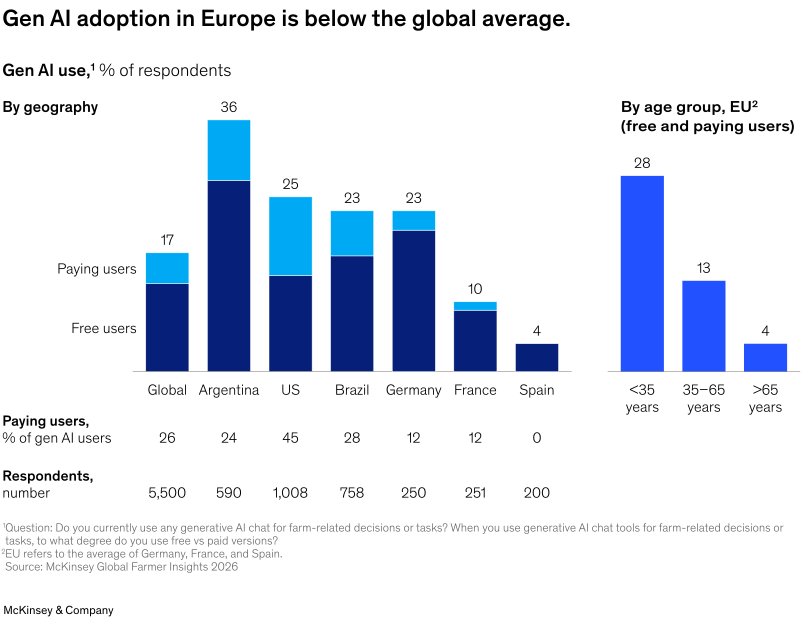
Age is a factor in AI adoption too. Among farmers younger than 35, about 28 percent report using it, compared with only 4 percent of those older than 65, which is broadly in line with the global average. As one German farmer put it, “I am positive toward AI, but AI still has to prove what it can do for me.”
Who farmers turn to for advice is changing too, with this pattern varying by market (Exhibit 4). French farmers have shifted strongly toward agronomists and away from sales representatives. German farmers place more weight on sales representatives, online research, and peers, whereas Spanish farmers continue to rely heavily on agronomists and peers.
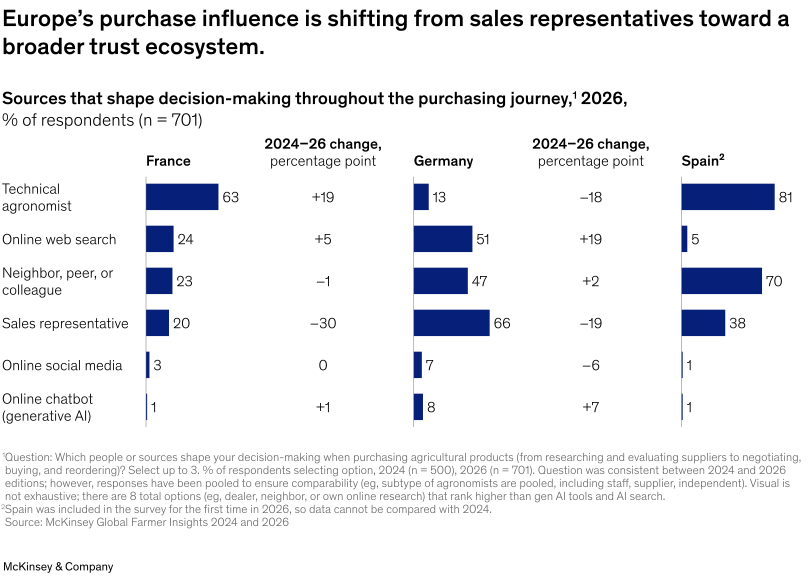
Overall, farmers are not replacing human advice with technology. Instead, they are adding independent advisers, peers, and digital sources alongside their traditional dealer and sales relationships.
What this means for the European agricultural value chain
Farmers in all three markets are spending with discipline, but their choices vary by country, crop type, profitability outlook, and digital maturity. A one-size-fits-all commercial approach is therefore unlikely to meet the needs of all farmers across the region.
Agricultural-input companies, equipment manufacturers, and other partners can help farmers identify value with greater granularity by geography, crop type, product category, and season. Three priorities stand out:
- Meet farmers where decisions are made. Combine in-person agronomic expertise with digital and AI-enabled decision support, recognizing that agronomists remain central even as digital adoption grows.
- Tailor offerings to local conditions. Adapt product mixes, financing options, purchasing models, and delivery approaches to country, crop, and farm-level needs.
- Anchor innovation in measurable ROI. Farmers remain open to technology, biologicals, and equipment investments when the performance case and financial case are clear, credible, and locally relevant.
Understanding how and why European farmers are spending more selectively can help stakeholders across the agriculture value chain continue to provide targeted support for regional needs.
The authors wish to thank Emma Galeucia for her contributions to this blog.
1 This survey was conducted before the extreme heat waves in Europe in summer 2026.