






McKinsey’s 2026 Global Farmer Insights survey, fielded between April and July 2026, uncovered insights from 5,500 farmers across ten countries. Building on this research, the Australia and New Zealand (AUS/NZ) portion of the survey, launched in late July 2026, surveyed 150 farmers to understand the most salient factors driving farmer behavior.
A key finding of the AUS/NZ survey is that these growers are adopting sophisticated on-farm agricultural technologies (agtech), such as digital agronomy, precision hardware, and gen AI, at almost twice the rate of their global peers. At the same time, their commercial purchasing behaviors and post-purchase expectations remain highly traditional. Farmers in this region strongly prefer in-person interactions, rely heavily on technical agronomists, and are less likely to use digital-only purchasing and support channels than those in other regions.
For agribusinesses operating in these regions, successfully navigating the market requires a thoughtful strategy between traditional and digital commercial models. Given AUS/NZ farmers’ propensity to adopt technology in other areas of their businesses, there is potential to move toward a more digital model in the future.
On-farm tech adoption is almost double the global average
The data indicates that AUS/NZ farmers lead most other advanced agricultural nations in on-farm technology penetration. While the global average for adopting at least one agtech product stands at 46 percent, the adoption rate in AUS/NZ is 86 percent. This surpasses other major agricultural markets, including Canada (65 percent) and the United States (77 percent).
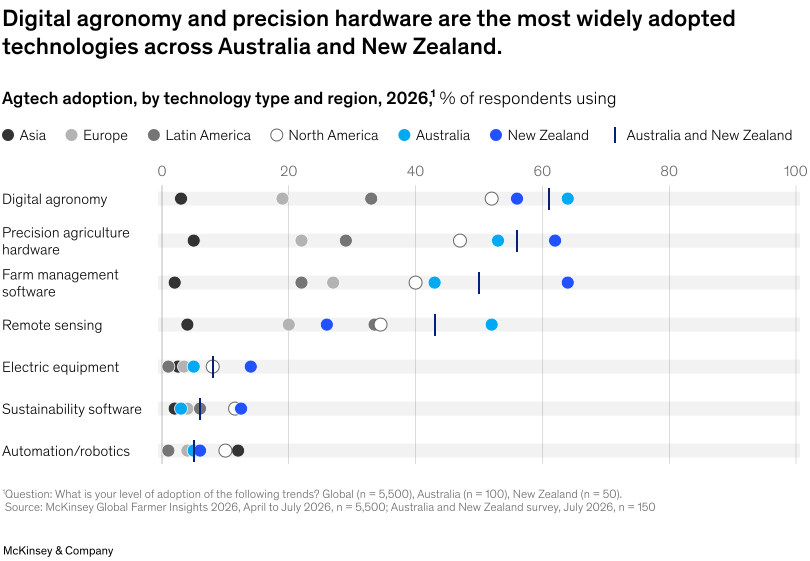
Tech adoption is relatively broad, with AUS/NZ farmers adopting at a consistently higher rate than global averages across most technology types. For example, 61 percent of farmers in the region use digital agronomy tools (such as variable-rate prescriptions), compared with just 24 percent globally. The use of precision hardware, such as GPS guidance and autosteer systems, stands at 56 percent, which is more than double the global average of 23 percent. Half of AUS/NZ growers use farm management software to run their operations, compared with the global adoption rate of 19 percent. The only areas where AUS/NZ does not show higher adoption are sustainability software and automation/robotics, likely because these nascent technologies have not yet reached scale in global markets, rather than because they indicate lagging adoption.
Looking at the regional split, digital agronomy is the most widely adopted technology in Australia, while in New Zealand it is farm management software (Exhibit 1).
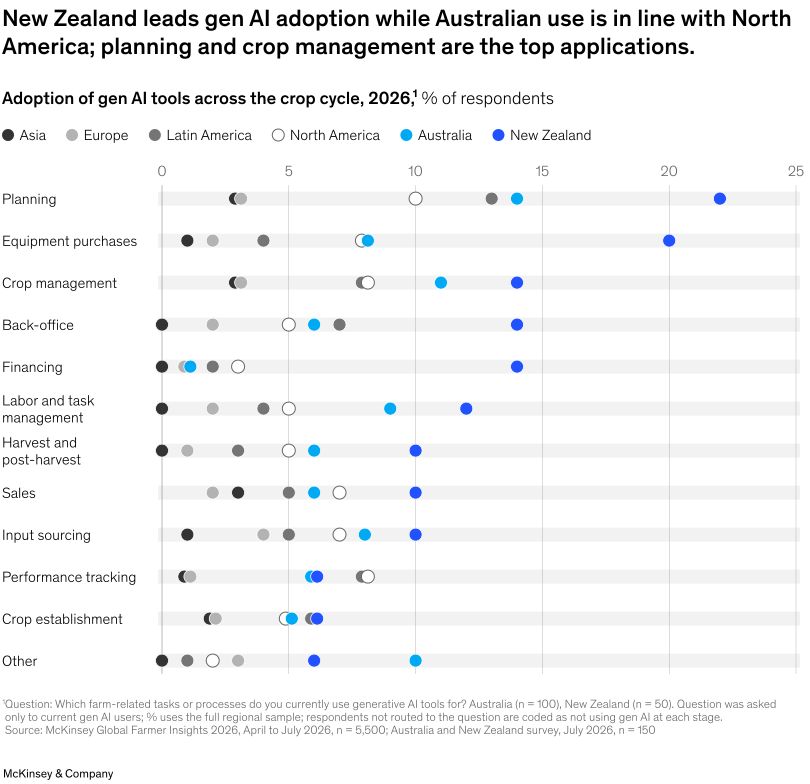
The use of gen AI for farm tasks is reported by 35 percent of growers in AUS/NZ, more than twice the global average of 17 percent. How Australian and New Zealand farmers choose to use gen AI is broadly consistent with global trends, with most using the technology for planning and crop management (Exhibit 2).
The high rate of on-farm digital integration in Australia and New Zealand could be driven by escalating operating costs and labor constraints. In Australia, average farm sizes are large, about 2,500 hectares1 compared with the 250-hectare average in the United States,2 increasing operational complexity and management overhead. Growers in these regions are managing this complexity by embedding digital tools into their daily operational workflows. These levels of adoption are positive early indicators, but how this technology will scale in growers’ operations will be a trend to watch.
Farmers look for the human touch in post-purchase support
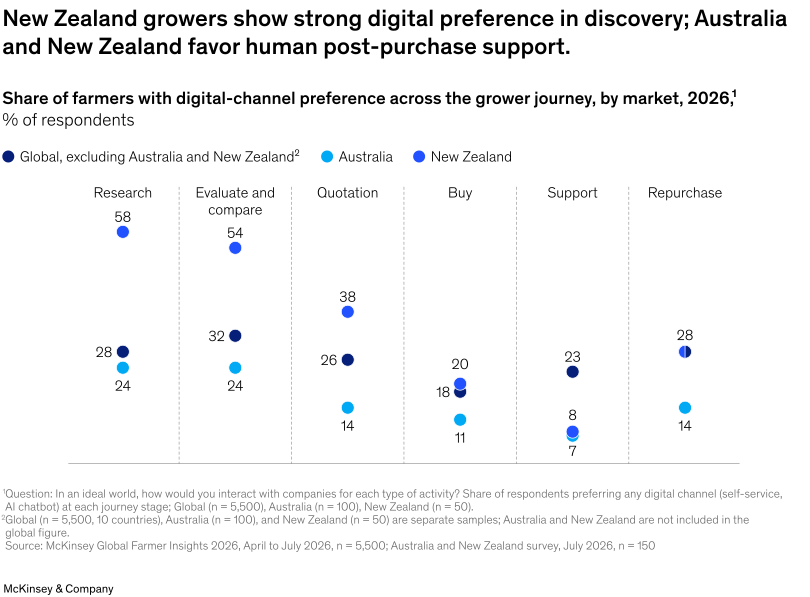
Despite high digital literacy on the farm, AUS/NZ growers show varying levels of digital engagement throughout the commercial purchasing lifecycle (Exhibit 3). While New Zealand farmers tend to prefer digital channels for pre-purchase support—and are well above the global average for research, evaluation and comparison, and quotations—Australian farmers are below the global average, preferring human engagement. During the post-purchase phase, farmers in both countries prefer human engagement, with only 7 to 8 percent preferring digital channels compared with 23 percent globally. The vast majority of AUS/NZ farmers therefore expect high-touch, in-person assistance after capital or input investments are made.
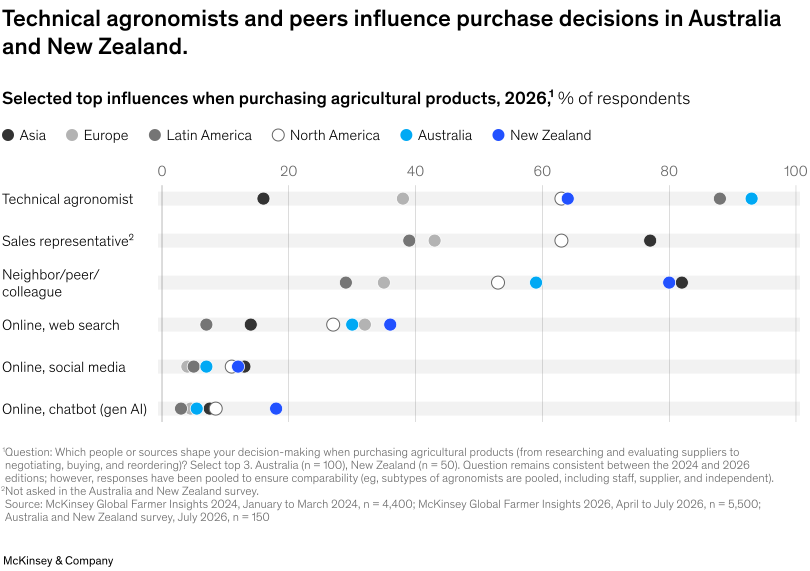
When it comes to trusting product recommendations, AUS/NZ growers rely heavily on technical agronomists, valuing their expertise and availability (Exhibit 4). Technical agronomists have the greatest influence on purchase decisions in Australia (93 percent) and remain important in New Zealand (64 percent). Peer influence is also strong, particularly in New Zealand (80 percent). Across the region, digital channels remain secondary in purchase decision-making, with web search at about 32 percent and social media and other online channels such as chatbots below 20 percent.
Strategic implications for stakeholders across the agricultural value chain
For agricultural businesses across the value chain, and especially those with a global footprint, success in the AUS/NZ market will likely require a tailored approach. Commercial strategies may need to align with the local market’s unique balance of high-tech capabilities and high-touch commercial expectations. Agricultural businesses could consider the following when developing an omnichannel commercial strategy:
- Deploy digital investments strategically. Companies need to ensure product information is available digitally, especially as AI use increases for research and planning, while continuing to invest in on-the-ground human expertise and support when it comes to purchasing decisions and making sales. Investments in digital capabilities should be made intentionally across the buying journey, ensuring resources are also allocated to in-person expertise, in line with grower expectations.
- Empower the sales force and local retail partners with tech. Rather than attempting to bypass traditional retail partners with direct-to-consumer digital commerce, agricultural businesses could use technology to empower the field staff who hold the relationship with the grower. For example, they could equip technical agronomists and retail partners with advanced digital agronomy, variable-rate prescription tools, and gen AI interfaces. This approach would position the local agronomist as the delivery mechanism for digital insights.
- Maintain touchpoints after the sale. Because post-purchase support is a critical competitive differentiator (with only 7 to 8 percent of AUS/NZ growers preferring digital channels for this), agricultural businesses, especially those marketing tech solutions, could invest in field-ready technical support teams. This would enable them to maintain regional support networks capable of providing rapid, in-person assistance for precision hardware calibration and software troubleshooting during critical seasonal windows such as planting and harvest.
The Australian and New Zealand agricultural markets are highly sophisticated and deeply relational. Growers are eager to adopt on-farm technologies to optimize their operations, but they require human relationships, local trust, and technical expertise when making buying decisions and receiving post-purchase support.
Commercial success in the region could therefore depend on building a hybrid business model. By combining robust digital research tools with highly trained, accessible field personnel, companies can meet these growers exactly where they are—delivering digital scale through trusted local partnerships.
1 “Farm data portal,” Department of Agriculture, Fisheries, and Forestry, Australian Government, accessed November 4, 2026.
2 Farms and land in farms, United States Department of Agriculture, February 13, 2026.