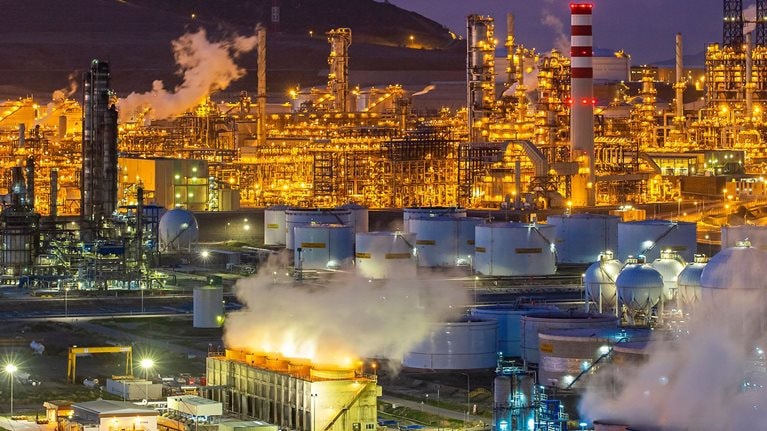
Modernizing a national industrial champion
As one of the largest energy companies in Eurasia, Azerbaijan’s SOCAR operates across the end-to-end energy value chain including oil and gas exploration and production, refining, chemicals, distribution and transportation, fuel retail, and renewables. SOCAR has a footprint in more than 15 countries and contributes to sustainable development and energy security locally, regionally, and internationally by enhancing its long oil and gas heritage with advanced technology and competencies.
From hydrocarbon dependance to digital-led competitiveness
SOCAR recognized that long-term competitiveness—for both the company and Azerbaijan—could not rely on scaling hydrocarbon production alone, and that innovation would be key to improving productivity. As part of its 2035 strategy, it made digital transformation a core pillar, looking to modernize operations, strengthen non-oil industries, and build world-class technical capabilities.
The journey began at two SOCAR sites in Türkiye. Those efforts, in partnership with McKinsey, earned global recognition through two World Economic Forum (WEF) Digital Lighthouse awards in 2020 and 2021. The sites are recognized as the first petrochemical plant and first refinery to win the award globally.
SOCAR then set its sights on scaling its now proven digital blueprint in its homebase of Azerbaijan. Among many candidates, SOCAR Carbamide was selected to launch the transformation. The plant produces ammonia and urea—critical agricultural inputs—and is Azerbaijan’s only domestic fertilizer producer. Launched in 2019, the plant still had untapped potential, and as geopolitical disruptions strained agricultural supply chains, boosting local production of fertilizer became urgent.
In 2023, SOCAR and McKinsey launched a 2.5-year transformation to increase output, improve gas efficiency, build talent, and create a model for broader industrial impact.
3 keys to Socar's Digital Transformation



Rewiring operations with industrial AI
Systematic transformation with in-house solution development
SOCAR leadership set out to transform the plant into a digital leader in the industry, aligning executives, plant leaders, and frontline teams—and ensuring sustained sponsorship across the top management team.
McKinsey partnered closely with SOCAR to shape and execute the program using a rewired approach—one that integrates strategy, operating model, talent, technology, and change management from the start.
“We were not simply installing technology,” says SOCAR President Rovshan Najaf. “We built a new operating model grounded in a systematic transformation approach—one where data, AI, and people operate as a unified ecosystem.”

The strategy was not based on replicating market practices. Instead, the approach focused on understanding the needs of frontline teams and developing tailored approaches accordingly.
“We not only adopted the most advanced industry solutions available but also built in-house solutions on top of them to address the unique needs of plant teams,” says SOCAR’s Chief Technology Officer Murad Abdullayev.
Together with SOCAR leaders and operators, the McKinsey team mapped end-to-end processes and identified the biggest constraints on throughput, energy efficiency, production stability, and maintenance reliability.

Industrial AI for operational efficiency and reliability
In less than three years, SOCAR and McKinsey, with its AI arm QuantumBlack, developed 42 in-house digital and AI solutions, achieving significant financial and operational impact. Some of the flagship solutions are showcased below.
No-code energy network optimization. Reducing how much natural gas is used to run the plant was critical so that SOCAR would have more natural gas to leverage elsewhere. McKinsey helped SOCAR build a self-serve no-code solution, EnergyAI. It analyzes hundreds of energy network variables in real time and runs up to two million simulations to determine the most efficient operating conditions. The system now recommends optimal set points, improving natural-gas efficiency by 24 percent. Its drag-and-drop configurator accelerated adoption among operators and enabled rapid scale-up across multiple units.
AI-based production variability optimization. To stabilize and increase production, the team moved away from waiting for operators to react to deviations and implemented a real-time variability diagnostics and optimization engine that continuously monitors key metrics and adjusts more than 150 control settings. Combined with operational changes, this shift increased throughput by 21 percent and reduced yield losses.
Maintenance LLM co-pilot with predictive engine. Mechanical failures, another drag on production, had previously been diagnosed by manual searches through scattered data and documentation. McKinsey supported the deployment of a predictive maintenance platform that combines sensor data with historical failure patterns to flag risks early. In parallel, SOCAR’s in-house generative AI copilot assists engineers by reviewing approximately 20,000 equipment manuals and supports root cause analyses—reducing unplanned maintenance by 66 percent.
Crucially, these solutions were not deployed as isolated pilots. They were integrated into a unified enterprise AI platform that connects advanced control systems, Internet of Things sensors, and lab results and paired with continuous impact tracking.
The SOCAR Digital Academy: Turning workers into digital champions
SOCAR understood early that transformation relied on frontline workers—who previously had little AI exposure—having ownership over the changes. The company launched the SOCAR Digital Academy as a structured upskilling program for frontline operators, engineers, and supervisors—and paired it with a change program to make the new ways of working stick.
The academy combined digital literacy modules with hands-on workshops, real use-case development, and cross-functional collaboration. Participants learned to interpret data dashboards, build simple analytics tools, work with data scientists, and propose operational improvements.
Within 2.5 years, approximately 70 percent of plant employees gained new digital capabilities. The program generated more than 40 AI-driven use cases—many proposed and implemented by frontline teams themselves.
“The Digital Academy gave people confidence, and they stopped seeing digital as something external,” says SOCAR Vice President of Human Capital and Inclusion Ziba Mustafayeva. “With the successful adoption, we developed a blueprint that can be scaled across our other sites.”

The Caspian AI Institute: Scaling beyond a single plant
As core use cases matured and frontline capability grew, SOCAR shifted its ambition from transforming a single plant to building an enterprise-wide industrial AI capability. The company launched the Caspian AI Institute—a regional hub dedicated to developing, industrializing, and deploying AI solutions within the energy industry. The institute now employs more than 60 AI and digital professionals and has developed over 30 AI products and 15 AI research patents, scaled across SOCAR.
“By institutionalizing talent, standards, and product development, we turned a plant-level transformation into a national industrial capability—positioning Azerbaijan to compete at the frontier of industrial AI,” says SOCAR Chief Data Officer Azad Huseynov.

Global recognition and lasting change
In January 2026, the World Economic Forum admitted SOCAR Carbamide into the Global Lighthouse Network, which recognizes manufacturing sites that achieve exceptional results by combining advanced technologies with strong leadership, workforce development, and measurable impact across productivity, sustainability, resilience, and talent.

“To stay competitive, we had to rethink how plants operate—from energy efficiency to decision-making speed,” says SOCAR Vice President of Refining and Petrochemicals Anar Mammadov. “Digital transformation was the lever that would move us from good performance to global leadership as part of our overarching strategy.”
For SOCAR, the recognition carried special weight. It marked the first WEF Lighthouse in Azerbaijan and the wider Central Asia region. SOCAR Carbamide also became the first urea fertilizer facility globally to receive the designation.
Crucially, the award recognizes plants that develop and embed their own in-house digital solutions at scale; it cannot be earned through the deployment of off-the-shelf third-party technologies—validating SOCAR’s growing innovation engine, leadership model, and deep workforce engagement that made the results sustainable.
Today, SOCAR Carbamide exports 90 percent of its production across the region, supporting sustainable agriculture and food security. The plant now covers 100 percent of domestic nitrogen fertilizer demand and contributes significantly to Azerbaijan’s non-oil export revenue.
For SOCAR, the Lighthouse designation marks more than a milestone for one plant. It signals what Azerbaijan’s industrial future can look like.
“The Lighthouse recognition reflects the lasting capabilities SOCAR has built alongside the performance gains achieved at Carbamide,” says McKinsey Partner Eren Cetinkaya. “It shows that industrial AI can be developed, scaled, and sustained through local talent and leadership—creating a foundation for the next generation of industrial growth in Azerbaijan.”
SOCAR Carbamide now stands not only as a fertilizer producer but as a global industrial AI champion in its field—and proof that such transformation can be delivered at home with local talent, strong leadership, and global ambition.
Sarp Ersoy contributed to the development of this article.
The team
Eren Cetinkaya
Distinguished PartnerIstanbul

Ahmet Can Tayeri
PartnerIstanbul
Cem Arslan
Expert Associate PartnerBaku
Related Articles