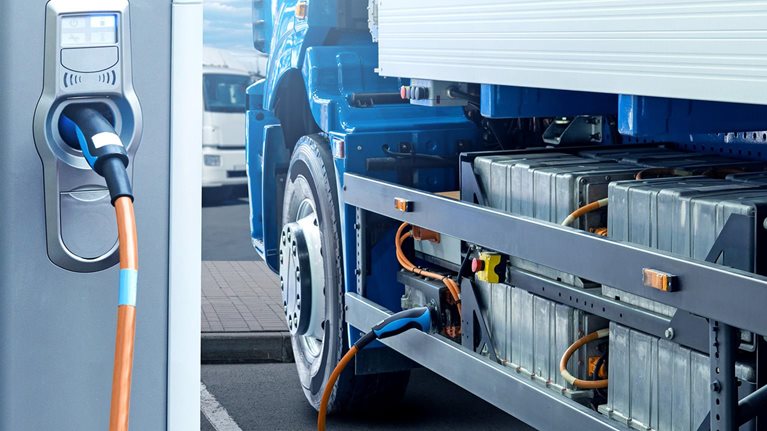
European truck manufacturers have released a wide range of zero-emission (ZE) models in the past nine years,1 yet new registrations of ZE trucks remained below 5 percent as of 2025.1 This slow rate of adoption underscores the need for a step change, not only to accelerate decarbonization but also to avoid the increasing economic costs of further delays.
First, every ZE vehicle (ZEV) replacing a diesel truck reduces CO2 emissions by some 60 to 80 metric tons of CO2 (tCO2) per year,3 and the costs of delaying this transition increase over time given the lifespan of trucks. Second, European operators risk missing the leaps in cost efficiency possible at larger volumes when, for example, demand is sufficient to support a dedicated battery-cell production line. Finally, the European Union’s heavy-duty-vehicle emission standards trigger significant penalties if OEMs fall behind regulatory targets,4 which could further limit their ability to innovate.
New entrants able to build scale elsewhere (typically in China) and enter Europe with cost and learning-curve advantages have already launched electric and hydrogen-powered trucks across European markets, challenging the continent’s technology and market leadership. Two things could help make them operationally feasible: ZE trucks have to become more economically attractive in more use cases and geographies, and the related infrastructure needs a boost.
Factors crucial to ZE truck success
Transitioning to ZE trucks takes much more than just using a different powertrain. It requires new platforms, infrastructure, and changes in operations and risk profiles for asset owners, including OEMs, suppliers, fleet operators, financiers, energy and infrastructure players, and regulators. Three factors are crucial.
1. Vehicles
Truck makers have launched more than 45 ZE models in the European market across all major OEMs.5 These models support commercial applications from high-runner use cases in regional distribution to long-haul trucking, while ZE offerings for vocational and specialized use cases are less mature but growing in demand. For electric trucks, driving ranges of up to 700 to 800 kilometers6 are already possible with the existing model lineup, depending on vehicle configuration.7
Hydrogen-powered internal combustion engines and fuel cell powertrains are available in limited series, with several OEMs announcing larger-scale rollouts that complement the existing battery-electric lineup, especially for on-demand long-haul and high-payload applications, with production expected to scale up over time. In addition, operational disadvantages resulting from the additional weight imposed by batteries and hydrogen storage vessels may be largely addressed by the ongoing revision of the European Vehicle Dimensions directive, which could allow higher gross vehicle weights.8
2. Economics
For about 30 percent of the truck market, ZEVs present a total cost of ownership (TCO) advantage.9 But their attractiveness can vary significantly depending on the use case and country, and effort is required to increase that percentage. Today, an estimated 20 percent of European road freight operates in countries with consistent ZE truck TCO advantages, with an additional 10 to 20 percent crossing either into or out of these countries.10
However, these cross-border use cases are more fragile, as differences in factors such as tolling, taxation, energy prices, charging availability, and public-charging tariffs can quickly erode the TCO advantage, especially for open-network long-haul operations (Exhibit 1). Increasing the share of the market for which ZE trucks are economically competitive will likely require either a 10 to 20 percent decline in their up-front cost or the adoption of differentiated road tolls by several more EU member states.

Economic attractiveness is key to winning customers, especially in the TCO-driven truck market. In a recent survey of 125 European fleet operators, about 60 percent expressed willingness to switch to ZE trucks at TCO parity, while up to 80 percent would do so if the TCO of ZE trucks was at least 10 percent below that of comparable diesel vehicles.11 While operators cite reduced CO2 emissions, regulatory requirements, incentives, and lower operating costs as primary reasons for buying ZE trucks, attractive up-front costs have been a point of competitive advantage for some Chinese OEMs that have recently entered the European market.
3. Infrastructure
Infrastructure is the critical barrier to ZE truck adoption. Only slightly more than 2,000 public fast-charging points for ZE trucks are available today—just a fraction of the 15,000 to 20,000 needed to support the scale-up of electric trucks to meet the current CO2 emission targets for 2030 (some 40,000 to 50,000 are required by 2035).12 Closing this gap will require at least doubling today’s total every year for the next five years. Hydrogen refueling stations are in a similar situation: Nearly 200 are operating today,13 while Europe’s Alternative Fuels Infrastructure Regulation alone requires around 700 hydrogen refueling stations along major corridors by 2030.14
Depot or fleet hub charging infrastructure will have to be built up in parallel to enable the cost-effective electrification of distribution and hub-to-hub long-haul transport. With 200,000 depot or fleet hub charging points required by 2030, this figure is even larger than public charging infrastructure, although average charging power can often be lower than for public infrastructure. To implement both public and fleet hub charging infrastructure, investments of more than €40 billion will be required by 2035 (Exhibit 2)—and that’s before necessary extensions and upgrades to the electricity grid.

Unlocking charging infrastructure deployment will require stakeholders to resolve two major bottlenecks:
- Grid access. Limited grid capacity often requires additional investment and construction for capacity upgrades. And even when sufficient grid capacity is available, permits and installation can take months and differ vastly across and within countries. For example, Germany has more than 800 grid operators,15 or distribution system operators (DSOs). The median wait for available energy from the medium-voltage grid after requesting access was around 120 days in 2024, but some DSOs report waits of up to two years—delaying necessary infrastructure and increasing risk and uncertainty for operators.16
- Derisking investments. The slow ramp-up of ZE trucks contrasts with rapid advancements in technology that are bringing faster charging times and more advanced designs for hydrogen refueling stations. If electric-truck adoption remains relatively low, infrastructure investors would benefit from increased certainty regarding demand through offtake agreements with anchor customers or other types of guarantees, helping mitigate the risk of stranded assets. With about 15 to 20 percent of trucks operating in on-demand settings or with short contract durations,17 solving infrastructure issues for individual corridors will likely not be sufficient; a comprehensive network across Europe would help make such operations feasible with ZE trucks.
Achieving sufficient scale
Europe’s ZE truck market has already made a critical first step: A broad set of vehicles are available, ready for commercial operations in key use cases, and economically attractive to a portion of the truck market. According to a recent McKinsey survey, given that about 60 percent of fleet operators are willing to substitute diesel trucks for ZE trucks at TCO parity—and a further 20 percent if TCO is 10 percent below parity—at least 20 percent of the truck market is addressable with ZE trucks today (before considering constraints on charging infrastructure and specific fleet operators’ planning horizons). Yet fewer than 5 percent of new vehicle sales were ZE trucks in 2025.
Addressing issues along two dimensions could help stakeholders achieve scale:
- Making ZE truck adoption economically feasible. This first requires further reducing the cost of new vehicles. A reduction of 10 to 20 percent in the up-front cost of ZE trucks would enable about 50 percent of annual truck sales in Europe to be TCO competitive,18 followed by expanding the product portfolio to additional use cases in construction and other vocational segments and optimizing vehicle specifications based on feedback from the field. But OEMs cannot reasonably close the gap on their own. Consistency in fuel costs and road toll incentives across EU member states is likely to be critical to unlocking favorable economics in more countries (especially for cross-border transport).
- Boosting addressable markets. More than a quarter of fleet operators cite the availability of charging infrastructure and corresponding investment needs as key barriers to ZE truck adoption.19 While the challenges are similar, their weight varies across use cases. For fleet hub charging, new approaches to proactive grid capacity planning for utilities and distribution network operators would help provide grid capacity where and when it is needed. New infrastructure service models can help provide access to funding and limit fleet operators’ capital expenditure exposure while opening up opportunities in energy management across sites of different operators. For public charging infrastructure, uncertainty about future demand is emerging as a key risk driver in addition to charging availability. Rapid technology advancement means chargers depreciate quickly while ad hoc demand remains limited. With only a few long-haul trucks on the road today, offtake guarantees with fleet operators or backstops by regulators may enable the investment required to build an initial infrastructure backbone.
Similarly, some fleet operators may struggle to realize the full TCO benefit of ZE trucks due in part to uncertainties in residual values, access to capital, inflated insurance rates, or a lack of confidence in uptime or truck performance. One potential solution involves integrated offers such as truck-as-a-service, which enables fleet operators to pay a monthly, distance, or usage-based fee for the provision of the vehicle, along with additional services such as insurance, service guarantees, and potentially charging infrastructure, instead of buying a vehicle outright.
ZE trucks hold potentially significant economic and environmental benefits once they reach scale. Yet realizing that potential, especially quickly, would involve significant changes and commitments by all stakeholders, enabled by a healthy balance between risk and reward for each. And wherever an imbalance occurs, regulators may need to step in to, for example, provide backstops for public charging infrastructure, enable distribution network operators to manage grid capacity differently, or tilt the TCO equation in favor of ZE trucks in more markets. It is critical to accelerate Europe’s transition to ZE trucks and, in turn, reduce risks to the continent’s technology leadership and competitiveness.