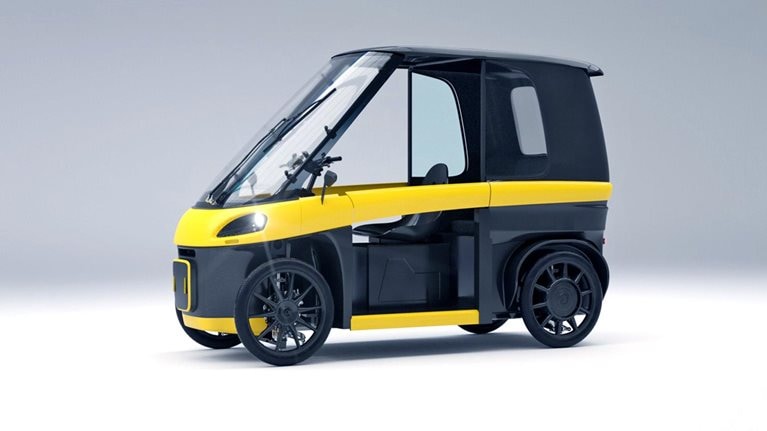
As McKinsey has written previously, minimobility vehicles (ultralight electric vehicles such as microcars, enclosed e-quads, pedal-assisted four-wheelers, and heavy-duty cargo bikes) show tremendous promise to help reduce urban traffic congestion, CO2 emissions, and vehicle ownership costs.1 Because minimobility vehicles are smaller than standard passenger electric vehicles (EVs), producing them requires less energy and fewer overall resources—including some battery components in short supply. Minimobility vehicles are less expensive to own than larger EVs and offer greater comfort, protection from inclement weather, and visibility than micromobility options such as e-kickscooters and bicycles.
Despite all of minimobility’s potential advantages, several minimobility leaders we spoke with recently indicated that the minimobility vehicle market is not yet scalable. (See sidebar, “Our methodology.”) The segment’s growth within the global mobility marketplace has, in fact, fallen short of the $100 billion total addressable market anticipated by 2030 for China, Europe, and North America.2
Minimobility vehicle adoption is highly localized and dependent upon such factors as municipal rules and weather conditions. For example, at the end of 2025, more than 32,000 microcars were registered across the Netherlands,3 and commercial heavy-duty cargo bikes are now a common sight on London streets. In the United States, minimobility vehicle use is still quite limited. Microcars are favored by retirement community residents in Florida, Texas, and Arizona, and in New York City, commercial cargo-bike use has grown in popularity since the city approved their use in 2024.4
Still, innovation among minimobility players remains strong: New vehicle types are being developed regularly, though most remain in early stages. While some leaders note that the wide range of new vehicles and use cases has deepened fragmentation in minimobility, all remain steadfast in their assertions that, at scale, minimobility can address fundamental environmental and spatial challenges inherent in urban mobility.
But structures to support fully scaling minimobility remain underdeveloped. Why? The leaders pointed to four challenging areas—regulation, cost, consumer hesitance, and infrastructure—that framed their thoughts on where and how they believe efforts to address fragmentation in the market and scale minimobility should be focused to achieve rapid and lasting impact.
While minimobility has not yet scaled, many macro trends are working in its favor: Cities are becoming more crowded, urban policies are discouraging the use of cars in city centers, and full-size vehicles are becoming less affordable for many consumers.
Why regulatory clarity is vital to scale minimobility
The minimobility leaders we spoke with describe a regulatory landscape in which minimobility vehicle classifications are nonexistent, inconsistent between geographies, or unclear. They explain that while policies aimed at achieving emissions targets have been somewhat helpful in expanding the reach of some minimobility solutions (such as cargo bikes), mobility legislation and incentives are still focused primarily—and often exclusively—on transitioning from traditional internal combustion engine (ICE) passenger and commercial vehicles to their EV counterparts. Rather, some of the leaders suggest, regulatory frameworks and legislation could be expanded to help strengthen demand signals for minimobility vehicles, reducing the mobility industry’s collective resource burden as well as its emissions levels.
One example from the micromobility industry (that could be applied to increase demand for minimobility options) is a broadly popular tax incentive program for German employers to lease bikes to their employees. Between 2020 and 2025, the program expanded by an average 23 percent annually, and leased sales have surpassed €3.1 billion in economic value.5 Additionally, couriers and other parcel delivery operations have incorporated heavy-duty cargo bikes into their vehicle fleets to achieve emissions reduction targets. For example, DHL uses cargo bikes in European cities such as Amsterdam and Paris to address emission regulations and urban congestion.6
Without lightweighting cars, we’re not going to reduce emissions from the car industry to the point that we can accept it.
How minimobility vehicles are classified (or not) bears directly on how convenient it is to operate them in a range of environments, which in turn determines the vehicles’ appeal to consumers. For example, whether a minimobility vehicle is placed in a class that makes it legal to operate on city streets and at speeds consistent with other vehicles are important factors. Likewise, classification can determine a municipality’s ability and willingness to create or adapt parking and driving lanes to accommodate a minimobility vehicle’s use.
To unlock minimobility growth, all the leaders we spoke with agreed: Regulatory clarity is imperative. Ideally, regulatory clarity should be paired with harmonized vehicle frameworks. Manufacturers argue that predictable, forward-looking regulatory environments are essential to planning investments, securing supply chain commitments, and building customer trust. All emphasized that incentives and favorable regulations matter, but predictability matters more because uncertain or short-term measures discourage both buyers and producers.
In addition, several leaders mentioned the potential for a new vehicle category to help bridge the gap between bicycles and cars. Finally, they emphasize the need to resolve regulatory issues quickly to ensure European and American players can compete globally while retaining domestic production.
Lowering minimobility production costs to unlock growth
Regulatory ambiguity and a lack of clear demand signals are, in part, keeping established automotive players from committing to partnerships with minimobility start-ups, according to the leaders we spoke with. While some leaders report they regularly engage their larger automotive counterparts in discussions around potential partnerships, thus far they have observed larger players apparently awaiting stronger demand signals. Without such partnerships, minimobility leaders explain, they cannot achieve economies of scale they need in supply chain and production costs to support mass market–level growth and lower vehicle prices.
A partnership between the leading players in the mobility industry and minimobility start-ups that includes OEMs, supply chains, and distribution is going to be incredibly important. A more engaged strategic partnership could also involve fueling in financial parts, licensing, joint venture, or M&A. Such strategic partnerships will fuel growth and a much more dynamic market for the whole “last-mile industry.”
Partnerships with established OEMs and tier-one suppliers are essential to make minimobility viable at scale. Minimobility start-ups could also consider forming partnerships in the two-wheeler space or in other industries, such as with third-party manufacturers. Though large automotive OEMs may struggle to make the economics work within their existing cost structures, and two-wheeler manufacturers may lack the capabilities required for more complex enclosed vehicles. So there is still work to be done to make these partnerships work.
Customers—especially fleets and cities—need minimobility vehicles to be as reliable as full-size automobiles and have comparable access to maintenance and repair services as well as spare parts. Individual start-ups need to be able to leverage the established automotive ecosystem to ensure long-term operability. In practice, this means sharing service and aftersales networks, pooling component sourcing to unlock scale benefits, and integrating minimobility vehicles into existing industrial and urban ecosystems. Minimobility players may also need to implement pragmatic, transitional production models, assembling vehicles locally while sourcing high-cost components globally, to reach affordable price points before full industrial scale and localized supply chains become viable. No start-up company can build continent-wide service networks, spare-parts logistics, or distribution channels on its own.
Most of the leaders we spoke with view current price points as not competitive in the mainstream market; they linked competitive pricing to a need for public sector spending and incentives as well as public–private co-investment. This combination of spending and investment is, they assert, essential to achieve the larger volumes, shared component platforms, and more robust supplier networks needed to reach affordable price levels. Without such targeted efforts, some noted, citing production in Europe and North America could remain cost-prohibitive due to labor and energy costs as well as tariffs.
Shaping consumer habits to expand minimobility’s reach
While consumers often find minimobility vehicles appealing once they try them, initial adoption of minimobility vehicles remains constrained by concerns about safety, protection from inclement weather, and comfort. Consumers often view minimobility vehicles as second or recreational vehicles, rather than as their primary means of transport. The broad perception of low-speed vehicles (LSVs) is that they are a more fun means of local transport than a full-size passenger vehicle. And unlike a golf cart, an LSV is equipped with safety features that make it safe to drive on public roads, which could be a key selling point in certain markets. Nonetheless, consumers in many markets, such as those in much of North America, are unaccustomed to vehicles with small footprints, low maximum operating speeds, or limited driving ranges, making it crucial to innovate, evolve, and adapt minimobility solutions to a variety of use cases and consumer profiles. Indeed, minimobility adoption is highly localized: Product–market fit depends on local traffic conditions, parking availability, weather conditions, city density and street design, and existing mobility habits and culture. Leaders we spoke with noted that consumers will only switch if minimobility solutions provide a clear everyday advantage in their locality.
Accelerating consumer adoption requires moving beyond a message that only resonates with climate-conscious users. Broader uptake will depend on framing small vehicles as enjoyable, attractive, and aspirational—not merely efficient or rational from a sustainability perspective.
The metric by which you want to drive adoption is to provide a product experience that is better than that of a traditional full-size passenger car. And that needs to come from the industry. If that means that the current offering isn't that solution, then you need to come up with an offering that is—or adjust your expectations and your sales targets.
New business models and use formats may play another important role in accelerating adoption. Shared fleets, subscription offerings, autonomous vehicle fleets, and integration with public transit or existing micromobility platforms can give users early exposure without requiring ownership. These models expand access, improve fleet utilization, and normalize small vehicles in daily life, often acting as a bridge toward private ownership once familiarity and trust grow.
Making infrastructure work for minimobility
All of the leaders we spoke with stressed the problematic misalignment between current infrastructure and the needs of lightweight vehicles. In general, light vehicles must operate in infrastructure that is not designed for their size or use case. Most cities are designed around the use of cars and vans and are not equipped to enable micro- and minimobility. For example, delivery vans are authorized to load and unload at curbside, but heavy-duty cargo bikes are not. Likewise, designated parking and vehicle charging infrastructure for microcars and e-quads is often lacking. Minimobility vehicles also often remain stuck in regular car traffic despite their smaller footprint.
For minimobility to work at scale in logistics applications, micro-hubs are imperative. In heavy-duty cargo-bike use cases, for example, the absence of micro-hubs near city centers inhibits operations. Micro-hubs provide a distribution point where packages and other goods to be delivered can be transferred from large logistics vehicles to minimobility vehicles (or micromobility vehicles). Providing minimobility delivery vehicles with curbside access is also important to ensure adoption as well as efficient service.
The minimobility leaders we spoke with also voiced a common understanding that their vehicles must adapt to the contours of current infrastructure. In Europe, where dense cities and everyday travel patterns are typically short and require only modest engine ranges, they view lightweight battery-electric-vehicle technology is the natural long-term pathway for minimobility.
All of the leaders we spoke with emphasized that by making even modest infrastructure changes to enhance minimobility visibility, safety, and convenience—for example, expanding existing bike lanes to make them wide enough to accommodate three- or four-wheeled vehicles—local governments can help encourage adoption. Broader adoption, in turn, can help reduce traffic congestion as well as emissions. Other relatively small changes that leaders indicate could yield major impact include making parking accessible to minimobility vehicles or even providing access to park and operate minimobility vehicles in zones where full-size cars are currently excluded. Cities could also showcase minimobility’s capabilities in ways that can catalyze larger-scale shifts in mobility, one leader pointed out.
If more cities provide the space and environment for cargobike operations, we can replace a large share of urban vans very quickly. The capability is there—the infrastructure has to be improved.
A vision for success: The future of minimobility
The leaders we spoke with have a shared vision for the future of minimobility: In the next decade, they hope to witness a sea change in cultural norms around mobility in which minimobility vehicles have become the go-to option for short-distance travel, viewed as a fun, more efficient, and all-around better way to navigate community streets. The leaders envision a mobility ecosystem in which lightweight, space-efficient vehicles handle the majority of everyday urban trips, complement public transport, and replace a meaningful share of full-size cars and vans. On future city streets, they hope, minimobility is integrated fully: Vehicles are parked perpendicular to the curb, glide through narrow lanes, and offer comfortable, year-round mobility with a minimal carbon footprint.
My dream is that you can only go downtown using microcars.
The vision for cargo minimobility applications is to replace a substantial share of combustion vans with heavy-duty e-cargo solutions enabled by micro-hubs and optimized curbside access. These vehicles would handle last-mile logistics in lieu of traditional large delivery vans.
There is precedence for downsizing vehicles: Small, lightweight cars called Kei Cars have surged in popularity in Japan. These cars accounted for 38 percent of new car registrations in the country in 2024, fueled by lower vehicle tax, insurance advantages, and beneficial parking rules.7
Minimobility leaders are clear on what is needed for their future visions to become reality. Minimobility can move from early promise to meaningful scale, they contend, but only if structural barriers are addressed urgently and comprehensively. Industry players cannot deliver a transition to lightweight vehicles alone, they stress—public and private sector engagement and investment will be decisive. The sooner stakeholders choose to act, they say, the sooner minimobility’s promised benefits can be delivered: dramatically lower emissions, reduced resource consumption and traffic congestion, and urban areas that are easy—even fun—to navigate and explore.