The auto finance industry is ripe for transformation. Historically defined by complex, labor-intensive processes and fragmented data systems, the sector has faced persistent inefficiencies across the entire value chain. Challenges such as inconsistent data formats, incomplete records, and limited real-time access have led to delays and errors. The industry also remains highly regionalized, with localized regulations, significant inefficiencies, and unique market specificities across regions.
Gen AI and other AI technologies provide a timely and powerful way to unlock significant value across the value chain. Gen AI can extend beyond customer interactions to support internal decision-making, generate insights, and optimize processes at scale. If leveraged effectively, AI has the potential to address long-standing inefficiencies and reshape the industry’s economics. McKinsey analysis suggests that gen AI could reduce cost-to-income ratios by lowering operating costs (which typically represent about 60 percent of income) by five to eight percentage points.
To get the most out of new AI technologies, leasing players can deploy agentic systems—that is, autonomous systems that leverage AI and machine learning (ML) to perform specific tasks. These systems go beyond traditional automation by enabling dynamic, context-aware decision-making and execution. They can allow for fully autonomous execution of tasks, or they can be used as tools that augment human decision-making and personalization, depending on the specific use case and desired outcomes. By integrating agentic technologies, the industry has a unique opportunity to reimagine its processes, improve profitability, and deliver a more seamless customer experience.
AI-driven agents as a solution
AI agents are specialized systems that combine advanced ML algorithms for decision-making with gen AI for communication and interaction. These agents can aid in both internal and external-facing processes across the organization, achieving new efficiencies by leveraging existing and new sources of data. However, not every problem requires an agentic solution—traditional ML models or AI may be more appropriate for certain use cases.
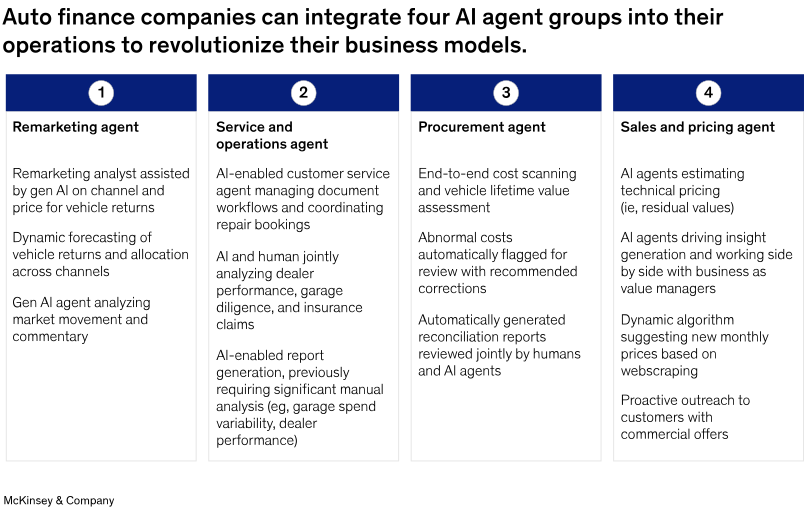
We suggest that organizations interested in creating a vision for an AI-driven enterprise start by considering building and integrating four groups of agents: a remarketing group, a service and operations group, a sales and pricing group, and a procurement and end-to-end value maximization group (Exhibit 1).
Remarketing agent group
The goal of the remarketing group of AI agents is to automate the extensive paperwork and coordination involved in the vehicle remarketing process. Agents in this group can also reach out to leasing customers to book inspection slots, communicate with transporters to schedule vehicle pickups, and liaise with dealers to refurbish vehicles. Additionally, this agent group can conduct comprehensive market assessments, generating reports on the most profitable channels and analyzing used-car trends in terms of volume and price.
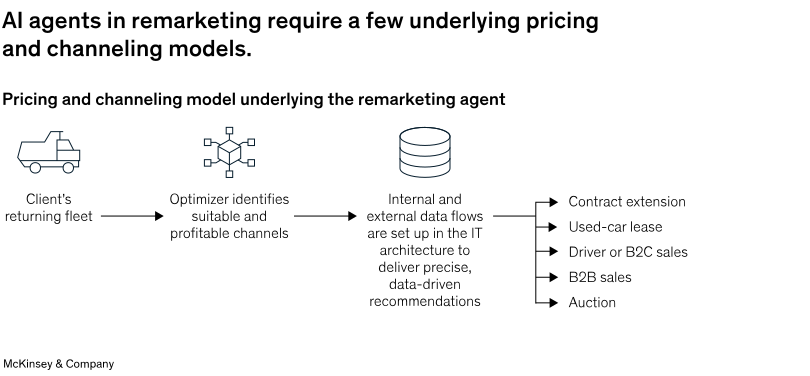
A few underlying technological capabilities are needed for the remarketing-agent group to work. A forecasting tool using statistical modeling and ML for predicting vehicle returns is essential for planning and allocation. In addition, a pricing and channeling optimizer, which requires accurate elasticity curves, ensures that vehicles are directed to the most suitable and profitable channels (Exhibit 2). Access to real-time market data, historical sales information, and profitability metrics is crucial for these tools to make informed decisions. By integrating these ML algorithms, the remarketing-agent group can deliver precise, data-driven recommendations that maximize profitability and streamline operations.
Service and operations agent group
This group of AI agents increases the automation associated with service and operational tasks. In this group, one agent might reach out to customers to organize scheduled maintenance or repairs and send them to preferred networks. A second agent could coordinate roadside assistance following accidents, while a third could manage infleeting and defleeting operations such as scheduling vehicle pickups and drop-offs.
Additionally, this agent group can generate comprehensive reports to maintain transparency and to control costs for maintenance, repairs, tires, and insurance. These agents have the ability to flag abnormal claims in insurance, identify unusual dealer spending on maintenance and repairs, and detect irregular tire usage by customers, ensuring cost efficiency and operational integrity. Customer service chatbots and virtual assistants can further support this group by handling routine inquiries, appointment scheduling, claim follow-ups, and other frontline interactions, enhancing responsiveness and reducing the workload for call centers.
To function effectively, AI agents in service and operations need a robust system for calibrating their thresholds for abnormal spending across various categories. AI and ML algorithms can help set and adjust these thresholds based on historical data and real-time inputs. This requires access to detailed financial data, historical maintenance records, and real-time operational metrics.
Sales and pricing agent group
AI agents in the sales and pricing group focus on reaching out to targeted client groups (including both B2C and B2B segments) with commercial offers for leasing, financing, and service products. In this group, one agent might manage commercial-pricing strategies and suggest new monthly prices using dynamic algorithms based on competitor analysis. This agent could also provide dealers with insights and recommendations across the customer journey. In the first phase of integrating AI agents with existing operations, one AI agent could support human sales agents in their commercial negotiations, offering tailored commercial deals that drive sales and customer satisfaction. At a later stage or in a pilot with retail customers, another AI agent could proactively communicate with clients. This group also deals with cross-border pricing and commercial management, with AI agents adapting offers and strategies to local market conditions, tax structures, and regulatory differences. This is especially relevant for international fleets and multinational clients.
To work reliably, sales and pricing AI agents rely on robust technical pricing models, including residual-value estimations. A key part of the sales and pricing group, advanced ML algorithms predict future vehicle values and optimize pricing strategies. Additionally, dynamic pricing algorithms are essential for adjusting prices in real time based on competitor data (retail only) and market conditions. For cross-border optimization, these agents require access to localized market data, tax rules, and currency trends. By integrating market, competitor, and historical data sources and leveraging AI capabilities, the sales and pricing AI agent group can deliver precise, data-driven pricing strategies that maximize profitability and competitiveness across markets.
AI agents will also empower customers in their car-buying journey. Increasingly, buyers will be able to use their own AI tools to optimize their search, compare offers, and negotiate better deals. This dynamic will likely level the playing field, limiting the extent to which dealers and finance players can capture value in the long run.
Procurement and end-to-end agent group
In this group, agents seek to perform end-to-end cost scanning and assessments of vehicle lifetime value. These agents provide a comprehensive view of financial profitability for all vehicles across leasing cycles and remarketing, with the goal of helping companies negotiate and partner with OEMs to select cars and tires with the highest ROI. This agent group can also generate reconciliation reports for humans and AI agents to review jointly.
The procurement AI agent group requires advanced financial assessment tools to evaluate vehicle lifetime value. Access to comprehensive financial data, historical cost records (such as for repair, maintenance, tires, and batteries), and real-time operational metrics is crucial.
A phased road map anchored in maturity and value
Implementing generative and agentic AI in the auto finance industry requires a robust technical foundation. Key prerequisites include advanced data infrastructure, ML algorithms, and real-time data integration capabilities.1 When building a road map to integrate AI agents, it is important to understand where the organization stands on the technological maturity curve. Fully agentic organizations have well-established capabilities in each of the following areas:
- technical foundations, including an agentic environment
- trained operational staff who understand process flows and can interact with agents
- trained technical teams to support agent design, maintenance, and improvement
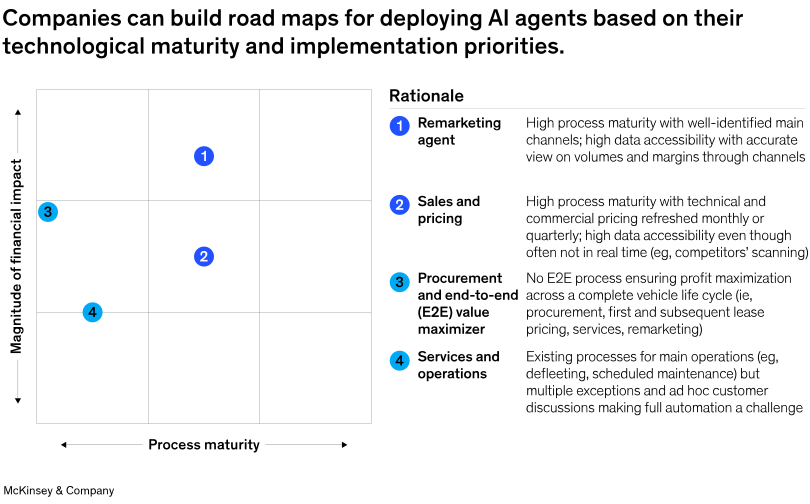
To unlock early impact, organizations can begin by integrating AI into remarketing efforts, because optimizing pricing across sales channels is both high impact and relatively easy to implement (Exhibit 3). This domain typically benefits from higher process digitalization, better data availability, and fewer dependencies, making it the ideal starting point for deploying AI agents. We estimate the impact at stake to be about €200 per car.
Next, companies can consider expanding AI tools in broader pricing strategies, supported by a more robust system of AI and trained technical teams. These capabilities can build on the momentum created in building the remarketing AI agent group and continue to deliver significant commercial upside. We estimate the impact at stake to be between €300 and €500 per car.
Operational use cases, such as service coordination and defleeting, tend to be more complex because of fragmented processes and limited digital maturity. These can be addressed in later phases, after companies have put in place foundational technology infrastructure and upskilled both operational and technical teams.
Balancing opportunity, costs, and risks
Implementing AI agents comes with associated costs, including retraining models, data labeling, and cloud consumption. Organizations must carefully evaluate these costs and prioritize the most valuable problems to solve to ensure a positive return on investment.
Finally, organizations must address the risks associated with AI, particularly in credit-related contexts. Compliance with regulations such as the Equal Credit Opportunity Act in the United States and the EU AI Act is critical. Robust risk management, data governance, transparency, and human oversight are essential to ensure compliance and build trust.
By integrating AI agent groups into the auto financing journey, companies can improve efficiency and reduce operating costs while empowering human agents to act more quickly on improved opportunities. Integrating these tools into existing organizations must be done thoughtfully, but if successful, the potential benefits are great.