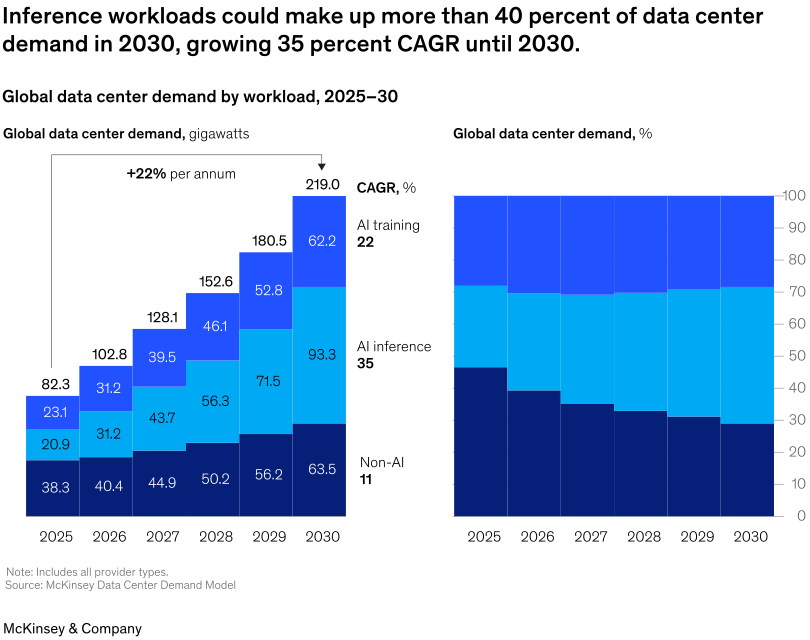
AI has become the main growth engine for US data centers, reshaping data center economics, power planning, and leasing decisions. Demand is split between two workloads—training and inference. While training workloads require large, high-density campuses with advanced mechanical, electrical, and plumbing systems and specialized hardware integration, AI inference is driving build-outs in metro and near-metro sites optimized for low latency, strong network connectivity, and energy efficiency, explain McKinsey’s Marc Sorel, Pankaj Sachdeva, and coauthors. By 2030, inference will surpass training to become the dominant workload in AI data centers, representing more than half of all AI compute and roughly 30 to 40 percent of total data center demand. This transition from one-time model training to sustained inference activity will increasingly inform hyperscalers’ decisions on location, network design, and power provisioning.
Image description.
A stacked bar chart on the left and a corresponding 100-percent stacked bar chart on the right illustrate projected global data center demand by workload type—non-AI, AI inference, and AI training—from 2025 to 2030, measured in gigawatts and percentage share, respectively. The left chart shows total demand rising sharply from 82.3 GW in 2025 to 219.0 GW by 2030, representing a 22 percent annual growth rate. Breaking down this growth, non-AI workloads increase modestly from 38.3 GW in 2025 to 63.5 GW in 2030 (11 percent CAGR), while AI inference jumps from 20.9 GW to 93.3 GW (35 percent CAGR), overtaking non-AI by 2029. AI training grows from 23.1 GW to 62.2 GW (22 percent CAGR) over the period. The right-hand chart translates these values into percentage shares, emphasizing that by 2030, AI inference workloads make up more than 40 percent of total demand, with non-AI workloads dropping below one-third, and AI training holding steady at just under 30 percent. The charts together highlight the accelerating shift toward AI-driven demand, particularly inference workloads, in global data center energy usage through 2030.
This image description was completed with the assistance of Writer, a gen AI tool.
Source: McKinsey Data Center Demand Model
End of image description.