In real estate, measurable benefits from AI adoption have been slow to materialize. Agentic AI, however, offers leaders a chance to rethink value creation—combining autonomy, planning, memory, and integration to reduce handoffs, improve service, accelerate decisions, and support durable operating models. The next phase of AI transformation will be won by redesigning domains, with AI able to automate or augment many steps through people–agent–robot collaboration. For measurable impact, leaders should ask, “Which workflows should we redesign so the software is allowed to do the work, with appropriate controls?,” say McKinsey’s Alex Wolkomir, Ankit Kapoor, Vaibhav Gujral, and Andrei Stoica.
Image description.
Opening panel (overall)
Image description: A four-quadrant chart shows how work hours in US construction and real estate split across people, AI-enabled agents, and robots. The top half is nonautomatable work, and the bottom half is automatable work. The left side is nonphysical work, and the right side is physical and nonphysical work. In the overview, people account for 34 percent in physical/nonphysical nonautomatable work and 12 percent in nonphysical nonautomatable work, while AI-enabled agents account for 41 percent in nonphysical automatable work and robots account for 13 percent in physical/nonphysical automatable work.
End of image description.
Simplified cut panels
People-centric
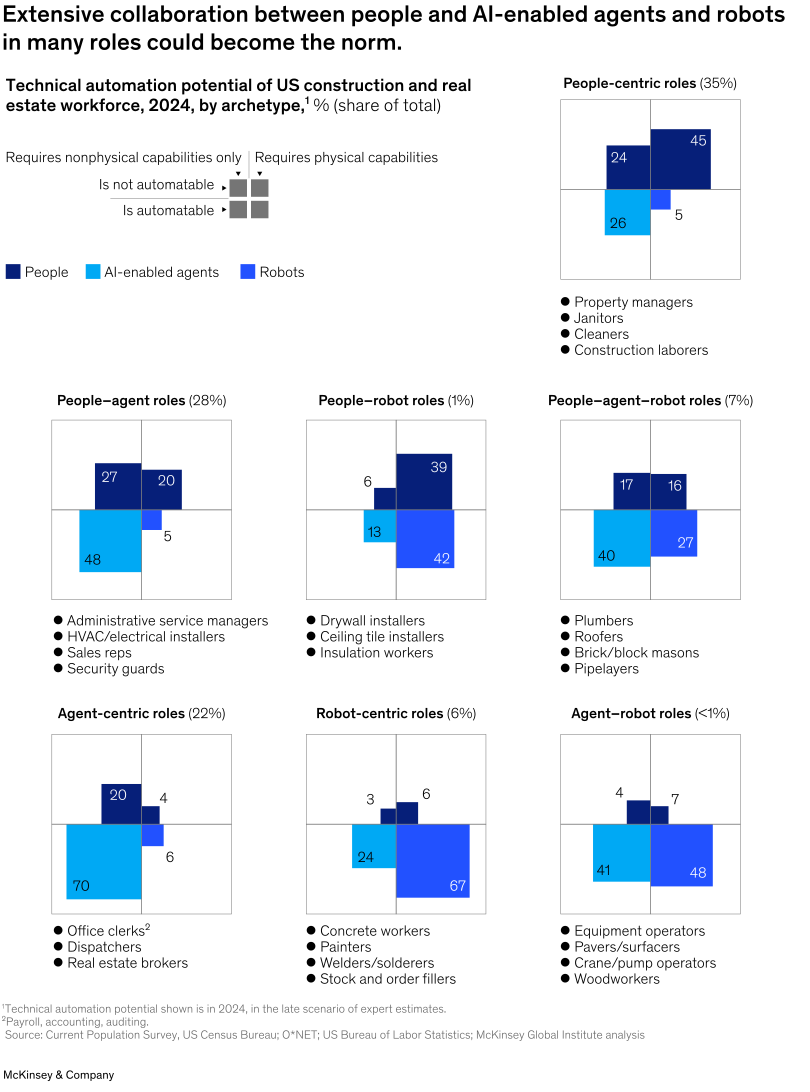
Image description: In people-centric roles, nonautomatable work dominates, with 45 percent in physical/nonphysical tasks and 24 percent in nonphysical tasks. Automatable work is lower, at 26 percent for AI-enabled agents and 5 percent for robots. End of image description.
People-agent
Image description: In people-agent roles, work is shared between people and AI-enabled agents. Values are 27 percent and 20 percent for people, 48 percent for AI-enabled agents, and 5 percent for robots. End of image description.
People-robot
Image description: In people-robot roles, people and robots carry most of the workload. Values are 6 percent and 39 percent for people, 13 percent for AI-enabled agents, and 42 percent for robots. End of image description.
People-agent-robot
Image description: In people-agent-robot roles, all three contributors are meaningful. Values are 17 percent and 16 percent for people, 40 percent for AI-enabled agents, and 27 percent for robots. End of image description.
Agent-centric
Image description: In agent-centric roles, AI-enabled agents dominate automatable nonphysical work at 70 percent. People are 20 percent and 4 percent, and robots are 6 percent. End of image description.
Robot-centric
Image description: In robot-centric roles, robots dominate automatable physical/nonphysical work at 67 percent. People are 3 percent and 6 percent, and AI-enabled agents are 24 percent. End of image description.
Agent-robot
Image description: In agent-robot roles, automation is mostly split between AI-enabled agents and robots, at 41 percent and 48 percent. People are lower at 4 percent and 7 percent.
End of image description.
Source: Current Population Survey, US Census Bureau; O*NET; US Bureau of Labor Statistics; McKinsey Global Institute analysis
End of image description.