The recent surge in trade controls and reciprocal tariffs is intense and unlike anything the world has seen since the 1930s. The impact on businesses is significant and unevenly distributed, say Senior Partner Cindy Levy and coauthors. In the automotive industry, for example, the origin of components differs widely by car model, making the effects of tariffs highly variable and triggering ripple effects through automakers’ supply chains.

Tariffs and global trade: Navigating the impact on business
Thursday, May 22 at 11:00a.m. EDT / 5:00p.m. CEST Join McKinsey senior partners Cindy Levy and Shubham Singhal to discuss how business leaders can gain an edge by identifying near-term and long-term strategic actions in the face of rapid changes to trade policy.
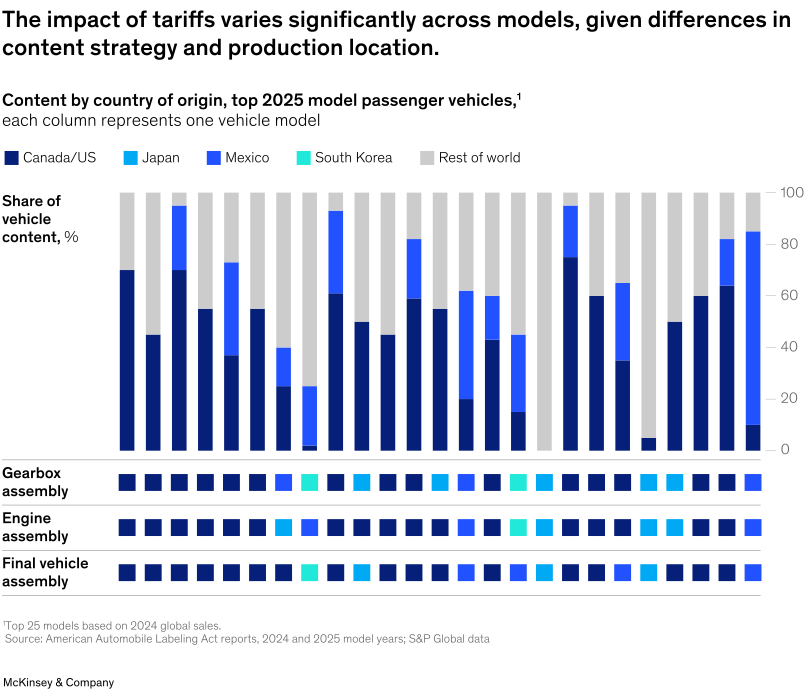
Image description begins:
A stacked bar chart displays the share of vehicle content by country of origin for the top 25 2025 model passenger vehicles. Each bar represents a single vehicle model. The chart segments each bar to show the percentage of content originating from Canada/US, Japan, Mexico, South Korea, and the rest of the world. The vertical axis represents the share of vehicle content in percentage points, ranging from 0% to 100%. Below the main chart, 3 smaller charts show the country of origin for the gearbox assembly, engine assembly, and final vehicle assembly, using the same color-coding system. Each of these charts displays a series of colored squares, one for each vehicle model. The data is based on 2024 global sales and sourced from American Automobile Labeling Act reports covering 2024 and 2025 model years and S&P Global data. Overall from the diagram it is clear that the bulk of the vehicles studied have their parts made in the US, Canada, or Mexico, but in every case to a lesser or larger degree there are parts from the rest of the world.
Note: This image description was completed with the assistance of Writer, a gen AI tool.
Source: American Automobile Labeling Act reports, 2024 and 2025 model years; S&P Global data.
End of image description.
To read the article, see “Navigating tariffs with a geopolitical nerve center,” April 11, 2025.