The life sciences industry has seen a surge in capital, and firms have announced more than $150 billion in new capital projects before 2030. However, capital alone doesn't guarantee success, note Senior Partner Parag Patel and coauthors. Some 95 percent of life sciences projects exceed their budget and schedule, with the sector overall experiencing a larger proportion of delays or capital expenditure overruns than almost any other industry. Since time to market is crucial for life sciences firms, they can consider adopting a time-based capital strategy by focusing on developing integrated capabilities to enhance delivery speed and reliability without boosting risk or cost variability, rather than just increasing spending.
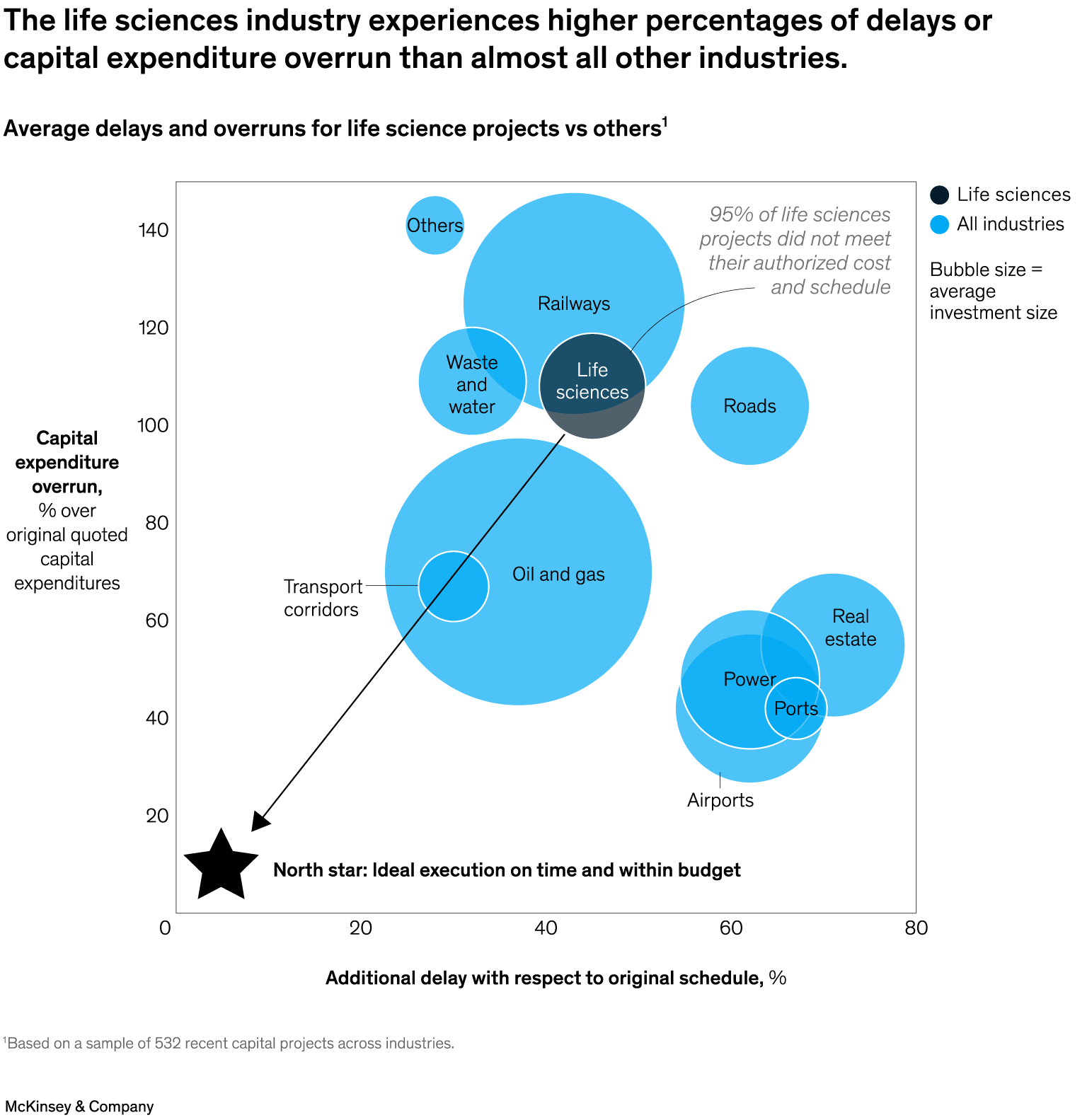
Image description:
A bubble chart scatterplot compares the average delays and overruns for life science projects versus other industries, with the size of each bubble representing the average investment size. The chart plots capital expenditure overrun as a percentage of original quoted capital expenditures on the y-axis against additional delay as a percentage of the original schedule on the x-axis. The life sciences industry is represented by a gray bubble, positioned at around 110% on the y-axis and 45% on the x-axis, indicating significant delays and overruns. Other industries, represented by light blue bubbles, are scattered around the chart, with some experiencing lower delays and overruns, such as transport corridors, and others experiencing higher delays and overruns, such as roads and railways. Notably, 95% of life sciences projects did not meet their authorized cost and schedule, as indicated by an annotation on the chart.
Note: This image description was completed with the assistance of Writer, a gen AI tool.
End of image description.
To read the article, see “The speed-to-market imperative for life sciences capital delivery,” August 4, 2025.